
Introduction
Most business owners sell their company exactly once—with no prior experience and no margin for error. The process demands:
- Confidential marketing to protect operations
- Financial due diligence and documentation
- Buyer negotiations and qualification
- Legal structuring and coordinated closing
All of this happens while you're still running the business day-to-day.
That's the core challenge. And it's exactly why the question "what do business brokers do?" matters so much before you decide whether to go it alone or engage professional help.
This guide covers everything: what a business broker actually is, the services they provide, how the process works step by step, what they charge, and how to choose the right one for your situation.
TLDR
- Business brokers manage the full sale of privately held businesses — from valuation through closing
- Core services include business valuation, confidential marketing, buyer screening, negotiation, and due diligence coordination
- Standard commissions run 8–12% for businesses under $1M, paid by the seller at closing
- Most deals close within 6–10 months of engagement, depending on business size
- Chelsis Financial offers a Complimentary Assessment of Value to help sellers understand their starting point
What Is a Business Broker?
When a business owner decides it's time to sell, they rarely know where to start — and that's exactly where a business broker comes in. A business broker is a specialist who manages the confidential sale of a company on the owner's behalf, operating in the space between real estate agents (who sell property) and M&A advisors (who handle large institutional deals).
How Business Brokers Differ from M&A Advisors
The distinction comes down to deal size and complexity:
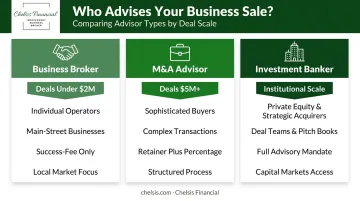
- Business brokers typically work with main-street and smaller businesses valued under $2M — per IBBA's guide to the profession — where the buyer pool is largely individual operators and small private investors
- M&A advisors handle larger, more complex deals—often $5M and above—involving sophisticated buyers and more extensive due diligence processes
- Investment bankers operate at institutional scale, working with deal teams, detailed pitch books, and buyers that include private equity firms and strategic acquirers
Most business owners selling a company under $5M will find a broker's scope — and their fee structure — better suited to their transaction than an M&A firm.
How Brokers Are Compensated
Business brokers work on a success fee model—they're paid a commission at closing, typically by the seller, calculated as a percentage of the final sale price. This structure aligns the broker's financial incentive with the seller's goal: get the best possible price and close the deal.
Licensing and Credentials
Licensing varies by state. According to IBBA, 17 states require a real estate license to sell a business—including California, Florida, and Colorado—while others have no specific requirement.
When licensing isn't mandated, voluntary credentials matter. Look for:
- IBBA membership (International Business Brokers Association)
- CBI designation (Certified Business Intermediary)—requires education, exam passage, and evidence of closed transactions
- Demonstrated transaction history in your industry
What Services Do Business Brokers Offer?
Business Valuation
Before any marketing begins, a broker establishes a defensible asking price. Pricing too high repels buyers; pricing too low surrenders value you've spent years building.
Chelsis Financial's valuation process uses SDE (Seller's Discretionary Earnings) as the primary metric—essentially, the total financial benefit the business generates for its owner. That figure is then multiplied by an industry-appropriate multiple, typically 1–4x annual owner cash flow, adjusted for revenue trends, customer concentration, and market position.
The process requires three years of financial statements: income/P&L, cash flow, balance sheets, and a seller's discretionary earnings statement. Chelsis Financial offers this as a Complimentary Assessment of Value with no obligation, giving sellers a clear picture of what their business is worth before deciding whether to proceed.
Confidential Marketing
Protecting the seller's identity while attracting serious buyers requires two distinct marketing materials:
- Blind profile — a non-identifying summary that describes the business category, financials, and opportunity without naming the company
- Confidential Information Memorandum (CIM) — a detailed document shared only after a buyer signs an NDA
Chelsis Financial uses DocuSign to manage the NDA process digitally, ensuring no sensitive information changes hands before confidentiality is documented. Listings include financial snapshots, growth opportunities, and ideal buyer profiles—all without revealing the seller's identity to the broader market.
Buyer Sourcing and Qualification
Individual sellers rarely have access to a pipeline of motivated, financially capable buyers. Brokers do—and that network is one of the most tangible advantages they bring.
Chelsis Financial networks with over 2,000 businesses in Indiana alone and maintains a Buyer Registry where acquisition criteria are logged—so when a matching listing appears, qualified buyers are notified immediately. This pre-built pipeline accelerates the process and improves the quality of early-stage inquiries.
Buyers are screened for financial capability and genuine intent before they're introduced to the seller. This protects the seller's time and prevents sensitive information from reaching tire-kickers.
Negotiation and Deal Structuring
A broker manages all negotiations on the seller's behalf, covering:
- Purchase price and payment terms
- Seller financing — Chelsis Financial typically advises 10–30% seller financing over 3–5 years, which signals confidence in the business and helps buyers bridge financing gaps
- Earnouts — partial payments tied to post-sale revenue milestones, useful when buyer and seller disagree on future performance
- Asset vs. stock sales — each has different tax and liability implications
The broker's role as an objective third party is valuable here. Business sales are personal. When emotions surface on either side, a broker keeps the conversation focused on terms—not tension—and prevents deals from falling apart over friction that has nothing to do with value.
Due Diligence Coordination
Due diligence is where many deals stall or collapse. IBBA notes that sellers often don't know what needs to be shared, creating costly surprises late in the process.
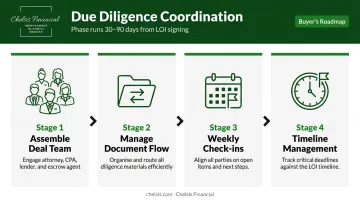
Chelsis Financial manages this phase by coordinating the full deal team and keeping document flow on track. Key elements of that coordination include:
- Assembling attorneys, CPAs, lenders, and escrow agents
- Managing document requests and responses between parties
- Weekly check-ins to maintain momentum and flag issues early
- Timeline management — due diligence typically runs 30–90 days from LOI, but stretches without active oversight
How Business Brokers Work: The Step-by-Step Process
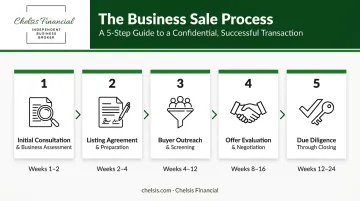
Step 1 — Initial Consultation and Business Assessment
Before anything is listed or marketed, the broker reviews the business's financials, operations, and market position to establish a defensible asking price. Chelsis Financial's Complimentary Assessment of Value is a no-obligation entry point—sellers receive a professional valuation before committing to an engagement.
Step 2 — Listing Agreement and Preparation
Once engaged, the broker and seller sign a listing agreement. According to BizBuySell, the engagement period typically runs 6–12 months, with 12 months being common given that the average sale takes around 9 months. The broker then prepares marketing materials: a blind profile, confidential information memorandum (CIM), and supporting financial documents.
Step 3 — Buyer Outreach and Screening
With materials ready, the broker markets the business through targeted channels, fields inquiries, distributes NDAs, and screens respondents for financial qualification. Only serious buyers reach the seller. When the process works well, multiple qualified parties express interest simultaneously—creating competitive tension that strengthens the seller's negotiating position.
Step 4 — Offer Evaluation and Negotiation
That competitive dynamic carries directly into offer evaluation. The broker presents and analyzes each offer side-by-side, advising on price, deal structure, and terms. Negotiations are broker-led, using competing interest to drive toward favorable price and terms for the seller.
Step 5 — Due Diligence Through Closing
The final stretch involves coordinating due diligence, ensuring legal documents are in order, managing lender timelines, and guiding both parties to close. Chelsis Financial's target window from LOI to closing is three to six months. The firm emphasizes that "time kills deals"—broker coordination and fast seller response times are what prevent late-stage deal failures.
What Do Business Brokers Charge?
Business brokers work on a success fee paid at closing—no sale, no commission.
Typical Commission Rates
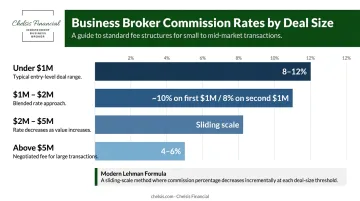
| Transaction Size | Typical Commission |
|---|---|
| Under $1M | 8–12% of sale price |
| $1M–$2M | ~10% on first $1M, 8% on second $1M |
| $2M–$5M | Sliding scale continues downward |
| Above $5M | Often 4–6% or lower, deal-specific |
IBBA's profession guide cites a range of 8–15% for main-street transactions, with minimums common on smaller deals. Morgan & Westfield describes a "Modern Lehman" sliding scale where the rate decreases incrementally as transaction value increases.
Some brokers also charge upfront retainers or administrative fees to cover preparation costs(occasionally refundable at closing). Ask about the full fee structure before signing a listing agreement.
Is the Commission Worth It?
Consider the math: a broker who negotiates a sale price 10–15% higher than what you'd achieve alone more than offsets an 8–10% commission. Factor in confidentiality protection, buyer vetting, and deal rescue during due diligence, and the commission typically pays for itself several times over.
How to Choose the Right Business Broker
Check Track Record and Industry Fit
Ask prospective brokers for:
- Their average time to close
- Experience in your specific industry or revenue range
- Examples of comparable transactions (even anonymized)
Chelsis Financial has closed deals across manufacturing, distribution, healthcare, technology, and service sectors—including aerospace machining, industrial equipment manufacturing, healthcare SaaS, and automotive service businesses. A broker with direct experience in your sector already knows which buyers are actively looking and how to position your business to attract them.
Verify Credentials and Professional Standing
In states without licensing requirements, voluntary credentials show a broker takes the work seriously. Look for IBBA membership and the CBI designation. Verify state licensing requirements directly—if your state mandates a real estate license, confirm your broker holds one.
Evaluate Fit and Communication Style
This relationship means sharing sensitive financial information and navigating high-stakes negotiations over many months. Trust matters more than most sellers expect going in. Before signing anything, ask yourself:
- Does the broker communicate clearly and respond promptly?
- Do they advocate directly for your goals rather than just pushing for a fast close?
- Do they treat your business with the same discretion they'd want for their own?
Chelsis Financial's Complimentary Assessment of Value is designed for this step—it gives you a chance to evaluate the working relationship before any formal commitment. Schedule a conversation at calendly.com/chelsis/getanswers or call 866-842-5151.
Frequently Asked Questions
What services do business brokers offer?
Business brokers provide valuation, confidential marketing, buyer sourcing and screening, negotiation, due diligence coordination, and closing support. A full-service broker manages the entire transaction from initial assessment through the final transfer of ownership.
How much do business brokers typically charge?
Commissions typically range from 8–12% for businesses under $1M, with sliding-scale structures for larger deals. The fee is paid by the seller at closing as a success fee. Some brokers also charge upfront retainers, which may be credited back at closing.
How do business brokers maintain confidentiality during a sale?
Brokers use blind profiles (non-identifying business summaries) for initial outreach and require signed NDAs before sharing detailed information. This controlled approach keeps employees, customers, and competitors unaware of the sale until the appropriate time.
What is the difference between a business broker and an M&A advisor?
Business brokers typically work with main-street businesses valued under $2M, while M&A advisors handle larger, more complex transactions involving institutional buyers. Broker commissions are often success-fee only, while M&A advisors frequently charge retainers plus a percentage of deal value.
How long does it take to sell a business with a broker?
IBBA/M&A Source Q2 2025 data shows engagement-to-close timelines of 6 months for businesses under $500K, up to 10 months for $2M–$5M deals. Accurate financials and realistic pricing upfront tend to shorten the process.
Do I really need a business broker to sell my business?
Some owners sell without one, but the risks are real: limited access to qualified buyers, confidentiality exposure, and inexperience in negotiations. For most owners, a broker's network and expertise more than justify the commission, particularly since a poorly structured deal or premature disclosure can cost far more.