
An accurate valuation isn't just a starting number. It's the foundation of your negotiating position, your ability to attract qualified buyers, and ultimately, the size of your exit check. According to BizBuySell's 2025 market recap, the median small business sold for $350,000, with a median close time of 170 days — numbers that shift dramatically based on how well a business is priced from the start.
With the US business brokerage industry comprising 1,500+ firms and roughly 8,800 brokers, separating brokers who specialize in small business valuation from generalists is harder than it looks. This guide profiles ten of the best, what makes each one worth considering, and what to look for before you sign an engagement agreement.
TL;DR
- Small business valuation typically uses Seller Discretionary Earnings (SDE) multiplied by an industry multiple — BizBuySell data puts the cross-sector average at 2.57x
- Top brokers hold credentials like CVA, ABV, ASA, or CBI — proof they produce defensible valuations, not inflated listing prices
- Key selection criteria: accreditations, industry experience, valuation methodology, buyer network quality, confidentiality protocols, fee transparency
- Chelsis Financial leads this list for Midwest small business sellers, with nine other nationally recognized firms ranked below
- A complimentary broker opinion of value is your best first step before committing to any engagement
What to Look for in a Business Broker for Small Business Valuation
Business brokers in the valuation context do something specific: they recast your financials, calculate true SDE, research comparable sold businesses, and produce a Broker's Opinion of Value (BOV). A BOV is market-oriented and sale-ready — distinct from a formal certified appraisal, but sufficient for most small business transactions.
Credentials That Matter
Not all brokers are equally qualified to value a business. Look for these designations:
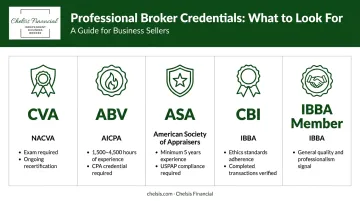
- CVA (Certified Valuation Analyst) — issued by NACVA; requires exam, experience threshold, and ongoing recertification
- ABV (Accredited in Business Valuation) — granted by AICPA; requires 1,500–4,500 hours of valuation experience depending on background
- ASA (Accredited Senior Appraiser) — issued by the American Society of Appraisers; requires five years of appraisal experience and USPAP compliance
- CBI (Certified Business Intermediary) — IBBA's designation for brokers meeting its standards for education, ethics, and completed transactions
- IBBA membership — a general quality signal for brokers focused on small business sales
Two Mistakes That Sink Sellers
Before you sign with a broker, watch for these two patterns that consistently derail sellers:
- Inflated valuations used to win the listing. An overpriced business sits on the market, attracts skeptical buyers, and often sells below what a realistic price would have fetched — or doesn't sell at all.
- No industry experience in your sector. Weak comparables produce a weak BOV. Thin buyer networks mean fewer qualified offers. Industry-specific experience is a baseline requirement, not a nice-to-have.
10 Best Business Brokers for Small Business Valuation
These brokers were selected based on:
- Valuation methodology rigor and approach transparency
- Professional accreditations and credentialed staff
- Buyer network strength and market reach
- Confidentiality practices during the sales process
- Relevance to small business sellers in the US
1. Chelsis Financial
Chelsis Financial is a Midwest-focused business brokerage firm built around confidential ownership transitions. Principal C. Ross Hedges leads the firm through transactions across manufacturing, healthcare, technology, distribution, and services — helping owners structure exits that fund retirement, career pivots, or what comes next.
Key differentiator: Chelsis Financial offers a Complimentary Assessment of Value — a no-obligation starting point that walks owners through SDE recasting, earnings multiples, and tangible asset valuation before any engagement is signed. For owners not yet ready to sell, it's a way to understand where they stand.
| Category | Details |
|---|---|
| Business Size Focus | Small to lower mid-market; transaction examples range from ~$616K to $6M+ in annual revenue |
| Valuation Approach | SDE recasting, earnings multiples (1x–4x), tangible asset valuation, market comparables |
| Key Services | Complimentary Assessment of Value, Buyer Registry, CIM preparation, full transaction management through closing |
| Fee Structure | Success-based model; complimentary initial assessment; contact for engagement terms |
| Geographic Focus | Midwest US (Indiana, Michigan, and surrounding region) |

📞 Contact: +1 866-842-5151
2. Sunbelt Business Brokers
Sunbelt is one of the largest business brokerage networks in the US, with offices spanning domestic and international markets. The network has been facilitating business sales for 40+ years, handling everything from sub-$1M main street businesses to transactions approaching $50M.
Key differentiator: One of the broadest geographic footprints in US brokerage, backed by a large aggregated buyer database. Best suited for sellers who need national or multi-market exposure. Vetting individual brokers before signing is worthwhile, as quality varies by office.
| Category | Details |
|---|---|
| Business Size Focus | $50,000 to $50M across industries |
| Valuation Approach | Cash flow analysis, market comparables, risk-based valuation factors |
| Key Services | Valuation, buyer outreach, confidential listings, deal structuring |
| Fee Structure | Commission-based; terms in signed agreement |
3. Transworld Business Advisors
Transworld operates a global franchise brokerage network with 250+ offices worldwide, 1,000+ active brokers, and 15,000+ businesses sold over 45+ years. It covers business brokerage, M&A, and franchise consulting.
Key differentiator: The combination of brokerage and franchise expertise gives sellers additional exit pathways. Their structured sales process and proprietary listing platforms provide consistent deal management.
| Category | Details |
|---|---|
| Business Size Focus | Small to mid-sized businesses across most industries |
| Valuation Approach | Asset, market, and income approaches; online valuation calculator available |
| Key Services | Business sales, franchise consulting, M&A advisory, deal preparation |
| Fee Structure | Not publicly disclosed; varies by office |
4. Murphy Business & Financial Corporation
Murphy Business operates across 38 states and Canada and has completed $4.3B+ in transactions. The firm offers both BOV reports and formal Certified Valuation Reports, with all certified work compliant with USPAP and Institute of Business Appraisers standards.
Key differentiator: Brokers are trained in standardized SDE recasting and financial analysis, producing valuations that hold up under lender and buyer scrutiny. Their lower-middle-market division focuses on companies with $1M+ EBITDA.
| Category | Details |
|---|---|
| Business Size Focus | Main street through lower middle market; $1M+ EBITDA for M&A division |
| Valuation Approach | BOV for smaller deals; Certified Valuation Reports (USPAP-compliant) for complex transactions |
| Key Services | SDE recasting, market comparables, certified appraisals, confidential listings |
| Fee Structure | Commission-based; not publicly disclosed |
5. VR Business Brokers
VR has operated for six decades, giving it one of the longest transaction histories in the industry. The network covers both main street and lower middle-market transactions, with enterprise values typically in the $3M–$25M range for its M&A division.
Key differentiator: Established broker network with proprietary valuation tools and deep experience across diverse industries. Their longevity provides a substantial comparable transaction database.
| Category | Details |
|---|---|
| Business Size Focus | Main street through lower middle market; $3M–$25M for M&A transactions |
| Valuation Approach | Income, asset, and market approaches |
| Key Services | Valuation, business-for-sale listings, buyer matching, deal closing support |
| Fee Structure | Not publicly disclosed |
6. Earned Exits
Earned Exits targets companies with $1M–$40M in revenue and claims 30 years of experience, $2B+ in transactions, and a network of 20,000 pre-qualified buyers across 17 industries. The firm is known for proactive buyer outreach rather than passive listing.
Key differentiator: Data-driven, targeted approach to finding qualified buyers. Sellers looking for strategic exit positioning — not just a listing — tend to get shorter timelines and better deal structures.
| Category | Details |
|---|---|
| Business Size Focus | $1M–$40M in revenue; service-based SMBs, digital businesses, cash-flowing local businesses |
| Valuation Approach | Free valuation with add-back analysis; SDE-focused |
| Key Services | Exit positioning, buyer outreach, deal structuring, free business valuation |
| Fee Structure | Not publicly disclosed |
7. National Business Valuation Services
National Business Valuation is a standalone valuation firm, not a transaction broker, recognized by the SBA as a qualified source for SBA Conclusion of Value reports for 7(a) lenders in all 50 states. Their team includes Certified Valuation Analysts.
Key differentiator: Purpose-built for owners who need a certified, lender-accepted valuation before engaging a broker, or for legal, estate, or SBA financing purposes. Use them when the situation requires a formal appraisal, not a BOV.
| Category | Details |
|---|---|
| Business Size Focus | All sizes; specializes in SBA loan transactions, exit planning, M&A prep |
| Valuation Approach | SBA Conclusion of Value, fair market valuations, USPAP-compliant reports |
| Key Services | SBA valuations, exit planning reports, legal/financial appraisals |
| Notable Credentials | CVA; SBA-recognized qualified source |
8. Exit Factor
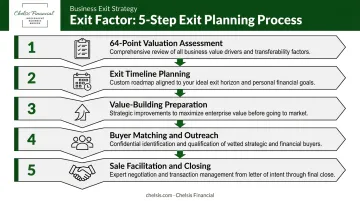
Exit Factor is a franchise-based brokerage network focused on exit planning and business sales for small to mid-sized owners. Their structured 5-step process begins with a 64-point valuation assessment and works backward from the owner's exit timeline.
Key differentiator: Exit planning starts before the owner is ready to sell. For businesses that need value-building work ahead of a transaction, Exit Factor's structured pre-sale process can produce a stronger sale price and cleaner deal terms.
| Category | Details |
|---|---|
| Business Size Focus | Small to mid-sized businesses; broad industry coverage |
| Valuation Approach | 64-point valuation calculator; earnings-based and market approach |
| Key Services | Exit planning, valuation, business sale facilitation |
| Fee Structure | Not publicly disclosed; franchise network model means local variation |
9. Sigma Mergers & Acquisitions
Sigma is a Texas-based business brokerage and M&A advisory firm serving small to lower middle-market companies. The firm charges success fees only — no upfront fees — and focuses on manufacturing, distribution, and service businesses.
Key differentiator: Transparent no-upfront-fee model and a strong track record in completed transactions. Their approach to competitive buyer solicitation aims to create multiple-offer situations that increase seller leverage.
| Category | Details |
|---|---|
| Business Size Focus | Small to lower middle market; manufacturing, distribution, services |
| Valuation Approach | Dallas business valuation services; earnings and market approaches |
| Key Services | Business valuation, confidential sales, competitive buyer outreach |
| Fee Structure | Success fee only; no upfront charges |
10. Calder Capital
Calder Capital is a nationwide lower middle-market M&A firm focused on businesses with revenues in the $1M–$100M range. Founded in 2013, the firm closed 58 deals in 2025 and 380+ deals since inception, and Axial recognized it as a top-10 lower middle-market M&A advisor.
Key differentiator: Runs a broad, competitive sale process using detailed Confidential Information Memorandums (CIMs) and targeted outreach to both strategic and financial buyers — designed to maximize seller leverage through multiple competing offers.
| Category | Details |
|---|---|
| Business Size Focus | $1M–$100M in revenue; lower middle market |
| Valuation Approach | Transaction-experience-based market expectations; realistic pricing over inflated listings |
| Key Services | CIM preparation, strategic/financial buyer outreach, competitive sale process, M&A advisory |
| Fee Structure | Not publicly disclosed |
How We Chose These Business Brokers
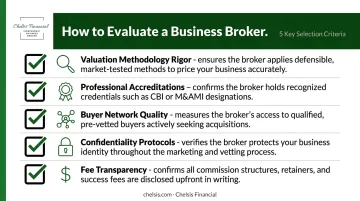
Each firm on this list was assessed across five criteria:
- Valuation methodology rigor — Does the firm use formal SDE recasting and comparable transaction data, or just estimate a number?
- Professional accreditations — Credentials like CVA, ABV, ASA, and CBI signal that valuations will hold up under buyer and lender scrutiny
- Buyer network quality — A wide, pre-qualified buyer pool directly affects how competitive the sale process becomes
- Confidentiality protocols — Proper NDA practices and controlled information flow protect sellers throughout the process
- Fee transparency — Sellers need to know commission structures before signing anything
Why Accreditations Are Non-Negotiable
A broker without formal valuation credentials can still produce a number — but that number may not survive buyer due diligence or lender review. According to IBBA's broker guidance, unrealistic seller expectations are among the top reasons deals fail. Credentialed brokers tend to give owners accurate pricing rather than the inflated figures some use to win listings.
When a broker skips formal recasting or can't back a valuation with real transaction comparables, the deal typically unravels at due diligence — costing the seller both time and negotiating leverage.
Conclusion
Choosing the right business broker comes down to one standard: can they produce a defensible, market-grounded valuation, connect you with serious buyers, and manage the process with discretion from assessment through closing?
Before signing with any broker, ask directly about their valuation methodology, industry experience, and buyer vetting process. How a broker prices your business on day one — accurately or optimistically — determines whether you close in months or watch a listing go cold.
If you're a Midwest business owner considering your options, Chelsis Financial offers a Complimentary Assessment of Value — a no-obligation way to understand what your business is worth before making any decisions. Call +1 866-842-5151 to start the conversation.
Frequently Asked Questions
How much should I pay for a business valuation?
Many business brokers offer a free Broker's Opinion of Value (BOV) as part of their engagement process. Formal certified appraisals — needed for SBA lending, estate planning, or legal purposes — typically cost more and vary based on business complexity and report type. Always clarify what type of valuation you're receiving and whether it's complimentary or fee-based.
What is the best valuation method for small businesses?
For owner-operated businesses under $5M in revenue, the earnings multiplier applied to SDE is the standard approach. BizBuySell data shows multiples averaging 2.57x overall, ranging from 2.0x to 3.3x by sector. Asset-based methods may supplement this for asset-heavy businesses.
What does a business broker charge to sell a small business?
Most brokers charge a success-based commission. Per IBBA's brokerage guide, main street commissions typically range from 8%–15% of the final sale price, sometimes with an agreed minimum. Some firms also charge upfront retainers or marketing fees — clarify all terms before signing.
How do business brokers determine the value of a small business?
Brokers recast the business's financials to calculate true SDE by adding back owner compensation, non-recurring costs, and personal expenses to net profit. They then apply an industry-appropriate earnings multiple drawn from comparable sold businesses. This produces a BOV rather than a certified appraisal.
What certifications should I look for in a business valuation specialist?
Key credentials include CVA (NACVA), ABV (AICPA), ASA (American Society of Appraisers), and the legacy CBA designation. For brokers specifically handling transactions, CBI from IBBA is the relevant professional designation. Any combination of these signals that a broker can produce valuations that buyers, lenders, and attorneys will take seriously.