
Business sale advisory is the professional process of guiding owners through preparation, marketing, negotiation, and closing — with the goal of maximizing value and protecting the seller's interests throughout. This guide covers everything you need to know: what advisory actually involves, who should be on your team, how the process works, and how to choose the right advisor for your situation.
TL;DR
- Business sale advisors manage the entire transaction: valuation, marketing, negotiation, and closing.
- Your advisory team should include a business broker or M&A advisor, transaction attorney, CPA, and wealth advisor.
- The sale process typically takes 6–12 months across four phases: preparation, marketing, negotiation, and closing.
- Getting an early valuation and organizing your financials are the two highest-impact steps before going to market.
- Most advisors work on a success fee, so their incentives align directly with yours.
What Is Business Sale Advisory?
Business sale advisory is far more than listing a business and waiting for offers. A qualified advisor handles every stage of the transaction:
- Evaluates and positions the business competitively
- Identifies and qualifies prospective buyers
- Manages negotiations and protects deal terms
- Coordinates due diligence and legal handoffs
- Maintains confidentiality throughout the process
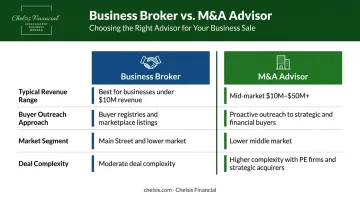
Business Broker vs. M&A Advisor
The right type of advisor depends on your business's size and complexity:
| Business Broker | M&A Advisor | |
|---|---|---|
| Best for | Businesses under ~$10M revenue | Mid-market companies, $10M–$50M+ |
| Buyer sourcing | Buyer registries, marketplace listings | Proactive outreach to strategic and financial buyers |
| Typical clients | Main Street and lower market | Lower middle market |
| Deal complexity | Moderate | Higher — PE firms, family offices, strategic acquirers |
Understanding which type of advisor fits your situation matters because the experience gap between sellers and buyers is real. Most sellers go through a business sale once. Buyers, by contrast, have often completed multiple acquisitions and arrive with experienced deal teams. Without an advisor, you're negotiating against people who do this professionally — a structural disadvantage that consistently shows up in the final price and terms.
The Advisory Team You Need When Selling a Business
No single person handles every aspect of a business sale. Successful transactions require a coordinated team across several specialties.
Business Sale Advisor / Business Broker
The advisor is the lead strategist. Their responsibilities include:
- Developing marketing materials (CIMs, blind teasers, buyer profiles)
- Identifying and qualifying buyers
- Creating competitive tension through multiple simultaneous offers
- Negotiating deal terms on the seller's behalf
- Coordinating all parties through closing
Confidentiality is one of the most critical functions an advisor performs. A skilled advisor screens buyers with NDAs, controls information flow carefully, and ensures employees, customers, and competitors don't learn about the sale prematurely. Chelsis Financial, for instance, manages buyer outreach through a structured registry that qualifies buyers before any sensitive information changes hands.
Transaction Attorney
You need an attorney with specific M&A transaction experience — not a general business lawyer or litigator. Only deal-seasoned counsel can protect you on the terms that matter most. Your M&A attorney will:
- Review and negotiate the purchase agreement
- Protect you from post-sale liabilities
- Ensure all representations, warranties, and indemnification terms work in your favor
CPA / Tax Advisor
Your CPA serves two functions. Before the sale, they normalize financial statements by:
- Identifying add-backs and one-time expense adjustments
- Presenting adjusted EBITDA accurately for buyer review
During due diligence, clean and well-organized financials reduce buyer risk perception and support your valuation. They also advise on tax strategies that can meaningfully affect your net proceeds.
Wealth Advisor
Often overlooked, a wealth advisor helps you answer a critical question before you accept any offer: what do you actually need from this sale? Post-sale income requirements, retirement planning, and estate considerations all inform whether a specific offer structure meets your real life goals — not just the headline number.
The Business Sale Process: Step by Step
The typical business sale takes 6–12 months from engagement to closing. Market Pulse Q2 2025 data from the IBBA and M&A Source shows the median time to close ranging from 6–9 months for most private transactions. Understanding each phase helps sellers avoid the missteps that derail deals.
Phase 1: Preparation and Valuation
Preparation starts with normalizing your financials. This means identifying add-backs — owner compensation above market rate, personal expenses run through the business, one-time costs — and presenting adjusted EBITDA that reflects the business's true earning power.
Valuation methods typically include:
- Comparable transactions — what similar businesses sold for recently
- Adjusted EBITDA multiples — the most common framework for private company valuation
- Discounted cash flow analysis — more common in larger, complex deals
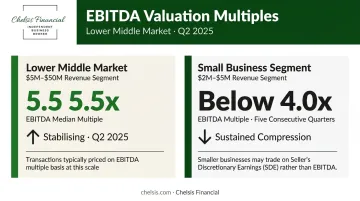
Current market benchmarks: the $5M–$50M lower middle market segment traded at a 5.5x EBITDA median multiple in Q2 2025, while the $2M–$5M segment remained below 4.0x for five consecutive quarters. Smaller businesses often trade on seller's discretionary earnings (SDE) rather than EBITDA.
Beyond financials, a thorough pre-sale review covers:
- Customer concentration (no single customer representing an outsized revenue share)
- Supplier relationships and contract status
- Employee depth and key-man dependency
- Legal contracts, leases, and IP documentation
- Operational systems and IT infrastructure
Chelsis Financial's advisors specifically flag high key-man dependency and customer concentration above 20–30% as two of the fastest ways to suppress valuation before a deal even reaches negotiation.
Phase 2: Marketing and Buyer Outreach
A good advisor builds a curated target list — not just a marketplace posting. That list includes:
- Strategic buyers: companies in your industry or adjacent sectors who value your capabilities, customer base, or market position
- Financial buyers: private equity groups, family offices, independent sponsors looking for platform or add-on acquisitions
Proactive, targeted outreach to multiple buyer types simultaneously creates competitive tension. When two or more qualified buyers are engaged at the same time, sellers gain real negotiating leverage — and that's what moves price.
Phase 3: Negotiation and Due Diligence
The Letter of Intent (LOI) stage requires careful review. A well-structured LOI captures:
- Headline purchase price and deal structure
- Working capital targets and adjustments
- Earnout provisions (if any)
- Exclusivity period and its length
Due diligence follows the signed LOI. Buyers scrutinize financials, operations, legal, tax, and HR. Any surprises discovered here create leverage for price reductions or deal restructuring — what's known as a "retrade."
The most common triggers: disorganized financials, undisclosed customer concentration risk, or key-man dependency that wasn't addressed in preparation.
Chelsis Financial emphasizes that prepared sellers close; unprepared sellers struggle. The firm requires three years of reconciled P&Ls, balance sheets, and tax returns before going to market — and recommends cloud-based accounting systems to accelerate buyer verification during diligence.
Phase 4: Closing
Once due diligence clears, closing involves finalizing the purchase agreement, resolving last-minute issues, and confirming all negotiated terms are accurately reflected in the final documents. Your attorney, CPA, and advisor all have active roles here.
Negotiate your post-sale transition terms — whether staying on for 6–12 months, exiting at close, or earning out over time — well before you reach this stage.
How to Maximize Your Business's Value Before the Sale
Three levers have the greatest impact on valuation before you go to market:
- Improve normalized EBITDA — reduce unnecessary owner expenses, demonstrate consistent revenue, and document any add-backs clearly
- Reduce customer concentration — buyers discount heavily when one client represents 30–40%+ of revenue; diversifying the revenue base before a sale materially reduces risk
- Document systems and processes — a business that can operate without the owner commands a higher multiple than one where operations depend on a single person
These operational improvements only go so far if the timing is wrong. According to Axial's analysis, falling interest rates directly expand valuation multiples: a 25–75 basis point rate drop can translate to roughly 0.5 turns of EBITDA multiple expansion. For businesses generating $1M–$5M in EBITDA, median multiples recovered from a 2023 low of 4x to over 6x by mid-2025 as financing conditions improved.
Selling when performance is trending upward and market conditions favor buyers gives you negotiating leverage. Waiting until performance dips — or until you're forced to sell — removes it.
If you're exploring options but not ready to commit, Chelsis Financial offers a Complimentary Assessment of Value: a no-obligation, confidential review of your business's worth based on financial performance, market trends, and industry benchmarks.
How to Choose the Right Business Sale Advisor
Not all advisors deliver the same results. Evaluate candidates on these criteria:
- Track record: completed transactions, close rate, average deal size relative to your business
- Industry experience: have they sold businesses in your sector before?
- Credentials: professional designations like CBI (Certified Business Intermediary, requiring 3+ completed transactions) or M&AMI (requiring 3 transactions of $5M or greater and 3 years of full-time M&A experience) signal demonstrated competency
- Buyer access: do they proactively market to qualified buyers, or just post listings and wait?
- Fee structure: success-fee advisors are financially aligned with your outcome — their compensation grows when yours does
Chemistry matters too. This relationship lasts 6–12 months and requires candid communication, mutual trust, and consistent follow-through. The best technical advisor on paper won't serve you well if communication breaks down during due diligence or negotiations.
Those criteria — buyer access, deal experience, and working relationship — are worth applying to any firm you consider. Chelsis Financial works with a network of qualified buyers across the Midwest, including a proprietary buyer registry and connections to private equity groups, strategic acquirers, and individual buyers. Support covers the full transaction: initial valuation, buyer marketing, negotiation, and closing. Confidentiality is a priority throughout — particularly for owners whose employees, customers, or competitors don't yet know a sale is being contemplated.
How Much Does a Business Sale Advisor Cost?
Most advisors work on a success fee — a percentage of the final sale price, earned only at closing. According to BizBuySell, common commission ranges are:
- 10–15% for businesses selling between $100K and $1M
- Reduced percentage on the balance for transactions above $1M (often structured using the Lehman Formula or a modified version)
- Flat fees of $10K–$15K for very small businesses under $100K
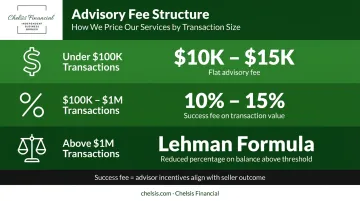
The fee structure creates a direct incentive: your advisor earns more only when you do. The more they negotiate for your business, the higher their own payout — so their goals and yours stay in sync from day one.
Some advisors also charge upfront retainers or monthly engagement fees — ask what's included before committing. A reputable advisor's fee should cover:
- Business valuation work
- Marketing material development
- Buyer qualification and vetting
- Negotiation support
- Coordination through closing
Clarify the full fee structure before signing an engagement agreement.
Frequently Asked Questions
What does business sale advisory involve?
Business sale advisory manages the full process of selling a company — valuation, buyer outreach, deal negotiation, due diligence, and ownership transfer. It's a structured, end-to-end process, not just a listing service.
How much is a business worth based on annual sales?
Business value is expressed as a multiple of EBITDA (earnings before interest, taxes, depreciation, and amortization) — not raw revenue. Multiples shift by industry, profitability, and growth trajectory, which is why a professional valuation is far more reliable than any revenue-based rule of thumb.
How much does a business sale advisor cost?
Most advisors charge a success fee of 3–10% of the sale price, paid at closing, though some also require a retainer. Ask upfront what the fee covers and how it's structured.
What is the difference between a business broker and an M&A advisor?
Business brokers typically serve smaller companies and market through buyer registries and listing platforms. M&A advisors work with mid-market companies and proactively target strategic and financial buyers. Business size and deal complexity are the clearest guides to which option fits.
When should I start working with a business sale advisor?
Engage an advisor 12–24 months before you plan to sell. That lead time lets you address financial weaknesses and reduce customer concentration — the two factors that most directly affect your final sale price.
How long does it take to sell a business with an advisor?
With a professional advisor, the typical timeline from engagement to closing ranges from 6–12 months, depending on business size, industry, market conditions, and how prepared the seller is at the outset.