
According to BizBuySell's Q1 2026 Insight Report, the median small-business sale price sits at $350,000, with median annual revenue of $713,404. That's not a routine financial event. It's a liquidity moment that deserves the same professional discipline as any other high-stakes transaction.
The temptation to sell independently is understandable — skip the broker, save the commission. But the real cost of going it alone rarely shows up as a saved fee. It shows up as a lower sale price, a confidentiality breach that rattles employees and customers, or a deal that falls apart after months of effort.
This article covers the concrete advantages of professional representation at each stage of a business sale — and what's at stake when those advantages are missing.
TL;DR
- Professional representation means a business broker manages valuation, marketing, buyer vetting, negotiation, and due diligence on your behalf
- Confidentiality is the most critical advantage — premature disclosure can destabilize employees, customers, and suppliers before a deal forms
- Accurate valuation prevents both overpricing (which stalls deals) and underpricing (which costs real money)
- Brokers create arm's-length distance in negotiations, protecting sellers from emotionally driven decisions
- Unrepresented sellers face mispricing risks, unvetted buyers, and significantly higher deal failure rates
What Is Professional Representation in a Business Sale?
A business broker — or M&A advisor for larger transactions — acts as the seller's agent throughout the entire sale process, from initial valuation through closing. This is meaningfully different from the role of an attorney or CPA.
Your lawyer handles contract language and legal risk. Your CPA handles tax strategy and financial compliance. A broker coordinates everything else: packaging the business for sale, sourcing and screening buyers, negotiating terms, and steering due diligence to a close. Their goal is to maximize sale price, protect confidentiality, and keep the deal moving — not to add process for its own sake.
Chelsis Financial works with business owners in the Midwest across sectors like manufacturing, industrial contracting, and technology. Their process starts with a Complimentary Assessment of Value, a no-obligation starting point that gives owners a defensible, market-based picture of what their business is worth before any commitment is made.
The Three Core Advantages of Professional Representation
The advantages below aren't theoretical. They reflect the operational realities that separate a well-managed sale from one that stalls, underdelivers, or collapses entirely. Each one ties directly to outcomes sellers care about: final price, timeline to close, deal stability, and buyer quality.
Advantage 1: Confidentiality That Protects Business Stability
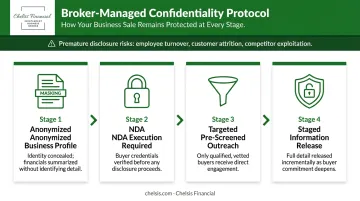
Confidentiality comes first because the risks of premature disclosure are both immediate and severe. When word gets out that a business is for sale — before the right buyer is identified and a deal is structured — employees start updating their resumes, customers begin evaluating alternatives, and competitors gain an opening they can exploit.
The IBBA confirms that a lack of confidentiality can hurt the owner, cause confusion with employees, and directly damage the business being sold. That damage doesn't reverse when a deal closes.
How brokers manage this:
- Create anonymized business profiles that highlight financial performance and growth potential without revealing the company's name or exact location
- Require signed NDAs before disclosing any identifying details to prospective buyers
- Use targeted outreach to pre-screened buyer networks rather than broad public advertising
- Control the staged release of sensitive information — customer data, employee details, and proprietary operational information — until buyer qualification is confirmed
Chelsis Financial follows this tiered approach: initial listings include industry type, general Midwest location, and key financial metrics. Specific business identity and operational detail are reserved for buyers who have executed a confidentiality agreement and cleared preliminary screening.
This matters most for:
- Owner-operated businesses with small, tight-knit teams where staff loyalty is a business asset
- Companies in competitive local markets where competitors monitor activity closely
- Sales requiring an extended marketing period to attract the right buyer
Without these controls, a seller loses negotiating leverage. Buyers who discover operational disruption — turnover, customer attrition, declining revenue — during the sale period have documented grounds to reduce their offer or walk away entirely.
Advantage 2: Accurate Valuation and Maximum Sale Price
Most business owners have a strong intuitive sense of what their company is worth, shaped by years of effort and genuine emotional investment. That intuition frequently diverges from what the market will pay.
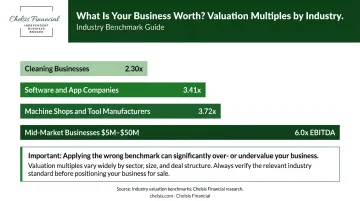
Valuation multiples vary significantly by sector and business size. BizBuySell's 2025 industry data shows cash-flow multiples ranging from 2.30x for cleaning businesses to 3.72x for machine shops and tool manufacturers to 3.41x for software and app companies.
For businesses in the $5M–$50M enterprise value range, IBBA/M&A Source Q4 2024 data reported an average of 6.0x EBITDA. A seller who applies the wrong benchmark — or no benchmark at all — can misprice their business significantly in either direction.
What professional valuation actually covers:
- Seller's Discretionary Earnings (SDE), EBITDA, and three years of normalized financials
- Owner dependency, customer concentration, recurring revenue, and management depth
- Industry comparables, buyer demand data, and deal structure options that affect net proceeds
Chelsis Financial's valuation methodology centers on SDE as the foundation for owner-operated businesses, with earnings multiples typically ranging from one to four times annual owner cash flow — adjusted based on factors like customer concentration (the firm applies a benchmark that no single customer should represent more than 10–15% of total revenue), revenue trends, and operational transferability.
The pricing problem with going it alone:
- Overpricing causes the business to sit on market, attracting skeptical buyers and eventually requiring a price reduction that signals distress
- Underpricing — which Chelsis Financial notes is the more common outcome for FSBO sellers — means walking away with thousands of dollars less than fair market value, often to buyers who used strong negotiating tactics to capitalize on the seller's valuation uncertainty
KPIs this advantage directly affects: final sale price, price-to-EBITDA multiple achieved, days on market, and number of qualified offers received.
Advantage 3: Buyer Vetting, Negotiation, and Deal Closure
Finding a buyer isn't the hard part. Finding the right buyer — financially qualified, operationally serious, and prepared to complete a transaction — is much harder.
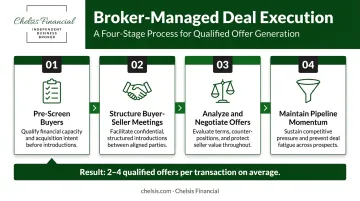
Q2 2025 IBBA/M&A Source Market Pulse data showed that most deals received 2 to 4 qualified offers, with deals in the $5M–$50M segment averaging 3.71 offers per transaction. That kind of competitive buyer process doesn't happen by accident. It's the product of a managed, broker-led outreach to a pre-screened network.
What brokers do across the full arc of the deal:
- Pre-screen buyers before they ever reach the seller — verifying financial capacity, acquisition intent, and industry fit
- Structure buyer-seller meetings to protect the seller's time and maintain controlled information flow
- Analyze and negotiate offers with professional objectivity the seller can't replicate on their own business
- Maintain pipeline momentum through due diligence so that if one buyer withdraws, the process doesn't restart from zero
Chelsis Financial advises sellers on LOI strategy — including negotiating down due diligence periods (from the standard 60–90 days to 30–45 days where feasible) and maintaining leverage before a no-shop clause takes effect. When the firm's transaction coordination services manage the process from LOI to close, they coordinate attorneys, CPAs, lenders, and escrow agents to keep documentation and financing on track.
The negotiation problem for unrepresented sellers:
Owners negotiating the sale of their own business are too close to the asset to negotiate objectively. Years of personal investment create emotional exposure that experienced buyers — particularly repeat corporate or private equity acquirers — are trained to recognize and use.
A broker provides the professional distance that protects deal terms. They can play the difficult role in negotiations while preserving the seller's direct relationship with the buyer for a smooth post-close transition.
KPIs this advantage directly affects: time from listing to offer acceptance, qualified buyer meetings generated, due diligence completion rate, and offer-to-close conversion rate.
What Happens When You Sell Without Professional Representation
Unrepresented business sales follow predictable failure patterns. According to a Market Pulse survey, unrealistic valuation expectations were cited by 51% of brokers and intermediaries as a common reason deals fail, and declining business performance during the sale period contributed to 17% of failures.
The most common failure modes for FSBO business sales:
- Mispricing from the start — Chelsis Financial's internal data notes that most FSBO sellers either underestimate or significantly overestimate business value; those who sell quickly often do so well below fair market value
- Confidentiality exposure — without structured NDAs and staged disclosure, sensitive business information reaches the wrong people before any deal is formed
- Unvetted buyers consume weeks of a seller's time — because there's no qualification filter, sellers end up in prolonged conversations with parties who were never financially able to close
- Negotiation vulnerability — FSBO sellers who don't know their business's true value are at genuine risk of exploitation by experienced buyers who use that information asymmetry to negotiate favorable terms
- Due diligence collapse — without a broker coordinating documentation and managing timelines, deals stall when buyers can't get organized responses to their requests, creating momentum loss that often kills transactions
Without representation, sellers have no way to stay ahead of the process. Every inquiry becomes a distraction, every negotiation an exposure, and every documentation request a potential deal-killer — all while the seller still has a business to run.
How to Get the Most Value from Professional Representation
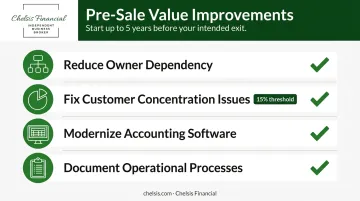
Representation delivers the most value when sellers engage early. Chelsis Financial recommends beginning the conversation up to five years before an intended exit — a broker can identify value improvements well before a deal begins, giving owners time to act on them and meaningfully strengthen the eventual asking price.
Specific pre-sale improvements the firm guides owners through include:
- Reducing owner dependency by building a capable management team that can operate without the owner's daily involvement
- Cleaning up customer concentration issues (anything above 15–20% of revenue from a single customer)
- Switching to modern accounting software that produces clean, auditable financials for buyer review
- Documenting operational processes to demonstrate transferability
Even for owners planning a sale within 12–18 months, the Chelsis Financial Complimentary Assessment of Value provides a clear starting point: a defensible valuation built on SDE analysis, three years of financial history, industry comparables, and non-financial value drivers — with no upfront commitment.
Once the process begins, how sellers show up matters. To get the most from the relationship:
- Be fully transparent about financials, business history, timeline, and personal goals — gaps surface during due diligence and damage deal terms
- Stay engaged throughout — review buyer feedback, respond quickly to documentation requests, and act on your broker's guidance on pricing and negotiation
- Treat it as a collaboration, not a delegation — outcomes are consistently better when sellers remain active participants
Sellers who approach the process this way — prepared early, transparent throughout, and engaged at every stage — are the ones who close on their terms.
Conclusion
Most business owners sell once. There's no trial run, no second attempt at a better price, and no recovering a confidentiality breach after it's happened. The advantages of professional representation — valuation accuracy, buyer screening, deal structure, and confidentiality controls — aren't isolated perks. They shape the outcome at every stage.
Sellers who bypass representation rarely save money. What they lose instead is negotiating leverage, qualified buyer access, and months of time — often ending with a lower price, a damaged deal, or a sale that never closes at all.
Whether a sale is 12 months out or five years away, starting early puts the decision on your terms rather than the market's. Chelsis Financial offers a complimentary business assessment to help owners understand what their company is worth today — and what it takes to maximize that value before going to market. That conversation costs nothing. Selling unprepared often costs far more.
Frequently Asked Questions
What is a business sales representative?
A business sales representative — commonly called a business broker — acts as the seller's agent in a business sale, managing valuation, marketing, buyer sourcing, negotiation, and closing on the seller's behalf. The role is similar in concept to a real estate agent but specifically focused on the sale of operating businesses.
How much does a business broker charge when selling a business?
Most brokers work on a success-fee basis, paid only when the transaction closes. BizBuySell reports common commission ranges of 10–15% for businesses under $1M, with lower negotiated rates above that — typically stepping down to 8% on amounts exceeding the first million.
How long does it take to sell a business with a broker?
Broker-represented sales generally take 6–12 months from listing to close, with higher-priced businesses typically requiring more time to find the right buyer. Once an offer is accepted, due diligence and closing typically run 60–90 days.
Can I sell my business without a broker?
Selling without a broker is possible, but carries meaningful risks — including confidentiality exposure, inaccurate valuation, unvetted buyers, and a higher likelihood of deal failure. For most sellers, the commission cost is smaller than the value gap between a self-managed and professionally managed exit.
What is a business valuation and why does it matter?
A business valuation assesses what your business is worth based on financial performance, industry comparables, assets, and market demand. It sets the asking price and anchors negotiations — preventing you from underpricing and leaving money behind, or overpricing and stalling the sale.
How do I keep my business sale confidential?
Confidentiality is maintained through anonymized marketing materials and NDAs signed before any identifying details are disclosed. A broker with a pre-screened buyer network ensures the sale never surfaces publicly to employees, customers, or competitors.