

Introduction
Most business owners know their company has real value — they've built it, grown it, and poured years into it. What's harder to know is how a buyer will actually measure that value when an offer comes to the table.
Buyers don't just look at revenue. They evaluate a business through the lens of risk — specifically, how likely is it that cash flows will hold up after they take ownership? Every weakness they find gets priced in. Verified strengths, on the other hand, justify paying more.
The factors buyers weigh most heavily are within your control. There are 8 specific, improvable value drivers that — when strengthened — reduce buyer risk perception and give you real leverage when negotiating a final price.
This article breaks down all 8: what each driver is, why buyers care about it, and how to start improving it before you come to market.
TLDR
- Buyers evaluate businesses on 8 value drivers that signal whether future cash flows are sustainable and low-risk.
- These 8 drivers span ownership independence, operational systems, customer diversity, growth strategy, revenue quality, cash flow strength, scalability, and competitive positioning — each covered in full below.
- Many of these improvements take 3–5 years to show up meaningfully in financials — starting early gives you the most leverage.
- A business that runs without its owner, grows predictably, and holds a defensible market position earns a premium at exit.
What Buyers Actually Look For Before Making an Offer
Every buyer — whether an individual operator, a strategic acquirer, or a private equity group — evaluates a business through two lenses: the size of future cash flows and the risk those cash flows won't materialize. Value drivers either increase projected earnings, reduce perceived risk, or both.
What surprises many sellers is how much weight qualitative factors carry. According to the Exit Planning Institute, intangible capitals — things like management depth, customer relationships, documented systems, and brand position — make up roughly 80% of a business's value. The financials matter, but they don't tell the whole story.
At Chelsis Financial, the picture is consistent with that reality. Buyers are highly risk-averse. The factors that most frequently erode deal confidence — or kill transactions outright — are:
- Owner dependence: buyers won't pay a premium for a business that can't run without you
- Customer concentration: revenue tied to one or two clients creates fragility no acquirer wants to absorb
- Missing documentation: gaps in financials, contracts, or operating procedures signal risk and slow due diligence to a crawl
How Early You Start Determines How Much You Can Improve
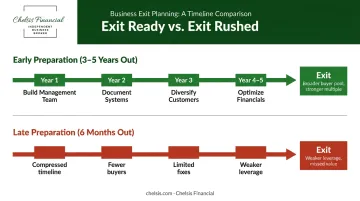
Value driver improvements aren't switches you flip before going to market. Building an independent management team, diversifying a customer base, and documenting operating systems all take time to register credibly in financials and due diligence. Buyers and their advisors will scrutinize the trend — not just the current snapshot.
Chelsis Financial recommends starting 3–5 years before a planned exit. One client, a Wisconsin-based commercial millwork manufacturer named Jim O'Keefe, began transitioning to an absentee ownership model five years before his target date. That runway produced a broader buyer pool, multiple competitive offers, and a stronger final multiple than he'd projected when he first engaged.
Late preparation limits what's fixable. Sellers who wait until six months out typically face compressed timelines, fewer qualified buyers, and less negotiating leverage. Starting early compresses perceived risk — and that difference shows up directly in what buyers are willing to pay.
Value Drivers 1–4: People, Operations, Customers, and Growth
Driver 1: An Independent Management Team
Owner dependency is the single biggest red flag most buyers encounter. If a business cannot function without the current owner, a buyer is essentially paying for something they may not be able to replicate — and they'll price that uncertainty into their offer.
According to IBBA, sales of Main Street and lower-middle-market businesses take 6 to 10 months from engagement to close. A business that falls apart during that window — because the owner is distracted by the sale process — is a liability. Buyers know this.
Building a strong management team serves a dual purpose:
- It makes the business transferable, reducing the buyer's post-acquisition risk
- It frees the owner to focus strategically on improving the other 7 drivers
Chelsis Financial has seen this dynamic play out clearly. Businesses with a management team in place "that will stay post-closing for a long time" dramatically broaden the buyer pool. High key-man dependency, on the other hand, is one of the fastest ways to suppress valuation or lose buyer interest entirely.
Driver 2: Scalable Operating Systems That Sustain Cash Flow
Documented, repeatable processes signal to buyers that performance isn't personality-dependent. When systems for operations, finance, and customer delivery are standardized and transferable, post-acquisition risk drops considerably.
The Exit Planning Institute identifies structural capital — the systems, processes, and documentation that remain with the company after the owner exits — as one of four core intangible capitals driving business value.
From a buyer's diligence perspective, this matters early. Chelsis Financial advises sellers to have a complete, organized package of financials, operational documents, and transition plans ready before the first offer arrives.
Key operational documentation buyers look for:
- Standard operating procedures for core functions
- Employee rosters and compensation structures
- Vendor and supplier contracts
- Customer delivery processes and service standards
- Financial reporting systems and controls
Businesses that can't produce clean documentation quickly introduce uncertainty into the deal. Buyers respond by discounting their offers or walking away.
Driver 3: A Diversified Customer Base
Customer concentration is a valuation problem that buyers take seriously. Mercer Capital notes that large customer concentrations increase not just expected cash flows but the risk applied to those cash flows — and higher risk lowers business value, even when the revenue looks strong on paper.
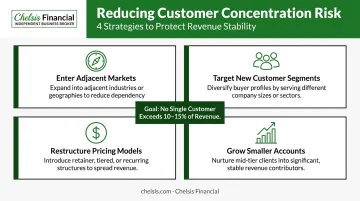
Chelsis Financial applies a practical benchmark: no single customer should represent more than 10–15% of total revenue. Beyond that threshold, buyers start asking hard questions — and often discount the business significantly to account for what happens if that customer walks after the transition.
Practical ways to reduce concentration risk:
- Enter adjacent markets or geographies to spread revenue
- Target new customer segments with similar buying profiles
- Restructure pricing models to reduce dependency on large contracts
- Actively grow smaller accounts to bring them up as a percentage
The goal isn't just spreading risk — it's demonstrating to buyers that revenue is stable across a broad base of customers, not propped up by one or two relationships the seller has personally maintained for years.
Driver 4: A Proven and Transferable Growth Strategy
Buyers pay a premium for businesses where growth is tied to repeatable strategy, not founder effort. Consistent, documented performance signals that momentum will carry through the transition.
Axial notes that EBITDA multiples vary significantly within industries based on company-specific factors including growth rate, profitability, and risk profile. Growth trajectory is one of the variables that separates a business selling at the low end of a multiple range from one at the high end.
What a transferable growth strategy looks like in practice:
- Measurable KPIs tracking revenue and margin trends
- A documented pipeline or market development roadmap
- Historical data showing growth tied to repeatable processes
- A forward-looking plan that doesn't require the founder to execute it
If growth has happened primarily because the owner is a strong salesperson or holds the key client relationships personally, buyers will factor that into their offer. The valuation gap between founder-dependent growth and system-driven growth is real — and it shows up in every serious negotiation.
Value Drivers 5–8: Revenue Quality, Cash Flow, Scalability, and Edge
Driver 5: Recurring Revenue That Resists Commoditization
Recurring revenue — through contracts, subscriptions, retainers, or demonstrated repeat-purchase patterns — gives buyers a predictable income baseline that reduces uncertainty and justifies higher valuation multiples. In IT services, for example, Axial reports that valuation depends heavily on recurring revenue, contract depth, and customer concentration.
Chelsis Financial has seen this driver produce dramatic results. A telephone answering service called Ruby Receptionists sold for more than 3 times revenue — well above the administrative support industry average of 1.8 times pre-tax profit — largely because it billed customers through recurring subscription contracts and had built proprietary technology competitors couldn't easily replicate.
Recurring revenue is only as valuable as it is defensible. If competitors can replicate your offering at a lower price, buyers will price in margin erosion risk. Sellers need to identify what makes their revenue genuinely sticky — customer switching costs, proprietary processes, contractual lock-in — and document those differentiators clearly.
Driver 6: Good and Consistently Improving Cash Flow
Strong revenue doesn't automatically mean strong value. Buyers scrutinize net cash flow and margins closely, and a common trap for growing businesses is that expansion investments temporarily compress margins, making a healthy, growing business look financially weaker than it actually is.
BizBuySell's most recent Insight Report shows median cash flow up 7% and median sale price up 13% year-over-year, suggesting buyers are willing to pay more when cash flow is demonstrably improving. The direction of the trend matters as much as the absolute number.
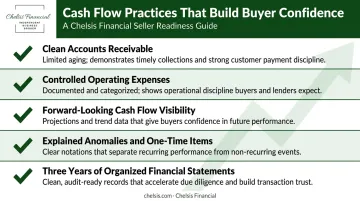
Practices that reinforce buyer confidence in financial health:
- Clean accounts receivable with limited aging
- Controlled, documented operating expenses
- Forward-looking cash flow visibility
- Clear explanations for any anomalies or one-time items
- 3 years of organized financial statements ready for diligence
For sellers whose margins look compressed due to recent growth investments, Chelsis Financial helps contextualize those adjustments through owner benefit analysis and add-backs — presenting a normalized view of the business's true earning capacity.
Driver 7: Demonstrated Scalability Beyond the Current Owner
A buyer isn't just paying for what the business is today. They're paying for what it could become. Scalability — documented systems that can handle volume increases, a clear path to market expansion, and operations that don't depend on the owner's personal capacity — shows buyers a business they can grow without rebuilding from scratch.
Even owners who have no personal interest in scaling further can still make this argument. The key is showing buyers the infrastructure exists and the market opportunity is real. That includes:
- Systems designed to handle higher transaction volume without breaking
- Processes that new team members can follow without constant supervision
- Identifiable adjacent markets or customer segments not yet fully penetrated
- Evidence that growth doesn't require proportional increases in owner involvement
Scalability documentation doesn't require a formal growth plan. A process manual, an org chart that functions without the owner, and one or two identifiable untapped markets are often enough to move the needle on valuation.
Driver 8: A Defensible Competitive Advantage
A genuine competitive moat — proprietary processes, brand equity, intellectual property, exclusive supplier relationships, or an established market position — is one of the most powerful value multipliers. Strategic buyers will pay a premium for something they cannot easily build themselves.
If the only competitive advantage is price, a buyer will conclude they can offer temporary discounts to win those customers away. That's not a moat — it's a vulnerability.
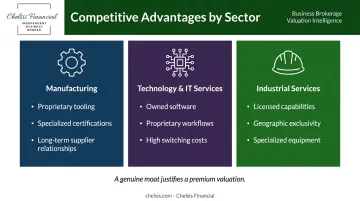
What defensible advantages look like across sectors Chelsis Financial serves:
- Manufacturing: Proprietary tooling, specialized certifications, long-term supplier relationships
- Technology/IT Services: Owned software, proprietary workflows, high switching costs
- Industrial Services: Licensed capabilities, geographic exclusivity, specialized equipment
Ruby Receptionists' proprietary call-routing technology is a useful benchmark: it wasn't just a differentiator. It was the primary justification for a valuation nearly double what comparable businesses were receiving.
How to Start Improving Your Business Value Today
Improving value drivers isn't a single task — it's a multi-year initiative. The right starting point is an honest, outside-in assessment of where the business currently stands on each of the 8 drivers.
A practical framework for getting started:
- Audit each driver objectively — where are the genuine strengths, and where are the gaps that a buyer would find during diligence?
- Prioritize by impact and time-to-implement — some improvements (like cleaning up financials) can happen quickly; others (like building a management team) take years
- Track progress against the goal — making the business as attractive and low-risk as possible to the widest range of qualified buyers
- Revisit the assessment regularly — value building is ongoing, not a one-time project
Most owners never get to step one. According to a 2023 EPI survey, only 41% of business owners had a formal written exit plan — and 9% had no plan at all. Owners who come to market without preparation routinely see lower sale prices and reduced buyer interest as a result.
Chelsis Financial's Complimentary Assessment of Value is designed to be that starting point. It gives business owners an objective, third-party view of current business value — reviewing financial performance, market positioning, and the specific factors most likely to affect their eventual sale price. There's no charge, and everything is held in strict confidence.
To schedule yours, contact C. Ross Hedges at crhedges@chelsis.com or book a call directly at calendly.com/chelsis/getanswers.
Frequently Asked Questions
What are the 8 drivers of company value?
The 8 drivers are: independent management, scalable operating systems, diversified customer base, proven growth strategy, recurring revenue, strong cash flow, demonstrated scalability, and competitive advantage. Together, they determine how buyers assess the risk and sustainability of future cash flows after acquisition.
What is the most important value driver when selling a business?
Management independence is widely considered the most critical driver. A business that relies entirely on its owner is inherently risky and hard to transfer. Strengthening this driver also creates the conditions needed to improve the other seven.
How far in advance should I start working on value drivers before selling?
Start at least 3–5 years before a planned exit. Many improvements — building a management team, diversifying the customer base, documenting systems — take time to show up meaningfully in financials and convince buyers those improvements are real.
How do I know if my business is too dependent on me as the owner?
Ask yourself: if I were out of the business for six months, would revenue and operations hold steady? If the honest answer is no, owner dependency is a significant risk that buyers will price into any offer they make.
What role does a business broker play in improving business value?
A business broker helps owners understand how buyers will evaluate their specific business and identifies which value drivers need strengthening before going to market. At Chelsis Financial, that work also includes positioning your business to attract the most qualified buyers at the strongest possible price.
Can a business sell successfully if not all 8 value drivers are strong?
Yes — few businesses are strong across all 8. But the more drivers that are well-developed, the larger the buyer pool and the stronger your negotiating position. Improving as many as possible before listing gives you measurable leverage when offers come in.