Professional business sales are routinely executed with near-total confidentiality when structured correctly. The key word is structured. Confidentiality doesn't happen by default; it's engineered through specific documents, sequenced disclosures, and disciplined buyer management.
This guide is written for US-based business owners considering a sale — whether due to retirement, a strategic pivot, or a life change — who understand that protecting confidentiality isn't just a preference. It's a financial imperative. When the wrong people find out too early, businesses lose staff, customers renegotiate, and buyers gain leverage. The result is a lower sale price, a longer timeline, or no deal at all.
Here's how to avoid that outcome.
TL;DR
- A discreet sale controls exactly who knows about the sale and when — keeping employees, customers, vendors, and competitors uninformed until closing.
- Your confidentiality risk depends heavily on which market approach you choose: targeting one buyer, a curated shortlist, or a broad anonymous campaign.
- Blind listings, NDAs, and phased information disclosure are what keep the deal quiet from first contact through closing.
- The most common reason confidentiality breaks down isn't the process — it's seller behavior: telling the wrong people too early.
- An experienced broker with a vetted buyer network is the most reliable way to control information flow from start to finish.
What Does It Mean to Sell a Business Discreetly?
Most business sales fail quietly — not because of price, but because word got out too soon. A discreet business sale controls that risk: information is shared only with vetted, NDA-signed parties. Employees, vendors, customers, and competitors remain unaware that the business is for sale until the appropriate time — typically after closing.
This is fundamentally different from a standard public listing, where identifying details appear on business-for-sale marketplaces for anyone to find. In a confidential sale:
- The business is never identified by name in initial marketing materials
- Buyers must qualify and sign an NDA before receiving any identifying information
- Due diligence access is staged, not open-ended
- The broker manages all initial buyer contact, keeping the seller's identity protected
According to the IBBA's glossary of industry terms, this process relies on three specific documents: a teaser (anonymous initial outreach), a CBR or Confidential Business Review (shared only with NDA-signed buyers), and a CIM or Confidential Information Memorandum (the full financial and operational profile shared in later stages).
A confidential sale doesn't mean a limited sale. A well-run discreet process can attract serious, qualified buyers and generate real competition. It just keeps that competition controlled rather than visible to anyone with a search bar.
Why Confidentiality Is Critical When Selling Your Business
The risks of premature disclosure aren't abstract. They directly affect what you walk away with.
Employee Risk
When key staff learn the business is for sale, job insecurity follows quickly. Top performers — the ones buyers most want to see on the org chart — are the first to explore their options.
A business that loses its operations manager or lead salesperson mid-sale looks materially different to a buyer than it did at valuation. That difference shows up in price.
Customer and Vendor Disruption
Word of a pending sale travels fast. Customers may quietly begin evaluating alternatives, while vendors often tighten credit terms or stall contract renewals until ownership is clarified. Either outcome undermines the financial performance you're trying to sell.
Competitive Intelligence Risk
Strategic buyers — including direct competitors — are often the most interested acquirers. They're also the most dangerous if the process isn't controlled. The American Bar Association's guidance on trade secret diligence in M&A is explicit: potential acquirers must agree not to disclose or use confidential information for any purpose other than evaluating the transaction. Without that restriction in place before sharing begins, a competitor can walk through your operations, review your client list, and walk away with no obligation to buy.
Negotiating Leverage
When buyers know you're actively selling — especially if they know how long the business has been on the market — they use that information. Timeline pressure becomes a negotiating tool. Confidentiality preserves your position by keeping urgency off the table.
Brand and Stakeholder Trust
A poorly managed disclosure can shake confidence in the business itself. When stakeholders sense instability, the effects compound:
- Customers begin pricing alternative suppliers before a deal closes
- Vendors delay renewals or request shorter contract terms
- Key employees hedge their bets, reducing engagement at a critical moment
A controlled disclosure — timed after closing — keeps those relationships intact and gives the incoming owner a real chance at a smooth handoff.
How to Sell a Business Discreetly: Step-by-Step
The end-to-end flow looks like this: confidential valuation → anonymous marketing → buyer vetting → controlled due diligence → close.
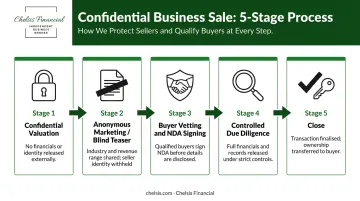
Each step releases only what a buyer needs to see — nothing more.
Step 1: Get a Confidential Business Valuation
Before anything else, you need to know what the business is worth — without broadcasting that you're exploring a sale.
A confidential valuation sets your asking price, identifies which buyer types to target, and gives you a defensible number for lender and buyer discussions.
Chelsis Financial offers a Complimentary Assessment of Value for owners at this stage. You'll need three years of financial statements — income statements, cash flow, and balance sheets — along with an estimate of tangible assets. In return, you receive a realistic market value analysis based on financial performance, industry benchmarks, and comparable transactions.
The entire process is conducted in strict confidence. No public disclosure, no obligation to proceed.
Step 2: Prepare a Blind Teaser Document
With your valuation in hand, the next step is controlling what buyers see first. A blind teaser (or blind profile) describes the business's financial performance, industry, and opportunity — without naming the company, identifying its location, or including any traceable details.
A well-constructed teaser typically includes:
- Revenue and cash flow ranges (not exact figures)
- Broad industry and sector description
- Geographic region (state or region, not city)
- General business model and customer type
- Growth opportunities and key strengths
All buyer inquiries at this stage go through proxy contact information — a generic email or broker-managed phone number — so no buyer can identify the seller before proper screening.
Step 3: Vet Buyers and Require NDAs Before Sharing Details
Once the teaser generates interest, qualification moves in two distinct phases.
Phase 1 — NDA execution: Buyers who express genuine interest must sign a legally binding NDA before receiving the CIM. The ABA's guidance is clear on timing: the NDA must be executed before any confidential details are shared, not after. It should also include explicit permitted-use restrictions — the buyer can only use the information to evaluate the transaction, not for any other purpose.
Phase 2 — Financial qualification: Alongside NDA execution, require basic financial background and proof of capital. A buyer who balks at this step before receiving your CIM is a red flag, not a serious prospect.
Step 4: Manage Due Diligence With Controlled Information Sharing
Due diligence in a discreet sale is staged, not open. Key practices include:
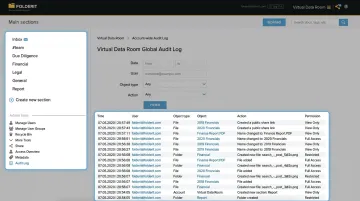
- Secure data room access — Documents are shared through a virtual data room (VDR) with tracked access, version control, and audit trails. As Datasite notes, M&A VDRs should maintain a complete audit trail for compliance. A shared Google Drive folder is not sufficient.
- Off-hours site visits — Schedule physical visits outside normal operating hours or hold them at neutral locations to avoid raising employee suspicion.
- Deferred sensitive disclosures — Customer lists, employee details, and key contract terms are held back until late in the process, once the buyer has demonstrated serious intent and a deal structure is taking shape.
This staged approach also protects you if the deal falls through. A buyer who walks away has seen only what they needed to see at each stage — not a full picture of how your business runs.
The Three Market Approaches for a Confidential Sale
The number of buyers you approach is the single biggest variable in how much confidentiality risk you accept. Choose deliberately.
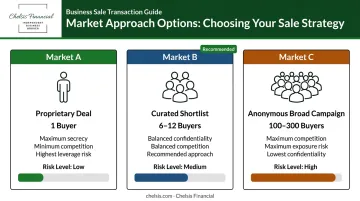
Market A — The Proprietary Deal (1 Buyer)
You approach one pre-identified acquirer: a partner, a competitor, a family member, or a known strategic buyer. This is maximum secrecy with minimum leak risk.
Without competition, the buyer holds all leverage. They can slow-walk the timeline, push the price down, and wait you out — because there's no alternative on your end. This approach makes sense only when you have a strong existing relationship and a clear sense of what the buyer will pay.
Market B — The Curated Shortlist (6–12 Buyers)
This is the most commonly recommended approach. A broker curates a list of 6–12 qualified buyers — often industry insiders, strategic acquirers, or established operators — who are approached individually and confidentially.
The balance works well: enough competition to support pricing and deal momentum, while keeping the circle small enough to maintain control. Chelsis Financial's buyer registry is built for exactly this — connecting sellers with pre-qualified buyers whose acquisition criteria match the business being sold.
Market C — The Anonymous Broad Campaign (100–300 Buyers)
Brokers distribute blind listings to a large pool of buyers with all identifying details removed. This maximizes competition and brings more offers faster.
The exposure risk rises with the pool size — the more buyers who see the listing, the higher the chance one of them knows your employees, vendors, or competitors. Consider this approach when you're prioritizing speed and price over secrecy, or when your business operates in an industry where individual buyers are unlikely to recognize your operation from a blind summary.
Common Confidentiality Mistakes — and When Full Discretion Can Backfire
Mistakes That Break Confidentiality
- Telling employees before closing — Even trusted long-term staff can inadvertently mention it to someone. Employees should hear about the sale from the new owner — not from you.
- Using public platforms or social media — Posting on general business-for-sale marketplaces or mentioning a potential sale in industry circles eliminates confidentiality immediately.
- Scheduling site visits during business hours — Buyers walking through the facility during normal operations raises obvious questions from staff and customers.
- Sharing financials before vetting — Sending P&L statements to any buyer who asks, without an NDA or proof of financial qualification, is how sensitive information ends up in competitors' hands.
- Telling advisors without structure — Attorneys and accountants are necessary partners, but looping them in before a confidentiality agreement is in place creates unnecessary exposure.
These mistakes share a common thread: each one trades short-term convenience for long-term risk. But the opposite error — locking down the process so tightly that no qualified buyer can engage — creates its own problems.
When Over-Restriction Backfires
Insisting on only one or two buyers doesn't just limit competition — it can kill the deal entirely.
A single buyer who knows they're your only option will test your patience and your price. Extended timelines carry real consequences: staff start noticing something is off, financial performance can shift, and the window for an optimal sale can close.
Discretion and competitiveness are not opposites. A well-run confidential process — one that reaches a vetted pool of qualified buyers simultaneously — produces competitive offers without exposing the business prematurely. The structure matters as much as the secrecy.
Buyer Red Flags to Watch For
Some "buyers" are not buyers at all. Watch for:
- Requesting facility tours or staff introductions before signing an NDA
- Asking for customer lists or operational details before reviewing financials
- Expressing interest without providing any financial background
- Continuing to gather information while delaying any commitment
These behaviors suggest the person across the table is collecting intelligence, not evaluating an acquisition. A broker who qualifies buyers — financially and by intent — before they ever contact you is what keeps this from happening.
Frequently Asked Questions
How do you discreetly sell a business?
Work with a business broker to use blind listings, NDAs, and phased information sharing. The broker manages all buyer contact at the anonymous stage, so no buyer can identify your business until they've been qualified and signed a confidentiality agreement.
Should I tell my employees I'm selling the business?
In most discreet sales, employees are not informed until after closing or very late in the process. Premature disclosure triggers job security concerns — and voluntary departures at exactly the moment buyers expect to see stable operations.
What is a blind listing and how does it protect my identity?
A blind listing describes your business — its financials, industry, and opportunity — without naming it or providing traceable details. Proxy contact information routes all inquiries through your broker, so interested buyers cannot identify your company before signing an NDA.
Do I need an NDA before showing my financials to a buyer?
Always. A signed NDA is a prerequisite before sharing any identifying financial or operational information. Per ABA guidance, the NDA should be in place before any confidential information is disclosed — not after preliminary discussions have started.
What happens if word gets out before the sale closes?
A premature leak can unsettle employees, prompt vendor renegotiations, and give competitors useful intelligence. The best response is a calm, prepared statement that acknowledges change is coming without confirming sale details. Accelerating the timeline to close is also worth discussing with your broker.
How long does a discreet business sale typically take?
IBBA data suggests most sales take 6–10 months from start to close, with later-stage due diligence and closing typically accounting for around 90 days of that. Working with a broker who has a pre-qualified buyer network tends to compress the early buyer-identification phase.