
The triggers vary — retirement, health changes, partnership shifts, or simply recognizing that the business has hit peak value. Whatever the reason, going in without a roadmap is expensive.
This guide covers everything: how to assess readiness, prepare your business, get a defensible valuation, navigate the full sale process step by step, and avoid the mistakes that derail deals or leave money on the table.
TLDR: Key Takeaways
- Start preparing 1–2 years before your target sale date to maximize value and attract stronger buyers
- A professional business valuation sets a defensible asking price — avoid pricing based on emotion
- Use NDAs before sharing any financial or operational details with prospective buyers
- A qualified business broker provides access to vetted buyers, negotiation support, and confidentiality protection
- Buyers scrutinize three things above all: clean financials, documented operations, and a solid transition plan
Deciding to Sell: Are You Actually Ready?
Personal readiness matters as much as business readiness. A half-committed seller telegraphs hesitation — and buyers notice. Deals stall, offers soften, and negotiations get messy when a seller isn't genuinely ready to let go.
Common, legitimate reasons to sell include:
- Retirement or approaching retirement age
- Health circumstances that limit continued involvement
- Partnership changes or disagreements
- A desire to pursue other ventures
- Recognizing the business is at peak value
That last point deserves attention. Project Equity estimates 73% of privately held U.S. companies plan to transition ownership within the next decade, representing a $14 trillion opportunity. Waiting until circumstances force your hand — illness, declining revenue, a difficult partner — puts you at a real disadvantage at the negotiating table.
Know Your Number First
Before doing anything else, consult a financial advisor to establish your minimum acceptable sale price — the figure needed to fund retirement, reinvestment, or whatever comes next. Without that anchor, every negotiation decision becomes a guess.
How to Prepare Your Business for Sale
Preparation can take 12 to 24 months — and it directly affects both your sale price and how quickly you close. Buyers who encounter disorganized financials, undocumented operations, or unresolved legal issues routinely walk away or reduce their offers.
Organize Your Financial Records
Buyers and their advisors will scrutinize 3–5 years of financial statements: profit and loss statements, balance sheets, tax returns, and cash flow statements. Inconsistencies between your P&L and tax returns are one of the fastest ways to introduce doubt — and doubt kills deals or reduces offers.
Before any buyer sees your financials, have a CPA review them for accuracy and completeness. According to Axial's 2025 Dead Deal Report, QoE EBITDA discrepancies caused 21.3% of broken LOIs — up from 10.6% in 2023. Clean books aren't optional; they're a competitive advantage.
That's why Chelsis Financial's Complimentary Assessment of Value starts with this exact documentation: income statements, cash flow statements, balance sheets, and a seller's discretionary earnings (SDE) statement for the current year plus three prior years.
Streamline Operations and Document Processes
Buyers want to acquire a business, not a job. If the company can't run without you, that's a problem — it narrows your buyer pool and suppresses your valuation.
Concrete steps to take:
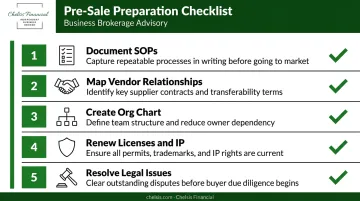
- Document standard operating procedures for key functions
- Map out critical vendor relationships and contracts
- Create an organizational chart showing who covers what
- Ensure all licenses, permits, and IP registrations are current
- Resolve any pending legal issues before going to market
Undocumented processes, expired licenses, and owner-dependent operations consistently surface as deal-killers during due diligence — and they're all preventable with early preparation.
Address Confidentiality and Maintain Performance
A drop in revenue mid-sale is one of the fastest ways to lose a deal or watch your offer price fall. Buyers track business performance throughout the process — not just at the point of initial offer.
Three practices protect both your deal and your business while the sale is in progress:
- Keep operations running at full strength — buyers monitor performance after the initial offer
- Avoid tipping off employees or customers before the deal is closed
- Require signed non-disclosure agreements before sharing any business information
Build a Transition Plan
A credible transition plan directly increases buyer confidence — and buyer confidence drives valuation. Options include:
- Empowering existing key staff to carry operational responsibility
- Hiring a manager before listing to reduce owner dependency
- Committing to a defined post-sale consulting period (Chelsis Financial typically structures 30 days of availability with options for longer arrangements on more complex businesses)
How to Value Your Business
Business owners frequently get valuation wrong — either overvaluing based on emotional attachment or undervaluing by ignoring intangible assets like brand reputation, customer loyalty, and recurring revenue contracts. Both mistakes cost real money.
The Four Primary Valuation Methods
The SBA recognizes three core approaches to business valuation:
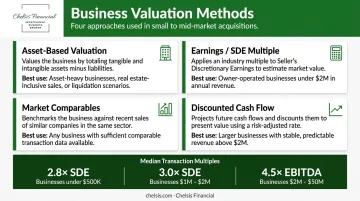
| Method | How It Works | Best For |
|---|---|---|
| Asset-Based | Total assets minus liabilities | Asset-heavy businesses |
| Earnings/SDE Multiple | Adjusted profit × market multiplier | Owner-operated small businesses |
| Market Comparables | Benchmarked against recent similar sales | Businesses with strong comparable data |
| Discounted Cash Flow | Projects future earnings, discounts to present value | Growth-stage or high-margin businesses |
For small businesses, the SDE multiple is most common. IBBA's Market Pulse Q1 2025 reported median multiples of 2.8x SDE for businesses under $500K and 3.0x SDE for businesses in the $1M–$2M range. Larger transactions in the $2M–$50M range transact closer to 4.5x EBITDA.
Key Value Drivers to Strengthen Before Selling
- Recurring revenue (predictable cash flow commands premium multiples)
- Diversified customer base (no single customer over 10–15% of revenue)
- Documented systems and processes
- Key employee retention
- Protected intellectual property
Get a Professional Valuation
Once you've identified the value drivers worth strengthening, you need a number you can actually defend. Self-valuing is a mistake: emotion skews the result, and an unsupported asking price invites aggressive counters from buyers. A professional, third-party valuation gives you a credible position in negotiations — one buyers can't easily dismiss.
Chelsis Financial offers a Complimentary Assessment of Value, fully confidential and at no charge, that reviews your financials and provides independently validated guidance on what your business is worth before you commit to anything. Schedule a call at calendly.com/chelsis/getanswers.
The Complete Step-by-Step Process for Selling Your Business
Every sale has its own variables, but the core sequence follows a predictable path. Here's how it typically unfolds.
Step 1: Choose Your Sale Method and Hire Your Advisory Team
Your options for selling:
- Direct sale to a known buyer (simple, but limited buyer pool)
- Public marketplace listing (broad exposure, lower confidentiality)
- Business broker (handles marketing, screening, confidentiality, and negotiation)
- Merger or ESOP (complex structures, best for larger or employee-owned transitions)
For most small to mid-market business owners, working with a broker delivers the best outcome. BizBuySell notes broker commissions typically run 10–15% of the final sale price — but the investment generally yields a better net result than a DIY sale, particularly when it comes to negotiating deal structure and protecting confidentiality.
Your full advisory team should include: an M&A advisor (your broker), a transaction attorney, a CPA, and ideally a wealth manager to plan for post-sale proceeds. Chelsis Financial works with sellers across Indiana and the broader Midwest — spanning manufacturing, industrial services, technology, healthcare, and automotive sectors — and can help assemble or coordinate this team from the start.
Step 2: Prepare Marketing Materials and Protect Confidentiality
Three core documents move the process forward:
- Investment Teaser — An anonymous business overview sent to prospects before any NDA is signed. Describes the business without revealing identity.
- NDA — Must be executed before any financial details are shared. Non-negotiable.
- Confidential Information Memorandum (CIM) — The full business story: operations, financials, growth opportunities, and management overview. Chelsis Financial prepares this on behalf of sellers as part of their marketing and deal packaging service.
Step 3: Screen Buyers and Review Offers
Not every interested party is a qualified buyer. When evaluating prospects, ask about:
- Source of capital and proof of funds
- Prior acquisition experience
- Post-sale intentions for the business and its employees
Serious buyers will submit an Indication of Interest (IOI) — a non-binding preliminary offer — followed by a Letter of Intent (LOI), which outlines key deal terms and typically includes an exclusivity period. The LOI narrows the field to one qualified buyer before formal due diligence begins.
Step 4: Navigate Due Diligence and Negotiate the Deal
Due diligence is where deals get made or broken. Buyers will examine:
- Financial statements and tax returns (3–5 years)
- Customer and supplier contracts
- Lease agreements
- Employee compensation and agreements
- IP ownership and protection
- Pending litigation or compliance issues
Sellers who arrive at this stage organized move faster and negotiate from strength. According to Axial, non-QoE diligence surprises caused 25.3% of broken LOIs in 2025 — meaning preparation directly prevents deal failure.
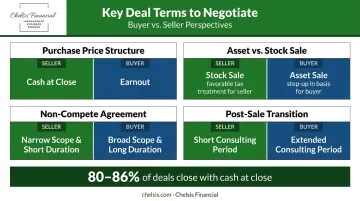
Key deal terms to understand and negotiate:
- Purchase price structure: cash at close vs. seller financing vs. earnouts
- Asset sale vs. stock sale: significant tax implications for both parties
- Non-compete agreements: scope, duration, and geography matter
- Post-sale transition responsibilities: tied to buyer confidence and sometimes earnout conditions
IBBA data shows 80–86% of deals close with cash at close across most deal sizes, with seller financing appearing in 9–17% of transactions depending on the price tier.
Step 5: Close the Deal and Manage the Transition
Closing involves finalizing contracts with legal counsel, satisfying contingencies, transferring licenses and permits, and exchanging funds. Your attorney handles the documentation; your broker coordinates the moving parts.
Post-close transition typically includes:
- Training the new owner on operations and key relationships
- Introducing them to major customers, vendors, and staff
- Transferring digital assets, system access, and IP
- Fulfilling any agreed consulting period
A well-managed transition supports any earnout conditions, reduces operational disruption for staff and customers, and gives the business the best chance of performing well under new ownership.
Common Mistakes to Avoid When Selling Your Business
Waiting too long. The best time to sell is when business is strong and trending upward. Selling under financial distress, declining revenue, or failing health eliminates negotiating leverage. If you're healthy and the business is performing well, that's the window — don't wait for circumstances to force the decision.
Neglecting confidentiality. Premature disclosure causes concrete damage: employees look for new jobs, customers worry about continuity, and competitors capitalize on the uncertainty. Using NDAs consistently and working with a discreet broker are the two most effective protections.
Letting the sale process distract you from running the business. A performance dip mid-sale is one of the most common reasons buyers reduce offers or walk away entirely. Delegate the sale process to an experienced broker so you can stay focused on operations — that separation is what keeps deals on track.
Frequently Asked Questions
What is the best way to sell a small business?
The best approach depends on size and complexity, but most small business owners get better outcomes working with a business broker. A broker handles valuation, buyer screening, confidentiality, and negotiation — so you can keep running the business while the sale moves forward.
How long does it take to sell a small business?
IBBA's Market Pulse Q1 2025 reported total time to close of 8 months for deals under $500K and 10–11 months for larger transactions. Preparation can begin 1–2 years before listing; due diligence complications, financing delays, or disorganized records are the most common reasons deals take longer.
How do I determine what my business is worth?
Valuation typically uses one of three methods: asset-based, earnings/SDE multiple, or market comparables. For a reliable, defensible number, work with a professional appraiser or broker rather than self-assessing — Chelsis Financial offers a Complimentary Assessment of Value as a starting point.
Do I need a business broker to sell my business?
You don't need one, but most owners achieve better outcomes — higher price, shorter timeline, stronger confidentiality — with an experienced broker who has an established buyer network. The commission cost is typically recovered through better deal terms and price.
What documents are needed to sell a business?
Core documents include:
- 3–5 years of financial statements and tax returns
- Signed NDA and investment teaser
- Confidential Information Memorandum (CIM)
- Letter of Intent (LOI)
- Final purchase/sale agreement reviewed by a transaction attorney
What are the tax implications of selling a business?
The IRS treats a business sale as the sale of individual assets — capital assets generate capital gains, while inventory generates ordinary income. Sale structure (asset vs. stock) significantly affects total tax liability, so consult a CPA before finalizing terms. Both parties must also file IRS Form 8594 for asset allocation.