
Most business owners underestimate what that process actually involves. Without a professional intermediary, sellers face emotional blind spots that distort pricing, limited access to qualified buyers, confidentiality risks that can destabilize operations, and a workload that pulls focus away from running the business at exactly the wrong moment.
This guide explains how selling a business with a broker works — from the first valuation conversation through closing — including what drives outcomes, what to look for in a broker, and what common misconceptions can cost you.
TL;DR
- A business broker manages the full sale: valuation, marketing, buyer screening, negotiation, and closing
- The process typically runs 6–12 months, following a defined sequence where each stage builds on the last
- Broker commissions typically run 10–15% for businesses sold between $100K–$1M, with negotiated tiers above $1M
- Selling with a broker gives you confidentiality, access to a vetted buyer pool, and negotiation support you won't have going it alone
- Vet any broker for industry experience, a proven buyer network, and clear fee terms before signing
What Does a Business Broker Do?
A business broker is a professional intermediary who represents the seller in the private sale of a business — managing every stage from valuation through the transfer of ownership.
According to the IBBA, a business broker acts as the seller's advocate throughout the transaction — protecting confidentiality, qualifying buyers, and keeping the deal on track from first contact to closing.
Core Responsibilities
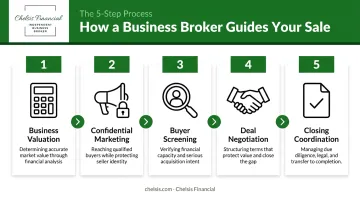
A broker typically handles:
- Sets a defensible asking price using financials, market comparables, and industry benchmarks
- Markets the business confidentially, reaching pre-screened buyers without revealing the seller's identity
- Screens buyers for financial capacity and genuine acquisition intent before sharing sensitive details
- Structures price, payment terms, and deal protections on the seller's behalf
- Coordinates closing across attorneys, CPAs, lenders, and escrow agents through the final stages
Chelsis Financial, a Midwest-based business brokerage firm, provides all of these services in-house while coordinating with specialized legal and accounting professionals for the transaction's final phase.
Business Broker vs. M&A Advisor
Not every deal calls for a business broker. The right representation depends on deal size and complexity:
- Business brokers typically handle businesses valued under $2M, per IBISWorld
- M&A advisors handle lower middle market transactions — generally $2M to $50M in enterprise value
- Some firms, including Chelsis Financial, operate across both segments, covering small and lower mid-market transactions depending on complexity
Why Sell Your Business with a Broker Instead of Going It Alone?
Most owners who attempt a solo sale underestimate what they're walking into. Three risks tend to derail FSBO transactions — and each one compounds the others.
Mispricing
Business owners who sell without professional help tend to either undervalue their company — leaving real money on the table — or overprice it, which repels serious buyers.
When a business sits overpriced, the market takes notice. Buyers grow skeptical, price reductions signal distress, and meanwhile employees start looking elsewhere, revenue softens, and the business's actual value erodes.
In our experience, owners who close quickly on their own frequently accept below-market terms — and if the deal wasn't properly structured, they may carry legal exposure they won't discover until months later.
Confidentiality Risks
The IBBA warns that lack of confidentiality can hurt employees, unsettle customers, and damage the business's financial performance. BizBuySell goes further, noting that premature disclosure can cause employees to seek other opportunities, lead vendors to question the business's stability, and hand competitors valuable intelligence.
Brokers manage this through non-disclosure agreements signed before any business details are shared, staged information release, and marketing approaches designed to protect the seller's identity until a qualified buyer is properly vetted.
Time and Workload
FSBO sellers should expect to dedicate 10–15 hours per week to the sale process — covering advertising, buyer screening, due diligence, negotiations, deal structure, and legal matters — all while running the business. That workload creates operational decline at exactly the moment buyers are scrutinizing performance most closely.
A broker absorbs most of that burden, keeping the owner focused on revenue stability and operational consistency through closing.
How Selling Your Business with a Broker Works: Step by Step
The full process typically takes 6–12 months, with BizBuySell reporting a median time on market of around 200 days. Each stage builds on the one before it.
Step 1: Business Valuation
The process begins with a formal assessment of the business's value. The three primary approaches are:
- Income-based: applies a multiple to Seller's Discretionary Earnings (SDE) or EBITDA; most common for owner-operated businesses
- Market-based: compares against recent sales of similar businesses in the same industry and geography
- Asset-based: values tangible assets including equipment, fixtures, and inventory, used as a floor
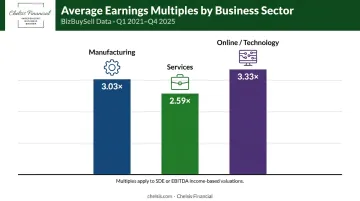
Industry earnings multiples vary meaningfully. BizBuySell's data from Q1 2021 through Q4 2025 shows averages of 3.03x for manufacturing, 2.59x for services, and 3.33x for online/technology businesses.
Chelsis Financial offers a Complimentary Assessment of Value for sellers — a no-cost starting point that reviews three years of financials and produces a market-informed asking price before going to market. All consultations are held in strict confidence.
Step 2: Preparing the Business for Sale
Preparation directly affects how smoothly a deal moves and how strong offers come in. Before listing, sellers should have ready:
- Three years of P&Ls, balance sheets, and tax returns — fully reconciled
- A current org chart with documented key roles and responsibilities
- Revenue breakdown by customer and product or service line
- All lease agreements, vendor contracts, and employee compensation structures
- A virtual data room (not just a shared Google Drive folder) for managing document access
Prepared sellers close. Unprepared sellers struggle. Disorganized financials are the single most common reason deals stall or fall apart entirely.
Step 3: Confidential Marketing to Qualified Buyers
Once prepared, the broker creates a Confidential Business Review — a professional marketing package that includes financial snapshots, business descriptions, growth opportunities, and an ideal buyer profile. This document is only shared after a buyer signs an NDA.
Chelsis Financial promotes listings through targeted outreach to pre-vetted buyer networks, online marketplaces, and industry channels, while also drawing on its registry of buyers across the Midwest — including individual owner-operators, established companies seeking expansion, and private equity groups.
Step 4: Buyer Screening, Offers, and Negotiation
Not every interested party is a qualified buyer. Brokers verify financial capacity and intent before sharing sensitive details. Once qualified, buyers submit Letters of Intent (LOIs) — which the broker then negotiates on the seller's behalf.
Key deal elements negotiated at this stage include:
- Sale price and structure — cash at close, seller financing, or a combination
- Seller financing terms — Chelsis Financial commonly recommends 10–30% seller financing over 3–5 years, which can bridge funding gaps and often yields a higher headline price
- Earnout provisions — tying a portion of the price to future performance milestones
- Transition period — typically 30 days to 6 months of post-close support from the seller
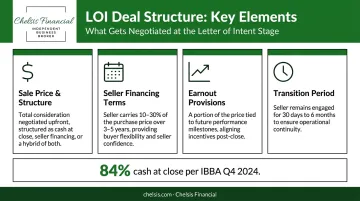
Per IBBA/M&A Source Q4 2024 data, sellers received approximately 84% cash at close, with seller financing accounting for 15% or less in most deals.
Step 5: Due Diligence and Closing
Once an LOI is accepted, the buyer enters due diligence — typically 30–60 days — verifying all financial, legal, and operational claims made during the sale process.
The broker's role during this phase includes:
- Organizing and managing the data room so documents reach the right parties efficiently
- Coordinating weekly check-ins between all parties to maintain momentum
- Managing communication between attorneys, CPAs, lenders, and escrow agents
- Keeping the deal on track — because time kills deals, and delayed closings cost real money
From accepted LOI to final close, most deals land in the 60–90 day range — assuming due diligence stays on schedule and both parties remain responsive.
How to Choose the Right Business Broker
Not all brokers are equal. The difference between a well-run process and a failed listing often comes down to who's managing it.
Credentials to Look For
- Certified Business Intermediary (CBI) — issued by the IBBA, requiring completed coursework, a passed exam, and three verified closed deals as lead seller broker
- IBBA membership — the largest international nonprofit association focused exclusively on business brokerage
- Demonstrated industry track record — ask specifically about closed deals in your sector within the last 12 months
Fee Structure Red Flags
According to BizBuySell, the most common commission range is 10–15% for businesses sold between $100K and $1M. For sales above $1M, tiered structures are common — for example, 10% on the first $1M and 8% on the remainder.
Be cautious of brokers who charge large upfront retainers before delivering results — you're absorbing the risk before they've proven their value. Reputable firms typically work on a success-fee basis, meaning they get paid when the deal closes.
Questions to Ask Before Signing
- How many businesses like mine have you sold in the last 12 months?
- Who has been buying businesses in my industry?
- What percentage of your listings result in a closed sale?
- How do you maintain confidentiality throughout the process?
- What does your buyer network look like — size, type, and how buyers are qualified?
The answers to these questions will tell you a lot — but so will the conversation itself.
The Fit Factor
The seller-broker relationship typically runs 6–12 months. Credentials matter, but so does communication style, honest pricing expectations, and whether the broker tells you what you need to hear — not just what you want to hear. Chelsis Financial centers its process on exactly that: market-informed valuations, a vetted buyer network, and straight talk from the first conversation through closing.
Key Factors That Affect the Sale Outcome
Financial Documentation Quality
Buyers and their advisors will scrutinize revenue trends, margins, cash flow consistency, and the cleanliness of records. Clean, well-organized financials across three or more years show a business that runs predictably, which translates into stronger offers and fewer renegotiations at the table.
Business Transferability
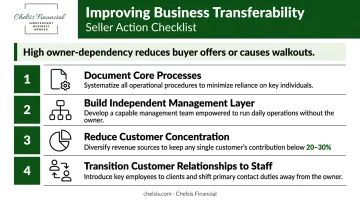
When a business can't function without its owner — because the owner holds every key relationship, makes every decision, and can't be replaced without disruption — buyers discount the price or walk away entirely.
Reducing transferability risk before going to market makes a measurable difference:
- Document all core processes so they can survive the owner's exit
- Build a management layer that can operate independently
- Reduce customer concentration — anything above 20–30% with a single client is an underwriting concern
- Transition customer relationships to staff before the sale process begins
Market Timing and Deal Structure
BizBuySell reported 2,599 closed transactions in Q3 2025 — up 8% year-over-year — with businesses selling at 94% of asking price in 2025. The $1M–$2M segment was viewed as a favorable seller's market by 57% of respondents in the IBBA/M&A Source Q2 2025 survey.
Strong market conditions create opportunity — but they don't guarantee a good outcome on their own. A seller who understands the difference between a cash-at-close offer and an earnout-heavy structure can evaluate what each actually means for realized proceeds, not just headline price.
Common Misconceptions About Selling a Business with a Broker
"The broker sets the price." The broker provides a market-based valuation recommendation. The seller decides the asking price. Brokers who inflate valuations to win the listing create a worse outcome: no serious buyers, eventual price reductions, and a listing that goes stale.
"Once I hire a broker, I can step back entirely." Sellers remain essential throughout. They provide documents, participate in buyer meetings, and make final decisions on offers. The broker handles execution — the owner drives the key decisions.
"A faster sale means a better sale." A well-run process that generates competitive buyer interest produces better terms than accepting the first offer to close quickly. A broker focused on process — not just a fast commission — will consistently deliver better outcomes.
Frequently Asked Questions
How much do business brokers charge to sell a business?
The most common range is 10–15% of the final sale price for businesses sold between $100K and $1M, paid at closing. For larger transactions, tiered structures are common. Some brokers charge upfront retainers, though success-fee-only arrangements are standard among many reputable firms.
Should I use a business broker to sell my business?
For most owners — especially first-time sellers, those without a buyer already lined up, or anyone who needs confidentiality — a broker's valuation expertise, buyer network, and negotiation support typically produce a better outcome than selling independently.
How much is a business worth with $500,000 in annual sales?
Valuation depends on profitability, not revenue. A business with $500K in sales might be worth significantly more or less depending on its margins and SDE. Industry averages from BizBuySell show multiples ranging from 2.59x (services) to 3.33x (online/tech) — only a valuation based on your actual financials gives you a defensible number.
How can I minimize capital gains tax when selling a business?
Talk to a tax advisor before closing — not at closing. Strategies like structuring as an installment sale (per IRS Publication 537), asset vs. stock sale classification, and Qualified Small Business Stock (QSBS) exemptions under Section 1202 can reduce your tax liability significantly.
How long does it take to sell a business with a broker?
Most sales take 6–12 months from initial valuation to closing, with a median of around 200 days on market. Timeline varies based on documentation readiness, industry conditions, and buyer demand.
What documents do I need to prepare when selling my business?
Core requirements include: three years of financial statements and tax returns, a current balance sheet, a statement of seller's discretionary earnings, an asset list, key customer and supplier contracts, and any existing lease or employment agreements.