

That's the cost of timing a valuation wrong.
Getting valued before selling isn't just about knowing a number — it's about having enough time to act on what that number reveals. The 18-month window is where meaningful change is still possible. This article explains why that timing matters, what it lets you fix, when to move earlier or later based on your situation, and what it costs to wait.
TL;DR
- An 18-month pre-sale valuation is a strategic roadmap that lets you fix problems before buyers find them.
- The most common deal-killers — owner dependency, messy financials, customer concentration — are fixable with time but become price cuts under scrutiny.
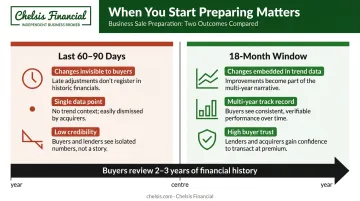
- Buyers review 2–3 years of financial history; improvements made in the final weeks before listing carry little credibility.
- Only 20–30% of businesses that go to market actually sell, according to the Exit Planning Institute. Preparation is what separates the ones that close.
- A complimentary pre-sale assessment is the lowest-risk first step for any owner thinking about an eventual exit.
Why Timing Matters: The Case for Getting Valued 18 Months Early
Most business owners treat a valuation like a final step — something to do once they've mentally checked out and are ready to hand over the keys. By that point, the valuation isn't a planning tool. It's an audit of missed opportunity.
A valuation done 18 months before a planned sale gives you findings you can act on. A valuation done at the time of listing just tells you what you can no longer fix.
The Financial History Problem
Buyers don't evaluate businesses on last month's numbers. Financial due diligence standards call for reviewing at least 2–3 years of historical financial statements plus trailing 12 months — and the U.S. Chamber of Commerce advises buyers to request 3–5 years of tax returns. This means:
- Changes made in the final 60–90 days before listing are invisible in the trend data buyers rely on
- Improvements embedded over 12–18 months show up in the trend data buyers trust
- A single strong year doesn't overcome two years of erratic or undocumented results
The Readiness Gap Is Wider Than Most Owners Think
The Exit Planning Institute's 2023 National State of Owner Readiness report found that 49% of owners plan to exit within five years, yet 31% have given only some or little attention to their exit strategy, and just 42% have a formal written transition plan. That gap between intent and preparation is where sellers routinely accept less than their business is worth.
External market timing — interest rates, buyer activity, industry consolidation — can't be controlled. Internal readiness can. The 18-month window positions you to capitalize on favorable conditions when they arrive, rather than accepting the market as you find it.
What the 18-Month Window Allows You to Fix
The real value of an early valuation isn't the dollar figure — it's the prioritized list of improvements it surfaces. Not everything needs fixing; a good assessment identifies the highest-impact changes for the time available.
Owner Dependency
When a business can't function without its owner, buyers notice immediately. Buyers are highly risk-averse about this, and the more indispensable an owner is, the harder the business is to sell and the less it's worth.
An 18-month runway gives you time to:
- Hire or promote managers who can handle daily operations
- Document processes that currently live in your head
- Ensure key customer relationships have a second point of contact
- Demonstrate operational continuity through a complete performance cycle
One pattern Chelsis Financial has seen work well: an owner brings in professional management and transitions to an oversight role well before the listing — demonstrating to buyers that the business runs independently. Buyers who see that shift documented across a full operating cycle tend to bid higher and negotiate less.
Financial Record Cleanup
Clean financials aren't just about optics — they're the foundation of buyer confidence and lender approval.
Common problems that surface during pre-sale reviews include:
- Personal expenses mixed into business accounts
- P&L statements and tax returns that tell different stories
- Inconsistent or undocumented add-backs in SDE calculations
- Operating from spreadsheets or outdated desktop software
In Chelsis Financial's experience, disorganized financial records are the single most common reason deals stall or collapse. Migrating to cloud-based accounting (such as QuickBooks Online) before listing isn't cosmetic — it allows a buyer's CPA to verify numbers in minutes rather than days, which accelerates the deal and cuts days off due diligence.
Three years of clean, reconciled financials take time to build. You can't manufacture that track record in six weeks.
Customer Concentration and Structural Risk
High customer concentration is one of the most common and most damaging valuation problems in small to mid-market businesses. Chelsis Financial applies a clear benchmark: no single customer should represent more than 10–15% of total revenue.
The consequences scale with concentration:
| Concentration Level | Buyer Response |
|---|---|
| Under 10–15% | Manageable concern |
| 20–30% | Expect buyer protections or price adjustment |
| 40–50% | Deal structure changes or significant discount |
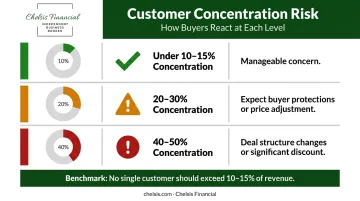
In one documented case, a company with nearly 50% of revenue tied to four accounts faced a 30% reduction in offer price. Eighteen months gives time to diversify the customer base, formalize contracts with key accounts, and reduce that exposure before it becomes a negotiation liability.
Value Enhancement Beyond Problem-Fixing
The 18-month window isn't only about removing discounts — it's also about earning better multiples. Proactive moves that buyers reward:
- Formalizing recurring revenue contracts (subscriptions, service agreements, retainers)
- Documenting proprietary processes and systems
- Building a clear competitive differentiation story
- Establishing an organizational chart that shows the team buyers are actually acquiring
When to Get a Business Valuation Based on Your Situation
Eighteen months is a strong general guideline, but the right timing depends on where you are — in your exit plan, your business cycle, and your personal circumstances.
Based on Your Exit Timeline
Within 2–3 years of a planned exit: Act now. Every month of preparation lead time is precious, and the window for meaningful change narrows quickly as you approach your target date.
Five or more years out: Use annual valuations as a strategic scorecard. They track whether operational decisions are building or eroding value over time. When the exit window opens, you'll enter it with momentum rather than scrambling to catch up.
Based on Business Health
Business is performing well: This is the ideal time to get valued and move toward market. Businesses are valued on recent trends, and entering the sale process during an upswing produces stronger multiples than waiting for performance to plateau.
Business is in a dip: A valuation is urgent. You need to understand whether the decline is recoverable before buyers see a downward trend in the data. Buyers discount declining businesses heavily. Knowing early whether recovery is realistic determines whether you prepare to sell, stabilize, or pivot strategy entirely.
Based on Ownership Circumstances
Beyond timelines and performance, some circumstances make a valuation urgent regardless of where you are in your planning:
- Partnership disputes or co-owner buyout discussions — an independent valuation establishes a defensible baseline that protects everyone's interests
- Health events or unexpected life changes — EPI data shows 50% of U.S. business exits are forced by the "5 Ds": death, disability, divorce, distress, and disagreement
- Unsolicited acquisition approaches — nearly 1 in 3 owners receive an unsolicited offer in any given year; without a valuation, you're negotiating blind
Signs It's the Right Time for a Pre-Sale Valuation
Some signals are obvious. Others are easy to rationalize away.
Life and business signals that warrant action:
- You're thinking seriously about retirement or a major life change
- A competitor has approached you about an acquisition
- You find yourself mentally stepping back from the business more than you used to
- A key partner, co-owner, or family member is changing their involvement
Performance-based signals that favor moving now:
- Two or more consecutive strong years
- Revenue spread across multiple customers (no single dominant account)
- Documented systems and processes in place
- A management team that doesn't depend entirely on you
Those performance conditions impress buyers. Getting valued while they hold locks in a strong baseline before market conditions shift.
Ask yourself: "Could I walk away from this business in 18 months at full value?" If the answer is uncertain, a professional valuation will tell you exactly why — and what to fix before you go to market.
Chelsis Financial's Complimentary Assessment of Value is a no-commitment starting point. It covers your financial performance across three to four years and gives you an honest baseline with enough runway to act on it. You can schedule a confidential call at calendly.com/chelsis/getanswers.
What Happens When You Wait Too Long
Problems Discovered Too Late to Fix
When valuation issues surface during buyer due diligence — owner dependency, disorganized financials, customer concentration, undocumented cash — there is no time to resolve them. Buyers either walk away or use the discoveries as leverage to renegotiate the price. What could have been addressed in 12 months becomes a concession negotiated in 12 days.
The Timeline Math Works Against Late Starters
BizBuySell's 2025 market data shows the median time to close a small business sale is 170 days — nearly six months after a deal is agreed. Manufacturing businesses averaged 223 days.
Add 60–90 days of due diligence, several weeks to find a qualified buyer, and time to prepare marketing materials — and the actual runway from "ready to list" to "closed" is closer to 12 months in an active market.
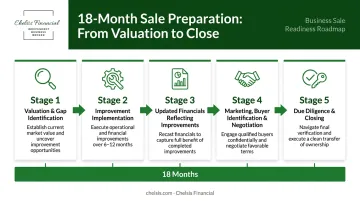
That leaves no margin for fixing anything that surfaces. The 18-month window accounts for:
- Valuation and gap identification
- Improvement implementation (6–12 months)
- Updated financials reflecting those improvements
- Marketing, buyer identification, and negotiation
- Due diligence and closing
The Financial Cost of Waiting
That compressed timeline has a direct price tag. Owners who go to market unprepared often walk away with less than their business is worth — not because the business failed, but because the timing did. Buyers who spot problems during diligence don't absorb them; they discount for them.
The stakes go beyond price. Only 20–30% of businesses that go to market actually close a sale. For owners who didn't prepare, the cost of waiting isn't a lower number on the closing statement. It's walking away with nothing.
Best Practices for Timing and Using Your Business Valuation
Three principles separate sellers who get full value from those who leave money on the table:
- Use it as a roadmap, not a report. Identify the 3–5 highest-impact improvements available before listing, prioritize them, and measure progress. A strong pre-sale valuation delivers specific recommendations — not just a number.
- Update it annually. A single valuation done 18 months out goes stale if your timeline extends. Business values shift as operations improve, markets move, or new risks emerge. Annual check-ins keep the preparation plan current.
- Work with advisors who understand the full exit journey. Valuation, financial preparation, and buyer matching are interconnected. The improvements you make should reflect what buyers in your specific market actually care about — not a generic checklist.

Chelsis Financial provides confidential, comprehensive support from initial valuation through closing, with access to a qualified buyer network and over 2,000 business connections in Indiana and the broader Midwest. The firm's work is built on one consistent finding: sellers who enter the process prepared — with clear financials, a realistic valuation, and time to act on it — consistently achieve better outcomes than those who don't.
Frequently Asked Questions
How do you value a business before selling?
Valuing a business before selling involves applying recognized methods — earnings multiples (SDE or EBITDA), discounted cash flow, or asset-based approaches — to normalized financial data covering at least three years. Professional guidance ensures the methodology matches your business size and that add-backs are documented in a way buyers and lenders will accept.
Is a business worth three times its profit?
The "3x profit" rule is a rough starting point. In practice, businesses under $500K typically trade around 2.0x SDE; the $1M–$2M range averages 3.0x SDE; and lower-middle-market deals ($2M–$5M) land closer to 4.1x EBITDA. Industry, growth rate, owner dependency, and revenue predictability all move the final number.
How far in advance should I get a valuation before selling?
Eighteen months is the right window — early enough to act on findings and implement meaningful improvements, but recent enough that the results reflect current business performance by the time you list. Owners within two to three years of a planned exit should treat this as urgent.
What problems does a pre-sale valuation typically uncover?
The most common issues are owner dependency, commingled personal and business expenses, inconsistent financial records, customer concentration above 10–15% with a single client, and informal processes or verbal agreements that buyers can't evaluate or underwrite.
Does getting a valuation mean I have to sell?
No. A business valuation is a planning tool, not a commitment. Many owners use periodic assessments to track whether their decisions are building or eroding value, and to ensure they can exit on their own timeline when the right conditions arrive.
How long does it take to improve a business's value before selling?
Meaningful, buyer-credible improvements — cleaner financials, reduced owner dependency, formalized contracts — typically require 12–18 months to show up in the verifiable track record buyers rely on.