
According to the Exit Planning Institute, only 20–30% of businesses that go to market actually sell. That's not a market problem — it's a preparation and process problem.
A transaction advisor exists to close that gap. They manage the full arc of a business sale: establishing value, finding qualified buyers, running a competitive process, and negotiating terms that protect what the owner has built. This post breaks down exactly what that looks like — and when to start.
TL;DR
- A transaction advisor manages the entire sale process so owners can stay focused on running the business
- Advisors bring a vetted buyer network, realistic pricing, and negotiation leverage that most owners can't replicate solo
- Engaging an advisor 3–5 years before your target exit gives you the best chance of maximizing value
- The right advisor serves as strategic coordinator, deal manager, and confidential intermediary in one
What Is a Transaction Advisor?
A transaction advisor is a specialized professional who guides business owners through the process of selling or transferring their company. The title shifts depending on deal size:
- Business broker — typically for deals under $2 million
- M&A advisor — for deals in the $2M–$50M range
- Investment banker — for larger, more complex transactions
The IBBA defines these professionals as intermediaries who assist buyers and sellers of privately held businesses throughout the transfer process. For the lower-to-mid-market segment — where most small and mid-sized business owners operate — a business broker handles the full advisor role.
How a Transaction Advisor Differs from Other Deal Professionals
Many business owners assume a CPA, attorney, or financial planner can fill this role. In practice, each serves a distinct function and none manages the full sale process on their own.
| Advisor | Primary Role |
|---|---|
| Transaction Advisor | Leads the sale process end-to-end |
| CPA / Accountant | Tax planning, financial statements, deal structure modeling |
| Attorney | Purchase agreement, representations and warranties, legal risk |
| Wealth Advisor | Post-sale financial planning and investment strategy |
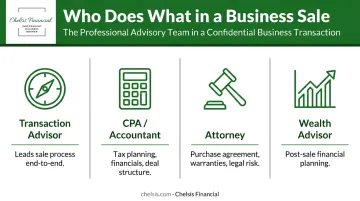
The transaction advisor is the lead coordinator. They manage the process, protect confidentiality, and keep every other professional working toward the same closing date.
Chelsis Financial serves this coordinator role for business owners across the Midwest, bringing market knowledge, a qualified buyer registry, and direct deal management from initial valuation through closing.
Core Responsibilities of a Transaction Advisor
Valuation and Business Positioning
The first task is establishing a realistic, market-informed value for the business. This isn't a formal certified appraisal — it's a commercially oriented analysis focused on what a willing buyer would actually pay today.
Per Q1 2026 Market Pulse data, current valuation benchmarks by deal size include:
- Under $500K: 2.0x SDE
- $500K–$1M: 2.8x SDE
- $1M–$2M: 3.0x SDE
- $2M–$5M: 4.0x EBITDA
- $5M–$50M: 5.1x EBITDA
Multiples vary significantly by industry. IT services businesses trade at higher multiples than restaurants or auto repair shops. An advisor who knows these benchmarks can position your business accordingly — and identify gaps between where the business trades today and where it could trade with preparation.
Confidential Marketing to Qualified Buyers
Once valuation is established, the advisor prepares a Confidential Information Memorandum (CIM) — a professionally structured package covering the business's financials, operations, competitive position, and growth opportunity.
This process runs entirely before the seller's identity is disclosed. Chelsis Financial's process requires buyers to execute a confidentiality agreement before any sensitive information is shared. This protects:
- Employees who don't yet know a sale is being considered
- Customer relationships that could be disrupted by early disclosure
- Competitive positioning if rivals learn the business is for sale
The firm markets to its buyer registry — which includes over 2,000 business contacts in Indiana and across the Midwest — targeting buyers based on acquisition criteria, financial capacity, and industry fit.
Buyer Screening and Process Management
Not every interested party deserves access to your financials. A transaction advisor screens inquiries based on financial qualification, strategic fit, and seriousness — filtering out unqualified prospects early.
Beyond screening, the advisor manages the structured sale process:
- Coordinating site visits and management meetings
- Managing data room access
- Setting LOI deadlines to maintain deal momentum
- Keeping multiple interested parties engaged simultaneously
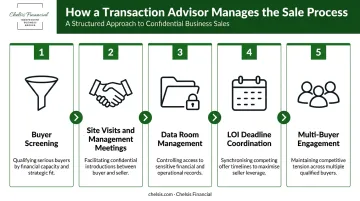
When buyers know they're competing, offers improve. When an owner negotiates alone with a single known buyer, that leverage disappears entirely.
Negotiating Terms Beyond Price
Price is one variable. Deal structure is the rest. A transaction advisor negotiates:
- Asset vs. stock sale — with very different tax implications for each
- Payment structure — lump sum, earnout, or seller financing
- Representations and warranties — statements of fact that carry legal risk post-close
- Non-compete terms and transition period length
An experienced advisor acts as the buffer between buyer and seller — preserving the working relationship through close while still advocating hard on every deal point. Chelsis Financial helps owners understand how their priorities — whether a clean exit or a structured multi-tranche arrangement — should shape the deal from the start.
Managing Due Diligence Through to Closing
Due diligence is where deals die. Buyers conducting financial, operational, legal, and sometimes environmental reviews will surface anything that wasn't disclosed upfront — and use it as leverage to renegotiate or walk away.
An advisor prepares the seller in advance by assembling a diligence-ready file that includes:
- Three years of financial statements and tax returns
- Owner benefit analysis and add-backs
- Lease agreements and vendor contracts
- Employee rosters and compensation structures
- Customer concentration and retention data
- Transition support plans
Chelsis Financial coordinates this entire process, working alongside the seller's CPA and attorney to keep documentation organized, issues resolved, and the deal moving toward close.
How Transaction Advisors Maximize Business Value
A transaction advisor's job is to increase what a buyer pays — and just as importantly, what the seller keeps.
Pre-Sale Preparation
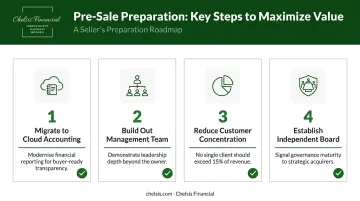
M&A Source's two-year preparation framework outlines preparation areas that can improve sale outcomes: cleaning up financials, reducing customer concentration, developing key employees, and building systems that don't depend on the owner's daily involvement.
Experienced advisors consistently recommend owners take action well in advance of a desired sale timeline. Specific steps include:
- Migrating to cloud-based accounting (QuickBooks Online) to improve diligence confidence
- Building out a management team — bringing in a CFO or COO where the business size justifies it
- Addressing customer relationship dependencies before going to market
- Creating an independent board to demonstrate long-term business continuity
Competitive Tension
When a potential buyer knows they have no competition, they make weaker offers with more punitive terms. A transaction advisor solves this by running a structured process that engages multiple qualified buyers simultaneously — creating the competition that drives pricing up and protects deal terms.
Tax and Structure Optimization
After-tax proceeds matter more than the headline sale price. Chelsis Financial coordinates with each seller's tax professional to ensure deal structure aligns with the owner's financial goals. That means modeling key variables before accepting any offer:
- Asset vs. stock sale implications
- Purchase price allocation
- Seller financing terms and their tax treatment
When Should You Engage a Transaction Advisor?
The Ideal Window: 3–5 Years Out
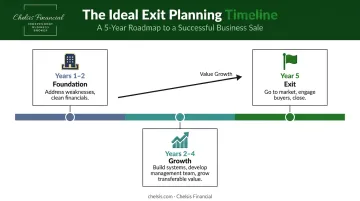
Edward Jones recommends that business owners get a calculation of value at least three to five years before their planned exit. That timeline creates room to:
- Address weaknesses that would reduce the sale price
- Build transferable systems that don't depend on the owner
- Prepare financials that will hold up to buyer scrutiny
- Execute preparation strategies that increase the multiple buyers will pay
When an Exit Is 12 Months Away
Not every owner has three to five years — and advisors can still add meaningful value on a compressed timeline, rapidly assessing the business, preparing marketing materials, and activating buyer networks.
But compressed timelines reduce options. Pricing strategy becomes the primary lever when time is short, and sellers typically have little room to fix the issues buyers will surface in due diligence.
Trigger Events Worth Acting On
Several circumstances signal it's time to at least start the conversation:
- Approaching retirement or a desire to diversify personal wealth
- An unsolicited offer from a competitor or strategic buyer
- A health event, family change, or partnership dispute
- A favorable shift in acquisition activity in your industry
The Exit Planning Institute identifies what it calls the "5 Ds" — Divorce, Disagreement, Disability, Distress, and Death — as the involuntary triggers that force roughly half of all business exits. Owners who engage an advisor before any of these events hit can shape the terms of their exit; those who wait are often forced to accept them.
What to Look for When Choosing a Transaction Advisor
Evaluate any transaction advisor on these criteria before engaging:
- Industry familiarity: have they sold businesses like yours?
- Track record: what's their close rate with similar-sized deals?
- Buyer network depth: are they bringing qualified buyers, or relying on public listings?
- Process transparency: can they explain exactly how they'll market your business?
- Confidentiality protocols: what specifically happens before your name is disclosed?
On fees: most business brokers work on a success-fee basis, typically 10–15% of the sale price for smaller transactions, decreasing as deal size grows. Clarify upfront whether any retainer or upfront fees apply.
Chelsis Financial offers a Complimentary Assessment of Value as a starting point — a no-cost, confidential review of the business's financials, market comparables, and fair asking price range. It gives you a clear picture of what your business is worth before committing to a full sale process.
Frequently Asked Questions
What is the role of a transaction advisor?
A transaction advisor manages the business sale process on the owner's behalf — from valuation and buyer marketing through negotiation and closing. Their goal is to maximize the sale price, protect confidentiality, and ensure the transaction closes on terms the seller can live with.
What is the difference between a transaction advisor and a business broker?
The terms are often used interchangeably. A business broker typically handles smaller deals end-to-end, while "transaction advisor" or "M&A advisor" tends to apply to larger, more complex transactions. The core function — representing the seller — is the same either way.
When should I hire a transaction advisor for my business exit?
Ideally 3–5 years before a planned exit, giving time to prepare the business and strengthen its value. Advisors can still improve outcomes when a sale is 12 months or less away. The earlier you engage one, the more leverage you have over timing, structure, and price.
How does a transaction advisor help maximize my sale price?
Advisors do this by running a competitive buyer process, identifying value drivers, preparing the business for due diligence, and negotiating terms beyond just headline price. Deal structure and tax treatment often matter as much as the number on the LOI.
Can I sell my business without a transaction advisor?
You can — but the risks are real. Without an advisor, you have limited buyer exposure, no competitive tension, a weaker negotiating position, and no buffer between you and the buyer during a difficult process. Problems an experienced advisor would have caught early — gaps in financials, title issues, earnout disputes — tend to surface in due diligence, triggering price cuts or killing the deal entirely.