
Introduction
Selling a business is one of the most consequential financial decisions an owner will ever make. The broker you choose plays a direct role in whether you close at the right price, on the right terms — or close at all.
The problem is that business brokers are not a uniform group. The right type depends on your business's size, industry complexity, and how much hands-on support you need. Hire the wrong fit and you risk undervaluation, confidentiality breaches, or a deal that falls apart entirely.
This guide covers the five main types of business brokers — how each one operates and which type is the right match for your sale.
TL;DR
- A business broker is a professional intermediary managing valuation, marketing, negotiations, and closing on behalf of a seller
- Five broker types exist: full-service, industry-specialized, M&A advisors, franchise brokers, and online business brokers
- Broker type should match your business's size, industry, and deal complexity — not just your budget
- Misaligned broker choices lead to undervaluation, poor confidentiality, and failed transactions
- Small to mid-sized business owners typically get the best outcome with a full-service broker and a vetted buyer network
What Is a Business Broker?
A business broker is a professional intermediary who facilitates the buying and selling of privately held businesses. The IBBA uses "intermediary" and "business broker" interchangeably, distinguishing the role from real estate agents, investment bankers, and general financial advisors.
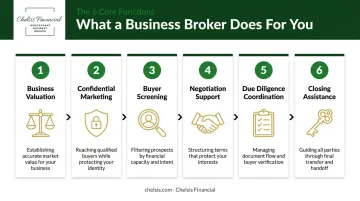
Core Functions a Broker Provides
A broker handles:
- Business valuation — establishing a defensible asking price based on financial performance and market comparables
- Confidential marketing — promoting the business through blind listings, curated buyer networks, and targeted outreach without exposing the seller's identity prematurely
- Buyer screening — vetting inquiries for financial qualification and strategic fit before granting access to sensitive business information
- Negotiation support — structuring offers, counteroffers, and deal terms in the seller's interest
- Due diligence coordination — organizing documentation and managing timelines with attorneys, CPAs, and lenders
- Closing assistance — keeping all parties aligned through to final transfer
Before any of these steps begin, a seller needs to know what their business is actually worth. Chelsis Financial offers a complimentary Assessment of Value (considering financial performance, market trends, and industry benchmarks) so owners enter the market with a price grounded in real data — not guesswork.
Why the Right Broker Type Matters
Pairing the wrong broker with your business creates real, measurable problems. An online marketplace handles a complex service business poorly. A generalist broker navigating a highly regulated niche industry will likely miss deal-critical nuances that affect buyer credibility and pricing.
What Goes Wrong Without the Right Match
The IBBA notes directly that lack of confidentiality can harm the owner, confuse employees, and damage the business itself before the sale closes. Beyond confidentiality, misalignment typically produces:
- Mispriced listings when a broker applies the wrong valuation multiple for your industry
- Unqualified buyer pools that attract interest without producing closings
- Extended time on market — BizBuySell's 2025 data puts median close time at 170 days; the wrong broker stretches that further
- Collapsed deals during due diligence from weak documentation or buyer pre-qualification
Three Factors That Determine the Right Broker Type
Understanding these failure points makes the selection criteria clearer. Three factors drive the decision:
- Business size and valuation: Broker types serve distinct deal-size segments, and working outside that range usually means less buyer access and weaker negotiating leverage.
- Industry complexity: Regulated or niche sectors require a broker who already understands the licensing, compliance, and valuation norms — not one learning on your transaction.
- Confidentiality needs: Businesses with tight-knit communities, key-person dependencies, or sensitive customer relationships need a broker with formal, structured confidentiality protocols in place from day one.
Types of Business Brokers
Broker types differ based on deal size, industry focus, service model, and the buyer networks they access. Knowing which type fits your situation is the first step toward choosing the right representation.
Full-Service Business Brokers
Full-service brokers manage the entire sales process end-to-end: valuation, marketing, buyer screening, negotiations, and closing. They work primarily for small to mid-sized privately held businesses. They act as the seller's dedicated advocate under a formal representation agreement and maintain discretion at every stage.
How they differ from other types: Unlike online platforms or discount models, full-service brokers provide personalized, hands-on support with active buyer screening and formal confidentiality safeguards baked into the process.
Best fit: Business owners who need a fully managed, discreet sale while continuing to run the business day-to-day.
| Strengths | Limitations |
|---|---|
| Comprehensive end-to-end management | Higher commission vs. DIY options |
| Vetted buyer network and structured confidentiality | Requires formal listing agreement |
| Active negotiation support throughout | Longer timeline than self-managed sales |
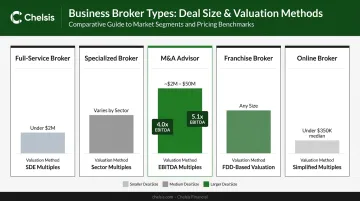
The IBBA defines the Main Street market as businesses valued under $2 million, with commissions typically ranging from 8%–15% of the final sale price, subject to an agreed minimum.
Chelsis Financial works within this model — offering complimentary business valuations, a qualified buyer registry, and transaction coordination across manufacturing, healthcare, industrial services, automotive, and technology sectors throughout the Midwest.
Specialized (Industry-Specific) Business Brokers
Specialized brokers focus exclusively on a particular industry (dental practices, restaurants, auto dealerships, construction firms) bringing sector-specific valuation expertise and a pre-qualified industry buyer pool.
How they differ: Unlike generalists, specialized brokers understand the valuation metrics, licensing requirements, and regulatory standards that directly affect deal structure. A dental practice, for example, carries specific licensing transfer requirements and patient retention assumptions that a generalist may not know how to model accurately.
Best fit: Businesses in niche markets where general buyers are rare and where specialized due diligence is required.
Primary limitation: Geographic availability. Specialized brokers may not exist in every market for every industry, which can limit seller options in smaller regions.
M&A Advisors
M&A advisors handle larger, more complex transactions — typically in the lower middle market, which the IBBA and M&A Source define as the $2M–$50M enterprise value range. Their work includes mergers, acquisitions, recapitalizations, and management buyouts, using sophisticated financial modeling that goes beyond standard broker practice.
How they differ: M&A advisors work with institutional buyers, private equity groups, and larger corporations. Valuation methods shift from seller's discretionary earnings (SDE) multiples — used below $2M — to EBITDA multiples at higher deal sizes. The Q1 2026 Market Pulse confirms: businesses in the $2M–$5M range traded at 4.0x EBITDA; the $5M–$50M segment at 5.1x EBITDA.
Fee structure: Based on an industry M&A fee-guide benchmark from Firmex, monthly work fees commonly run $5,000–$10,000, often credited against the final success fee, which decreases as deal size grows.
Best fit: Mid-market companies with complex ownership structures, significant recurring revenue, or those seeking strategic acquisition partners.
Limitations: Retainer requirements, longer timelines, and a process that's simply not suited to smaller Main Street transactions.
Franchise Brokers
Franchise brokers specialize exclusively in the buying and selling of franchise businesses — covering Franchise Disclosure Documents (FDDs), franchisor approval processes, resale restrictions, and the legal and operational requirements unique to franchise transactions.
The distinguishing factor: Franchise sales require mandatory third-party franchisor approval, specific documentation, and transfer fees. The FTC mandates that franchisors provide prospective buyers with a disclosure document covering 23 specified items. General brokers are typically not equipped to navigate this process.
Best fit: Sellers exiting a franchise unit and buyers seeking an established franchise location.
Limitation: This expertise is narrow — it doesn't apply to independent, non-franchise businesses, and trying to apply it outside its scope adds cost without value.
Online Business Brokers
Online business brokers are platforms or digital-first agencies (BizBuySell, BusinessesForSale.com, Flippa) that list businesses on marketplace sites, provide broad online exposure, and offer tiered or lower-cost services with less personalized broker involvement.
How they differ by service model: Sellers receive listing exposure and basic marketing materials rather than a dedicated broker relationship. Buyer lead generation is driven by platform traffic, not a curated, vetted network.
Scale context: BizBuySell reported a median sale price of $350,000 in 2025 — reflecting the small-scale businesses that dominate these platforms.
Best fit: Very small businesses where cost efficiency is the primary driver and the owner is prepared to manage more of the process independently.
Key limitations:
- Reduced confidentiality controls — blind listing management falls on the seller
- Variable buyer quality — platform traffic includes tire-kickers alongside serious buyers
- Limited negotiation support
- BizBuySell notes that some qualified buyers view a no-broker listing as a red flag
How to Choose the Right Business Broker for Your Sale
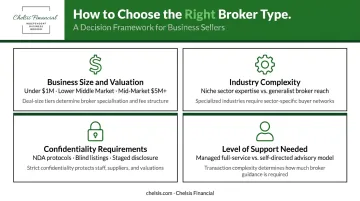
Choosing a broker comes down to four specific factors tied to your sale — not reputation, not commission rate. Work through each before making a decision.
Decision Factors
1. Business size and valuation Use deal-size ranges to narrow your options:
- Under $2M → Full-service Main Street broker
- $2M–$50M → Full-service broker or M&A advisor, depending on complexity
- Franchise business (any size) → Franchise broker
2. Industry complexity If your business operates in a heavily regulated or niche sector, a specialized broker's domain knowledge often outweighs the breadth of a generalist. Ask any broker you interview for a list of comparable transactions closed in your industry.
3. Confidentiality requirements Community-based businesses, or those with sensitive employee and customer relationships, require a broker with formal confidentiality protocols — blind listings, NDAs, staged information disclosure, and screened buyer access. There is no substitute for this.
4. Level of support needed If you intend to keep running the business through the sale process — the approach most sellers take — you need a broker who manages all steps independently. A platform-only approach places the operational burden back on you.
Chelsis Financial is structured for owners who need a discreet, professionally managed process: from a complimentary initial valuation through a clean, fully coordinated close, with full coordination of attorneys, CPAs, lenders, and closing agents.
Common Mistakes When Choosing a Business Broker
Selecting on Commission Rate Alone
This is the most costly mistake sellers make. Consider a practical example: if a broker charges 9% instead of 12% but undervalues the business by $150,000, the seller has saved roughly $22,500 on commission while losing $150,000 in sale price. That's a net loss of $127,500 — and that's before accounting for a longer time-on-market.
Sellers who go it alone face a related trap: overpricing due to personal attachment or underpricing due to limited market data. Either way, the final return suffers.
Mismatching Broker Sophistication to Deal Size
The fit between broker type and deal size matters more than most sellers realize. Two common mismatches:
- Too much firepower: An M&A advisor on a $400,000 Main Street sale adds retainer costs, institutional timelines, and a misaligned buyer pool
- Too little support: A listing platform for a $4M industrial services business leaves confidentiality unprotected and negotiation unsupported
Ignoring Verified Transaction History
General brokerage experience does not substitute for sector-relevant closed deals. Ask every broker you interview for:
- A list of comparable transactions completed (anonymized is fine)
- References from sellers in similar industries
- Their approach to valuation in your specific sector
Overlooking Confidentiality Safeguards
Premature disclosure of a sale (to employees, customers, or competitors) can erode business value before closing. The IBBA warns that confidentiality breaches confuse employees, spook customers, and can kill a deal outright.
Any broker you hire should explain specifically how they protect seller identity during marketing and control information access during due diligence.
Frequently Asked Questions
Which are the types of business brokerage?
The five main types are full-service, specialized/industry-specific, M&A advisors, franchise brokers, and online business brokers. They differ by deal size, industry focus, service model, and the buyer networks they access.
What is the difference between a business broker and an M&A advisor?
Business brokers handle smaller Main Street transactions — typically under $2M — while M&A advisors manage larger, more complex deals in the $2M–$50M range. They differ in valuation models (SDE vs. EBITDA multiples), buyer types, and fee structures, with M&A advisors adding retainers to their success fees.
How much does a business broker typically charge?
For Main Street businesses, IBBA benchmarks place broker commissions at 8%–15% of the final sale price, often subject to a minimum fee. M&A advisors in the middle market typically combine monthly work fees ($5,000–$10,000) with a declining success-fee structure tied to deal size.
Do I need a business broker to sell my business?
Not legally — but most owners benefit significantly from a broker's buyer network, confidentiality controls, and negotiation expertise. Without one, qualified buyers may view the listing skeptically, and sellers frequently misprice their businesses.
How long does it take to sell a business with a broker?
BizBuySell reported a median close time of 170 days in 2025. Timelines vary by industry — manufacturing averaged 223 days, retail 163 days — and by deal size, business complexity, and market conditions.
Can a business broker represent both the buyer and the seller?
Dual agency is legally permitted in some US states under specific written disclosure and consent requirements. However, it carries real conflicts of interest — a broker representing both sides cannot advocate fully for either — and both parties should evaluate those risks carefully before agreeing to it.