
Introduction
Most business owners don't realize how wide the pricing range is until they start shopping: valuations can run from completely free to well over $50,000. The right choice depends on why you need the valuation, your business's size and complexity, and who performs it.
Get it wrong, and you risk leaving money on the table at closing — or paying for a level of certification you simply don't need.
This guide breaks down typical pricing tiers, the key factors driving cost, the different types of valuations, and how to decide what you actually need.
Key Takeaways
- Business valuation costs range from $0 (broker-provided) to $40,000+ for complex certified appraisals
- What you pay depends on why you need the valuation, your company's size, the quality of your financials, and whether certification is required
- Most sellers access free or low-cost valuations through their broker — Chelsis Financial offers a complimentary Assessment of Value for qualifying businesses
- Skip the expensive certified appraisal unless your situation involves legal, tax, or regulatory requirements
- Clean, organized financial records reduce both valuation costs and time to close
How Much Does a Business Valuation Cost?
Business valuation does not have a single fixed price—costs vary based on the valuation type, company complexity, and provider. Misunderstanding this can lead to overpaying for services not needed, or underpaying and receiving a report that doesn't hold up when it matters most.
Here's a quick breakdown before diving into each tier:
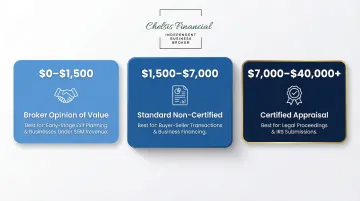
| Valuation Type | Typical Cost | Best For |
|---|---|---|
| Broker Opinion of Value | $0–$1,500 | Early-stage exit planning, businesses under $5M revenue |
| Standard Non-Certified | $1,500–$7,000 | Buyer-seller transactions, financing discussions |
| Certified Appraisal | $7,000–$40,000+ | Legal proceedings, IRS/estate submissions, SBA loans |
Broker Opinion of Value / Free Valuation: $0–$1,500
Many business brokers and M&A advisors offer free or very low-cost valuations as part of building relationships with potential seller clients. These typically include income-based analysis, comparable sales data, and SDE (Seller's Discretionary Earnings) or EBITDA multiples. According to the International Business Brokers Association (IBBA), a Broker Opinion of Value (BOV) is a "special limited appraisal or business valuation" prepared using market knowledge and comparable sales data.
What's included:
- Analysis of recent earnings (SDE or EBITDA)
- Comparable business sales in your market
- Industry-specific multiples
- Estimated market value range
Best for: Sellers exploring their options, early-stage exit planning, businesses under $5M in revenue
Chelsis Financial's complimentary Assessment of Value falls in this tier—covering four years of financial statements and drawing on comparable sales data from over 2,000 Midwest businesses to produce a valuation suitable for pricing decisions and lender conversations.
Standard Non-Certified Valuation: $1,500–$7,000
Professional valuation reports in this tier are prepared by experienced analysts or appraisers but without formal certification sign-off. Small businesses under $2M in revenue typically land at the lower end ($1,500–$3,000), while lower mid-market businesses ($2M–$15M revenue) trend toward the higher end ($5,000–$7,000).
These reports use multiple valuation methodologies—income approach, market approach, and asset-based approach—to arrive at a comprehensive value estimate.
Best for: Buyers and sellers conducting standard buy-sell transactions, strategic planning, financing discussions
When the stakes rise—litigation, estate planning, or regulatory scrutiny—a non-certified report often won't hold up. That's where certified appraisals come in.
Certified Appraisal: $7,000–$40,000+
Certified appraisals follow strict professional standards (USPAP or NACVA guidelines), require credentialed appraisers (ASA, CVA, ABV designations), and include detailed documentation. Prices scale with business complexity and revenue—mid-market companies ($15M–$50M revenue) typically exceed $20,000, with complex multi-entity structures reaching $50,000+.
Best for: Legal proceedings (divorce, partner disputes), IRS/estate planning submissions, SBA loan applications, litigation support
Key Factors That Affect the Cost of a Business Valuation
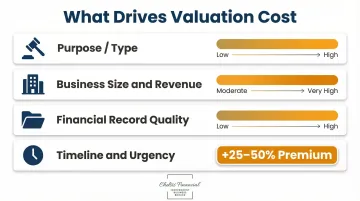
Valuation pricing is driven by technical, legal, and business-specific factors. Understanding each one helps you predict where your cost will land before you commit to an appraiser.
Purpose and Type of Valuation
There's a fundamental split between fair market valuations (used for buying/selling) and legal valuations (used for court proceedings, divorce, partner disputes). Legal valuations require certified professionals meeting specific standards, which drives costs considerably higher.
Example: A divorce proceeding typically requires a certified appraisal that can withstand legal scrutiny, while selling to a third party may only need a broker opinion or standard report.
Size and Revenue of the Business
Larger businesses have more complex financials, multiple departments, or locations, all of which require more analyst time. A company with $1M in revenue is far simpler to value than one with $20M. According to industry data, valuation costs can range from $2,000–$10,000 for micro-businesses but easily reach $50,000–$100,000+ for large private companies with tens of millions in revenue.
Cleanliness of Financial Records
Businesses with messy books—heavy personal expenses run through the business, inconsistent inventory tracking, or undocumented add-backs—require more analyst time to reconstruct accurate financials.
When records are poor, appraisers must engage in forensic reconstruction, tracing deposits across multiple periods and separating return on labor from return on equity.
Cost impact: An expert billing $300–$700 per hour may spend dozens of hours cleaning up data before the actual valuation can begin.
To keep costs down, prepare before you engage an appraiser:
- Organize three years of financial statements
- Document all owner add-backs with supporting notes
- Reconcile all accounts and remove personal expenses from business records
Level of Certification Required
Reports prepared by analysts differ materially from those formally signed off by credentialed appraisers (CVA, ABV, ASA designations). Certification adds cost but also adds legal defensibility and credibility with banks, courts, and the IRS.
Credential examples:
- ASA (Accredited Senior Appraiser)
- CVA (Certified Valuation Analyst)
- ABV (Accredited in Business Valuation)
Timeline / Urgency
Standard valuations take 4–8 weeks to complete, while expedited reports can be delivered in 1–2 weeks for additional fees. Rush valuations for urgent situations (partnership disputes, emergency capital needs) typically carry a premium of 25%–50%.
Example: A standard $15,000 valuation could increase to $18,750 or $22,500 due to poor timeline planning alone.
Types of Business Valuations and Their Costs
The right valuation type depends entirely on your situation. Below is a breakdown of the most common report types, what each includes, and what you can expect to pay.
Broker Opinion of Value (BOV) / Fair Market Valuation
This is the most common entry point for business sellers. Typically free or low-cost, it's prepared by a business broker or M&A advisor using market comparables and earnings multiples. It is not legally defensible but is appropriate for sale transactions.
Cost: $0–$1,500
Non-Certified Professional Appraisal
More rigorous than a BOV, this is professionally prepared by a valuation specialist using multiple methodologies (income, market, asset approaches), but without a formal certification signature. Suitable for M&A transactions, SBA loan support, and strategic planning.
Cost: $1,500–$7,000 depending on business size
Certified Summary or Detailed Appraisal
Full-scope reports meeting USPAP or NACVA standards, signed by a credentialed appraiser. Used for IRS submissions, estate planning, litigation, partner buyouts. These reports include 40–100+ pages of detailed documentation and analysis.
Cost: $7,000–$40,000+ depending on complexity
Quality of Earnings (QoE) Report
A QoE goes beyond valuation to assess the accuracy and sustainability of reported earnings—often required in M&A due diligence for larger deals. According to industry data, QoE reports typically cost:
- Small deals (<$2.5M revenue): $12,000–$15,000
- Mid-sized deals (<$10M enterprise value): $14,000–$35,000
- Large deals (>$10M enterprise value): $25,000–$60,000+
Note: QoE reports are overkill for most small business sales and serve a different purpose than valuations. Where a valuation tells you what a business is worth, a QoE tells you whether the reported earnings behind that number can be trusted.
Free vs. Paid Business Valuations — What's the Real Difference?
While free online valuation tools exist, they significantly undervalue most businesses. Professional appraisers warn that automated tools provide rough estimates lacking the depth and accuracy of professional appraisals. Free tools miss critical factors like:
- Personal goodwill and intangible assets
- Owner compensation add-backs
- Industry-specific multiples
- Local market conditions
- Discretionary expenses run through the business
That said, not every free valuation is created equal. A free assessment from a reputable business broker or M&A advisor — like the complimentary valuation Chelsis Financial offers — is a different animal entirely. These are performed by experienced professionals using real comparable sales data and are appropriate for sellers planning an exit, though they are not designed for legal or regulatory purposes.
Here's how the three tiers compare:
- Free online tools — produce rough estimates; miss intangibles and market context
- Free broker assessments — legitimate starting point for sellers exploring an exit
- Paid certified appraisals — required for legal proceedings, tax filings, and complex transactions
How to Choose the Right Valuation — and Avoid Costly Mistakes
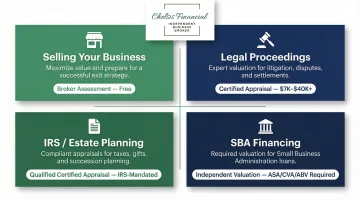
Follow this simple decision framework to match the valuation type to your purpose:
- Selling your business: Start with a broker assessment (often free). This provides a defensible market value for pricing discussions and attracts serious buyers.
- Legal proceedings: Divorce, shareholder disputes, or partner buyouts require a certified appraisal signed by a credentialed professional.
- IRS/estate planning: The IRS mandates qualified appraisals for non-cash charitable contributions over $5,000 and estate/gift tax purposes, following Revenue Ruling 59-60.
- SBA financing: SBA SOP 50 10 8 requires an independent valuation from a qualified source (ASA, CBA, ABV, or CVA) when financing includes more than $250,000 in goodwill or intangible assets.
The Most Common and Costly Mistake
Most sellers go wrong in one of two directions: overpaying for a full certified appraisal when a broker opinion would have served the purpose, or relying on a free online calculator that undervalues the business by 30–50% and hands leverage to the buyer before negotiations even start.
Match the tool to the job. A $500 online estimate has no standing in a courtroom or with the IRS. A $10,000 certified appraisal is unnecessary if you're in early-stage conversations with a broker. Getting this right is how you protect the return on your most valuable asset.
Frequently Asked Questions
How much is my financial advisor business worth?
Financial advisory businesses are valued on AUM, recurring revenue, client retention, and transition risk. Multiples typically range from 1x to 3x revenue, though high-performing practices with strong recurring revenue and a clear succession plan can command more.
Can I get a free business valuation?
Yes, free valuations are available from business brokers and M&A advisors as part of their service offering, and these can be reliable starting points for sellers. However, free online tools tend to be unreliable. Free broker assessments are not suitable for legal or regulatory purposes—those require certified appraisals.
What is the difference between a certified and non-certified business valuation?
A certified valuation is completed by a credentialed appraiser (CVA, ABV, or ASA) under USPAP or NACVA standards—making it legally defensible for court or IRS use. A non-certified report is professionally prepared and appropriate for business sales and planning, but won't hold up in formal legal proceedings.
How long does a business valuation take?
Most professional valuations take 2–4 weeks. Certified appraisals for complex businesses may take 4–6 weeks. Expedited timelines are available at a premium when urgency is required, typically adding 25%–50% to the cost.
Do I need a business valuation to sell my business?
While it's not legally required, a professional valuation (or broker assessment) is strongly recommended before listing a business for sale. It establishes a defensible asking price, attracts serious buyers, and strengthens the seller's negotiating position.
What documents do I need for a business valuation?
Typical requirements include 3–5 years of tax returns and financial statements, a current balance sheet, owner compensation details, and any significant contracts or lease agreements. Well-organized records reduce back-and-forth with the appraiser, which directly cuts both time and cost.