
Introduction: Selling a Service Business in 2026
Most service business owners spend years building something valuable—and then underestimate what it's actually worth when it's time to sell. In 2026, buyer demand is strong across service sectors, but prepared sellers consistently close at higher multiples than those who go to market without a plan.
Service businesses face a challenge product companies don't: value lives in relationships, reputation, and recurring revenue rather than physical inventory. A well-regarded client list, a skilled team, and a strong brand can command a premium price—or almost nothing—based entirely on how transferable those assets are to a new owner.
This guide walks through valuation methods, preparation steps, buyer types, deal structures, and what to expect from the sales process. Whether you're planning to exit in six months or three years, the goal is the same: sell with confidence, not guesswork.
TLDR: Key Takeaways
- Service businesses sell based on earnings multiples (typically 2x–4x SDE), recurring revenue strength, and how easily they can operate without the current owner
- Preparation—clean financials, reduced owner dependency, documented processes—directly increases your sale price and speeds up closing
- The 2026 M&A market features strong buyer demand from individual operators, strategic acquirers, and private equity groups actively consolidating service sectors
- An experienced business broker protects confidentiality, surfaces qualified buyers, and prevents the costly mistakes that kill deals
What Makes Selling a Service Business Different in 2026
Service businesses are valued primarily on intangible assets: client relationships, contracted revenue, staff expertise, and brand reputation. Unlike manufacturing or retail businesses with physical inventory and equipment, service companies derive their worth from what can't be touched—which makes the pricing dynamic fundamentally different from any other business type.
The question every buyer raises: "How much of this business depends on the current owner?" Owner dependency is one of the most common reasons service business deals fall apart or underperform on price. If you're the only one who knows how to land new clients, manage key accounts, or deliver the core service, buyers see risk—not value. Reducing this dependency before listing is critical to achieving a premium multiple.
That context matters because the 2026 M&A environment for service businesses is active but increasingly discerning. With 4.1 million Americans turning 65 annually between 2024 and 2027, an estimated 6 million small-to-medium businesses will transition by 2035, representing $5 trillion in enterprise value.
That wave of supply gives buyers options. Unprepared sellers are penalized with longer due diligence periods, lower multiples, and tougher deal terms.
Key market trends in 2026:
- Private equity firms now capture 59% of acquisitions in the $5M–$50M range, heavily favoring "buy-and-build" strategies in fragmented sectors like home services, IT managed services, and healthcare
- The service sector showed the strongest growth in 2025, with transaction volume up 4% and median sale prices rising 5% to $340,000
- Interest rates have stabilized, improving deal financing conditions compared to 2023–2024
- Sectors seeing the most buyer activity include HVAC/plumbing, IT/MSPs, digital marketing agencies, and outpatient healthcare
Buyers are actively looking. What they want are businesses that can operate and grow without the founder in the room.
How to Value Your Service Business
Understanding SDE and EBITDA Multiples
Service businesses are typically valued using one of two methods: Seller's Discretionary Earnings (SDE) multiples for businesses under $2M in enterprise value, and EBITDA multiples for larger or more institutionalized operations.
SDE represents the total financial benefit to a single owner-operator, including net profit plus owner's salary, benefits, and discretionary expenses. It answers the question: "How much money does this business put in the owner's pocket each year?"
EBITDA (Earnings Before Interest, Taxes, Depreciation, and Amortization) is used for larger businesses with professional management teams. It represents earnings before accounting for capital structure and non-operating expenses, making it easier to compare businesses across different ownership structures. Below the $2M threshold, buyers are typically individuals or small strategic acquirers focused on SDE; above it, you're dealing with private equity or larger corporates who analyze EBITDA.
What Multiples Can You Expect?
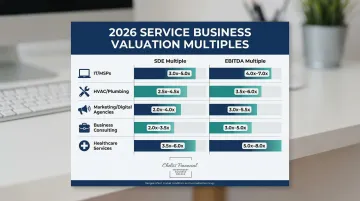
In 2026, service businesses typically sell for 2x–4x SDE for smaller operations. The exact multiple depends on several factors, with recurring revenue, low owner dependency, and strong margins pushing multiples higher.
Sector-specific multiple ranges:
- IT/MSPs: 2.99x SDE (small businesses) or 6.0x–12.0x EBITDA (larger firms)
- HVAC/Plumbing: 2.80x SDE (HVAC) / 2.62x SDE (Plumbing), or 4.0x–7.8x EBITDA
- Marketing/Digital Agencies: 2.86x SDE or 4.9x–9.0x EBITDA
- Business Consulting: 2.0x–2.8x SDE or 6.1x–9.1x EBITDA
- Healthcare (Outpatient/Clinics): 2.37x SDE or 6.0x–12.0x+ EBITDA
Key Value Drivers That Push Multiples Higher
Five factors consistently separate high-multiple exits from average ones:
- Recurring revenue: Contractually obligated recurring revenue commands multiples 1x–3x higher than project-based models. Subscription and retainer structures signal lower risk to buyers.
- Client diversification: No single client should exceed 20% of revenue. Concentration above that threshold triggers discounts — buyers price in the risk of losing a dominant account post-sale.
- Low owner dependency: A business that runs smoothly without the owner for weeks looks like a cash-flow engine. One that stalls without the founder looks like a job.
- Strong margins: A 20% EBITDA margin is a healthy benchmark for service businesses, though targets shift by sector.
- Documented systems: Written processes signal scalability. Without them, buyers assume the business runs on the founder's memory — and price accordingly.
What Drags Valuation Down
The most common valuation killers — and how much they typically cost you:
- Heavy owner involvement in sales, delivery, or client relationships lowers multiples by 20%–30%
- Undocumented processes signal the business runs on the founder's expertise, not repeatable systems
- Customer concentration above 20% with a single client triggers steep discounts from buyers
- Declining revenue trends raise concerns about trajectory and long-term viability
- Messy financials destroy buyer confidence and are the single most common deal-killer at due diligence
Addressing even two or three of these issues before going to market can shift your multiple significantly — and the dollar impact compounds fast on a business generating $500K–$2M in annual earnings.
Get a Professional Valuation First
A professional valuation based on normalized earnings, market comparables, and industry trends is the essential first step — not an online calculator. Chelsis Financial offers a **complimentary Assessment of Value** so business owners can understand what their business is realistically worth before committing to a sale. Contact them at 866-842-5151 to schedule your assessment.
Preparing Your Service Business for Sale
Clean Up Your Financials
Buyers and their lenders will scrutinize your numbers. Organize three years of profit and loss statements, tax returns, and balance sheets. Ensure financials are accurate, up to date, and clearly identify your SDE or EBITDA figure.
Key steps:
- Reconcile discrepancies between tax returns and internal financials
- Document all add-backs (owner salary, personal expenses, one-time costs) with supporting evidence
- Prepare a normalized earnings statement that buyers can trust
- Work with your CPA to ensure consistency and accuracy
Valuation gaps are the #1 deal killer, responsible for 49% of failed lower-middle-market transactions. Clean financials prevent disputes and build buyer confidence.
Reduce Owner Dependency
Cross-train staff so key functions aren't dependent on you. Delegate key client relationships to team members—introduce them as primary contacts and step back from day-to-day interactions. Document repeatable processes in an operations manual covering sales, delivery, customer service, and administration.
Practical actions:
- Identify the top 3–5 tasks only you currently perform and train someone else to handle them
- Transfer ownership of client relationships by having team members lead meetings and calls
- Create written SOPs (Standard Operating Procedures) for core workflows
- Test the system by taking a two-week vacation and letting the team run the business
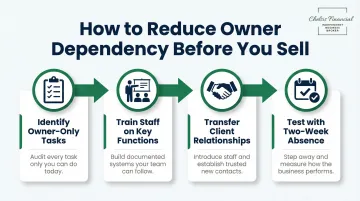
A business that runs without you is worth more—and far easier to sell.
Secure and Organize Contracts
Review, clean up, and organize client agreements, vendor relationships, employee contracts, and any intellectual property documentation before going to market. Missing or poorly documented contracts frequently cause deal delays and re-pricing.
What to organize:
- Client contracts (especially recurring revenue agreements)
- Vendor and supplier agreements
- Employee contracts and non-compete agreements
- Leases for office space or equipment
- Licenses, certifications, and permits
- Intellectual property documentation (trademarks, copyrights, proprietary processes)
Create a digital data room with organized folders so buyers can access documents quickly during due diligence.
Strengthen Your Online Reputation
Buyers research your online presence early — often before they've signed an NDA. A strong reputation signals brand equity and reduces perceived risk.
Quick reputation wins:
- Audit your Google Business profile and confirm contact details, hours, and photos are current
- Respond professionally to any negative reviews (buyers will read them)
- Ask satisfied clients to leave a Google or industry-specific review
- Update LinkedIn and any industry directory listings to reflect current services
Consult a CPA and Tax Advisor
The structure of the deal—asset sale versus stock sale—has major tax implications. An asset sale typically results in higher taxes for the seller but is preferred by most buyers. A stock sale can be more tax-efficient for sellers but carries liability risks for buyers.
Have this conversation before an offer is on the table, not after. Work with your CPA to model both scenarios and understand your actual net proceeds under each. Chelsis Financial works directly with your tax advisor to ensure the deal structure matches your exit timeline and keeps unnecessary tax costs off the table.
Understanding Buyer Types and Deal Structures
Three Main Buyer Profiles in 2026
Who's buying service businesses in 2026? Broadly, three types—and each values your business on different terms.
- Individual owner-operators are the most common buyers for businesses under $2M. They run the business themselves, typically using SBA loans or personal savings, and prioritize cash flow and lifestyle fit over strategic synergies.
- Strategic buyers—competitors or adjacent businesses—acquire to gain market share, expand geographically, or add complementary services. They often pay higher multiples because operational synergies justify the premium.
- Private equity and search funds are increasingly active in fragmented service sectors. PE firms use a "buy-and-build" strategy: acquire a platform company, then roll up smaller competitors. They bring sophisticated due diligence and often offer earnout or equity rollover structures.
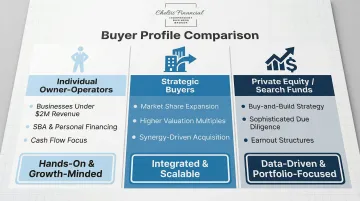
The buyer type shapes more than just the offer—it usually determines how the deal gets structured.
Asset Sale vs. Stock Sale
Most small service business deals are structured as asset sales, where the buyer purchases specific assets (client contracts, equipment, intellectual property) but not the legal entity itself. This protects buyers from unknown liabilities but often results in higher taxes for sellers.
Stock sales transfer ownership of the entire legal entity, including all assets and liabilities. Sellers often prefer this structure for tax reasons, but buyers are cautious due to liability exposure.
Earnouts and Seller Financing
Earnouts are performance-based payments that bridge valuation gaps. Used in roughly 22% of M&A deals, historical data shows successful payouts average only 50 cents on the dollar—dropping to 21 cents when zero-payout deals are factored in.
If an earnout is unavoidable, protect yourself with three structural guardrails:
- Keep the term under 24 months
- Tie milestones to top-line revenue, not profit (harder to manipulate)
- Include covenants preventing the buyer from actions that undermine earnout achievement
Seller financing—where the seller loans the buyer 10%–30% of the purchase price over 3–5 years—attracts a broader pool of buyers and signals confidence in the business's future performance. For sellers who qualify, it can accelerate closing timelines and support stronger final valuations.
Protecting Confidentiality
Never list your business publicly or tell employees and clients you're selling until the deal is near closing. Working with a broker who has a vetted buyer registry—like Chelsis Financial—protects confidentiality while reaching qualified prospects. Buyers sign NDAs before receiving any identifying business details.
The Sales Process: From Listing to Closing
Core Stages and Timeline
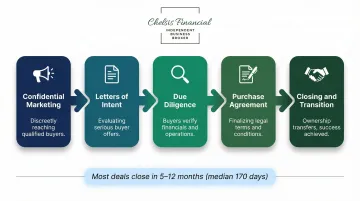
The typical service business sale follows this path: confidential marketing → receiving and evaluating Letters of Intent (LOIs) → due diligence → purchase agreement negotiation → closing and transition.
The majority of deals (81%) take 5 to 12 months to close, with a median timeline of 170 days in 2025. Retail businesses close fastest, while manufacturing and complex service businesses take longer.
Two early stages deserve close attention:
- Confidential marketing: A blind profile describes your business without revealing its identity. Qualified buyers sign NDAs before accessing detailed information.
- Letters of Intent (LOIs): Preliminary offers that outline price, structure, financing, and key terms. The highest price isn't always the best deal — weigh the buyer's financing strength, proposed structure, and transition expectations.
Due Diligence
Buyers verify financials, review contracts, assess operations, and often speak with key staff or clients under NDA. Prepare a digital data room with organized documents to make this process smooth and reduce delays.
Common due diligence requests:
- Three years of financial statements and tax returns
- Client contracts and revenue concentration analysis
- Employee agreements and organizational charts
- Vendor contracts and supplier relationships
- Operational processes and SOPs
- Legal and compliance documentation
Good organization speeds up due diligence and reduces the chance buyers find issues that trigger re-pricing.
Transition Period
Once the deal closes, the work isn't quite done. Most service business sales include a seller transition period — typically 30–90 days — where the owner introduces the buyer to key clients and staff. Structure this carefully in the purchase agreement to protect both parties and ensure a clean handoff.
Transition responsibilities typically include:
- Introducing the buyer to top clients and key relationships
- Training on operational systems and processes
- Assisting with employee retention and morale
- Providing consulting support as needed
Clear expectations and defined timelines prevent misunderstandings and help preserve the business's value during ownership transfer.
Why Working with a Business Broker Matters
Tangible Advantages of Professional Representation
A qualified business broker brings accurate pricing based on market comparables, access to a pre-qualified buyer pool, confidential deal management, and experience navigating negotiations that first-time sellers often mishandle.
Key benefits:
- Achieve higher final prices through effective positioning and managed competitive bidding
- Screen buyers, execute NDAs, and control information flow before any details leave the room
- Tap into registries of vetted, financially qualified buyers who are actively seeking acquisitions
- Navigate LOI evaluation, due diligence, and purchase agreement negotiation — areas where inexperienced sellers routinely leave money on the table
Chelsis Financial: Your Trusted Partner
If you're looking for a broker who handles the full process — from initial valuation through closing — Chelsis Financial works with service business owners across the Midwest to structure confidential, well-managed sales. The firm maintains an active registry of vetted buyers and manages every engagement so sellers never have to navigate due diligence or negotiations alone.
Chelsis Financial starts every engagement with a complimentary, no-obligation Assessment of Value—helping you understand what your business is realistically worth before you commit to selling. This assessment considers your financial performance, market trends, and industry benchmarks so you enter the market with a valuation you can stand behind.
Ready to take the first step? Contact Chelsis Financial at 866-842-5151 to schedule your complimentary Assessment of Value and get a clear picture of what your business is worth.
Frequently Asked Questions
How much can you sell a service business for?
Service businesses typically sell for 2x–4x SDE for smaller businesses (under $2M), with higher multiples for larger or more systematized operations. Recurring revenue, low owner dependency, and clean financials are the main levers that determine where a business lands in that range.
How to value a business earnings multiple?
Earnings multiples are calculated by multiplying the business's normalized SDE or EBITDA by a market-determined multiple. That multiple varies by industry, size, growth trend, and risk—which is why a professional valuation is the most reliable way to arrive at a defensible price.
Is 20% a good EBITDA for a service business?
A 20% EBITDA margin is healthy for most service businesses, though benchmarks vary by sector. Strong margins attract buyers and support a higher valuation multiple—both signs of efficient operations and solid pricing power.
What does "sell-side advisory" mean?
Sell-side advisory refers to a professional (such as a business broker or M&A advisor) who represents the seller's interests throughout the sale process—from valuation and marketing to negotiating terms and closing the deal.
What is the holdover clause in a listing agreement?
A holdover clause (also called a tail clause) means that if a buyer introduced during the listing period completes a purchase after the listing agreement expires, the broker may still be entitled to their commission. Sellers should review this clause carefully before signing any broker agreement to understand the timeframe and conditions.