

Introduction
Across the Midwest, thousands of tool and die shop owners face the same quiet dilemma: decades of precision craftsmanship, loyal OEM relationships, and specialized equipment worth hundreds of thousands of dollars — but no clear path to exit. You've built a business that requires deep technical expertise, relies on skilled machinists who are nearly impossible to replace, and operates in a sector most buyers don't understand. Getting out without leaving money on the table takes deliberate planning.
Selling a tool and die manufacturing business is uniquely complex. Unlike service companies or retail operations, your value is tied up in specialized CNC and EDM equipment, proprietary tooling knowledge, and customer relationships with automotive or aerospace OEMs who demand precision measured in thousandths of an inch.
If you're the only master toolmaker, if your top customer represents 40% of revenue, or if your processes live in your head rather than in documented procedures, buyers will see risk — and price it accordingly.
This guide walks you through the specific steps, valuation factors, and preparation strategies that maximize sale price and protect the legacy you've built.
Key Takeaways
- Tool and die shops are in high demand due to reshoring trends and retiring baby boomer owners
- Valuations range from 3.5x to 12x earnings — automation, certifications, and customer diversity drive the spread
- Preparation should start 12–18 months before listing to address key-person risk and clean financials
- Customer concentration above 25% kills deals or cuts valuation by 15–30%
- Expect a 6–12 month sales timeline; SBA loans and seller financing are the most common close structures
Is Now a Good Time to Sell Your Tool & Die Business?
The market for precision manufacturing businesses is stronger than it's been in years. M&A activity in precision manufacturing increased 10% year-over-year in early 2025, driven by reshoring of domestic production and tariffs that incentivize U.S. companies to shift from imported components to domestic suppliers. Automotive OEMs, aerospace contractors, and medical device manufacturers are all competing for limited capacity from qualified tool and die shops.
That demand is colliding with a shrinking supply. The number of active tool and die establishments has declined from 2,252 in 2019 to 1,976 in 2023 as baby boomer owners retire, creating acquisition opportunities for buyers who recognize that building a skilled workforce from scratch is nearly impossible. The National Tooling and Machining Association identifies recruitment and retention as the number one industry challenge, which means strategic acquirers are paying premiums to gain immediate access to trained machinists and toolmakers.
Three types of buyers are actively searching:
- Larger machining companies and OEM customers acquiring shops to bring tooling in-house
- PE firms building precision manufacturing platforms around recurring revenue and specialized capabilities
- Experienced manufacturing managers or tradespeople buying established shops with trained staff and proven equipment
With fewer shops available and buyer interest high, well-positioned tool and die businesses are commanding multiples that would have been difficult to achieve even three years ago.
How Tool & Die Businesses Are Valued
Valuation methods vary based on business size and structure. Smaller, owner-operated shops are typically valued using Seller's Discretionary Earnings (SDE) — the total financial benefit the owner receives, including salary, perks, and profit. Larger operations with professional management in place use EBITDA multiples (Earnings Before Interest, Taxes, Depreciation, and Amortization), which measure the business's cash-generating ability independent of the owner. Understanding where your shop falls on that spectrum is the starting point for any realistic pricing conversation.
Typical Earnings Multiples
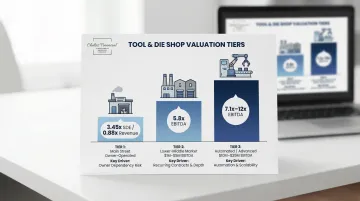
Machine shops and metal product businesses on the Main Street market sell for an average of 3.45x SDE, with revenue multiples around 0.88x. For lower-middle-market companies generating $1M to $5M in EBITDA, multiples average 5.8x, while larger operations generating $10M to $25M in EBITDA command 7.1x multiples.
Shops that have invested in advanced automation are pushing well beyond those benchmarks. Firms with high-end CNC machines, lights-out robotics, and AI-assisted quality control are achieving EBITDA multiples of 10x to 12x — buyers pay a premium for operations that have structurally solved the labor shortage problem.
Key Value Drivers That Push Multiples Higher
- Specialized equipment in good condition — 5-axis CNC machines, EDM equipment, automated pallet systems
- Proprietary tooling IP — custom die designs, documented process specifications
- Long-term OEM contracts — multi-year agreements with automotive Tier 1 suppliers or aerospace primes
- Low customer concentration — no single customer above 20% of revenue
- Skilled workforce that stays post-sale — cross-trained employees, documented succession plans
Common Value Detractors Buyers Will Flag
- Heavy owner dependency — you're the only master toolmaker or technical problem-solver
- Aging or poorly maintained equipment — machines past their useful life without maintenance records
- Single dominant customer — one account representing 30%+ of revenue
- Undocumented processes — tooling specs and production procedures exist only in your head
- Declining revenue trends — shrinking sales over the past 2–3 years
Chelsis Financial offers a **Complimentary Assessment of Value** for tool and die shop owners — a no-cost review of your financials, equipment, customer base, and market positioning that produces a defensible price range before you enter the market.
Preparing Your Tool & Die Shop for Sale
Preparation should begin 12–18 months before listing. That window gives you time to clean up financials, document operations, reduce key-person risk, and address contract vulnerabilities before buyers — and their attorneys — start asking hard questions.
Financial Documentation Buyers Will Require
Buyers and their lenders will demand three years of profit and loss statements, balance sheets, and tax returns, along with a well-documented SDE or EBITDA reconciliation showing add-backs. Your financials must reconcile cleanly across all three documents. If your P&L shows $500K in profit but your tax return shows $300K, buyers will reduce their offer or walk away entirely.
Organize your financial records now:
- Migrate to cloud-based accounting (QuickBooks Online or similar)
- Reconcile bank statements monthly
- Document all add-backs (owner salary, personal expenses, one-time costs)
- Work with your CPA to ensure tax returns and financials tell the same story
Reducing Key-Person Risk
If you're the primary technical operator — the one who programs complex jobs, troubleshoots tooling failures, or maintains OEM relationships — buyers will see significant risk. Here's how to reduce it:
- Cross-train senior employees on critical processes and customer relationships
- Document production procedures — create written specs for tooling setups, machine parameters, and quality checks
- Step back 2–3 days per week in the months before listing — prove the shop runs profitably without your daily involvement
Equipment and Tooling Inventory Audit
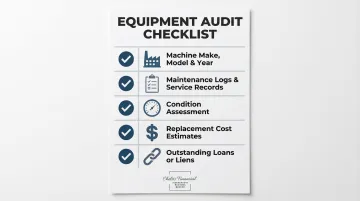
Create a detailed equipment list covering age, condition, maintenance records, and replacement value for all CNC machines, EDM equipment, presses, and tooling assets. Buyers and SBA lenders will scrutinize this list closely. A well-documented asset schedule supports both valuation and financing approval.
Include:
- Machine make, model, and year
- Maintenance logs and recent service records
- Current condition assessment (excellent, good, fair, poor)
- Replacement cost estimates
- Outstanding equipment loans or liens
Review Customer Contracts Before Going to Market
Many OEM and Tier 1 supplier agreements contain change-of-control clauses that allow the customer to terminate the contract if ownership changes. These clauses can derail deals during late-stage due diligence or force last-minute price reductions.
Action steps:
- Audit all material customer contracts for change-of-control and anti-assignment language
- Where possible, secure longer-term agreements or renewals before listing
- Obtain written confirmation from key customers that they'll continue the relationship post-sale
- Identify 10–15 customers willing to provide references to prospective buyers during due diligence
Who Buys Tool & Die Manufacturing Businesses?
Understanding your likely buyer helps you tailor how you package and market the business. Three main buyer categories dominate this market:
1. Strategic Buyers
Larger machining companies, contract manufacturers, or OEM customers looking to bring tooling in-house. Strategic buyers typically pay the highest multiples because they can realize immediate synergies — consolidating operations or cross-selling to existing accounts. What they're evaluating:
- Customer relationships and contract depth
- Equipment capability and capacity fit
- Geographic coverage relative to their existing footprint
2. Private Equity Groups
PE firms building precision manufacturing platforms focus on EBITDA margins, scalability, and recurring revenue. PE buyers typically require EBITDA of $1M+ and prefer shops with industry-specific certifications like AS9100D (aerospace) or IATF 16949 (automotive). Their checklist usually includes:
- Professional management that can run without the owner
- Documented processes and quality systems
- A credible path to organic or add-on growth
3. Individual Owner-Operators
Skilled tradespeople or manufacturing managers seeking to own a proven shop. Unlike institutional buyers, they're buying a job as much as an asset — which means their concerns are personal and practical:
- Seller transition support and training period length
- Equipment condition and remaining useful life
- Workforce stability (will key employees stay?)
Most individual buyers rely on SBA financing, so clean books and a cooperative seller make a real difference in getting a deal closed.
Seller financing (carrying 10–20% of the purchase price over 3–5 years) can expand your buyer pool, attract stronger offers, and often produces a higher total sale price than an all-cash-only requirement.
The Selling Process: Step by Step
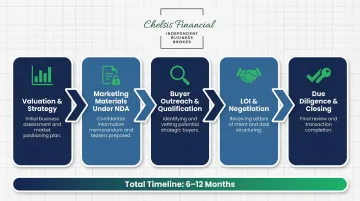
Step 1: Valuation and Go-to-Market Strategy
Start with a formal or broker-assisted valuation to establish a defensible asking price. Pricing too high scares off serious buyers; pricing too low leaves money on the table. A business broker like Chelsis Financial can leverage their qualified buyer network and industry knowledge to position your shop competitively from day one.
Step 2: Prepare Marketing Materials Under NDA
Create a confidential information memorandum (CIM) that presents your shop's financials, equipment list, customer profile, and growth opportunities to pre-qualified buyers — without revealing your company name until an NDA is signed. Premature disclosure risks unsettling employees, prompting customers to shop alternatives, and giving suppliers reason to renegotiate terms.
Step 3: Buyer Outreach and Qualification
Market the business through your broker's buyer network, industry contacts, and platforms like BizBuySell using a blind listing. Qualify buyers by financial capacity and industry background before sharing detailed information. Competing interest from multiple qualified buyers gives you negotiating leverage and helps maintain the asking price.
Step 4: Letter of Intent (LOI) and Negotiation
Once a strong candidate emerges, negotiate the LOI covering price, deal structure (asset vs. stock sale), working capital, seller financing terms, and transition period. Earnout provisions need special attention: SBA 7(a) loans prohibit seller earnouts, though performance-based buyer rebates are permitted.
Step 5: Due Diligence, Financing, and Closing
The buyer and their lender will conduct a deep review of financials, equipment, contracts, and environmental compliance. Most tool and die acquisitions close with SBA financing, which requires strict adherence to SBA size standards (maximum 500 employees for NAICS 333514).
Keep a well-organized virtual data room ready to respond quickly to document requests. Once due diligence clears, the final phase moves through three steps:
- Finalize the purchase agreement and schedule closing
- Plan a transition period to introduce the buyer to key customers, suppliers, and staff
- Budget for the full timeline — most sales take 6–12 months from listing to closing, with well-prepared businesses moving faster
Frequently Asked Questions
Are tool and die manufacturing businesses in demand?
Yes. Strong demand is driven by reshoring trends, retirements among shop owners, and increased need from automotive, aerospace, and medical sectors. Qualified tool and die shops attract multiple buyer types including strategic acquirers and private equity, with buyer demand currently outpacing supply.
What assets of a tool and die manufacturing business sell quickly for cash?
CNC machining centers, EDM equipment, stamping presses, precision measuring tools, and raw material inventory have the highest liquidity. Well-maintained, newer equipment commands the highest resale value and can often be sold separately in an asset-only transaction if a full business sale isn't pursued.
What is my tool and die business worth?
Value is primarily based on earnings multiples (SDE or EBITDA), with machine shops typically selling in the 3.5x–4.5x earnings range. Actual multiples adjust up or down based on equipment condition, customer concentration, workforce stability, certifications, and growth potential.
How long does it take to sell a tool and die manufacturing business?
Most sales take 6–12 months from initial listing to closing, with well-prepared businesses moving faster. Preparation prior to listing — clean financials, documentation, equipment records — is the single biggest factor in shortening the timeline.
Should I use a business broker to sell my tool and die shop?
A broker brings a pre-qualified buyer network, handles confidential marketing, and manages due diligence coordination. For sellers without direct access to vetted buyers or M&A experience, the commission typically pays for itself in improved outcomes.
What documents do I need to prepare before selling my tool and die business?
Prepare three years of tax returns, profit and loss statements, balance sheets, an equipment list with valuations, customer and supplier contracts, and an SDE or EBITDA reconciliation. Having these ready before listing speeds up buyer qualification and due diligence.
Ready to explore what your tool and die business is worth? Chelsis Financial offers a Complimentary Assessment of Value with no obligation. Contact C. Ross Hedges at 866-842-5151 or schedule a confidential consultation.