
This guide addresses the hesitation many owners feel—broker fees, loss of control, uncertainty about what brokers actually do—and provides an honest assessment of both the benefits and limitations. You'll learn what brokers do, when they're worth it, when they're not, what they cost, and how to choose one who acts as your advocate rather than just a listing service.
TLDR: Key Takeaways
- Business brokers manage the entire sale process — valuation, confidential marketing, buyer vetting, negotiation, and closing
- Most valuable for businesses worth $250K+ where you need a buyer and want to protect operations during the sale
- Fees typically range from 8–15% on a success-fee basis, paid only at closing
- Going solo works for very small deals or known buyers, but carries real risks around pricing, confidentiality, and deal failure
- The right broker serves as your negotiator, deal manager, and advisor throughout the entire transaction
What Does a Business Broker Actually Do?
A business broker is a professional intermediary who represents the seller throughout the sale process, from initial valuation to post-closing transition. Unlike a real estate agent who focuses on property transactions or an investment banker who handles large corporate deals, a business broker specializes in small to mid-market company sales—typically businesses valued between $250K and $50M.
Core Services Brokers Provide
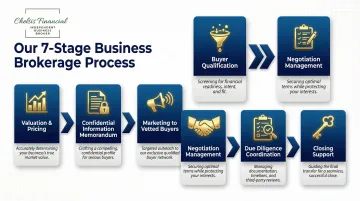
Business brokers handle seven critical stages:
Valuation and Pricing: Brokers establish a defensible asking price based on recent comparable sales, financial analysis, and market conditions. According to BizBuySell's broker fee guide, most business owners either overvalue their companies due to emotional attachment or undervalue them due to lack of market context.
Confidential Information Memorandum (CIM): They prepare a professional document that presents your business to buyers without revealing your identity initially.
Marketing to Vetted Buyers: Rather than posting open listings, brokers tap into registries of pre-vetted, financially qualified buyers—bypassing the noise of public listings entirely.
Buyer Qualification: Brokers filter out "tire kickers"—unqualified prospects who waste time—and focus on serious buyers with proven financial capacity.
Negotiation Management: They handle all price discussions, deal structure terms, earn-outs, and post-sale obligations while keeping emotions separate from strategy.
Due Diligence Coordination: Brokers shepherd buyers through the 60-120 day due diligence process, managing document requests and keeping all parties on track.
Closing Support: They coordinate with attorneys, accountants, and lenders to get the deal across the finish line.
What Brokers Don't Do
Brokers are not attorneys or accountants. You'll still need a complete deal team—your broker coordinates these professionals but doesn't replace them.
Most brokers also require a signed exclusive listing agreement, typically 6-12 months. This ensures they can invest the time and resources to market your business without competing against you or other brokers.
Chelsis Financial works with Midwest sellers across manufacturing, healthcare, and industrial services—bringing a vetted buyer network and deal team coordination to every engagement.
The Key Benefits of Using a Broker to Sell Your Business
Confidentiality Protection
A broker shields your identity throughout the marketing process using NDAs and blind profiles. This matters because employees may leave if they learn the business is for sale, customers may look elsewhere for stability, and competitors may use the information against you. Chelsis Financial uses digital NDAs through DocuSign to ensure interested parties sign confidentiality agreements before accessing detailed business information.
Access to a Qualified Buyer Pool
Brokers maintain registries of pre-vetted, financially qualified buyers rather than relying on open listings. This filters out unqualified prospects and accelerates serious conversations. According to IBBA data, nearly half (47%) of successfully closed deals have at least one other offer on the table, and 40% have at least two other offers. This competitive tension drives higher sale prices.
Accurate Business Valuation
Between 23% and 29% of business sales fail entirely due to unrealistic seller price expectations. Roughly 84% of those gaps fall between 11% and 30%. A broker's valuation—grounded in recent comparable sales and financial analysis—sets a defensible, market-appropriate asking price. Chelsis Financial offers a Complimentary Assessment of Value as a starting point, reviewing formal financial statements, analyzing cash flow, and calculating seller's discretionary earnings (SDE).
You Keep Running Your Business
Selling a business is a full-time job—and so is running one. The average time to close a business sale is 6 to 10 months, with due diligence alone consuming 60 to 120 days. A broker takes on the full-time burden of the sales process so you can stay focused on operations. Buyers monitor business performance in real time during evaluation, and any revenue dip during the process raises immediate red flags.
Negotiation Expertise and Emotional Objectivity
Negotiations are where deals are won or lost. Broker-represented sellers benefit from a professional who can separate emotion from strategy, counter lowball tactics, and protect seller interests on price, deal structure, earn-outs, and post-sale obligations. Without that buffer, sellers often accept below-market terms or surrender value on deal structure.
Higher Closing Rate
Industry data shows that 46% of engagements terminated without closing in late 2021. Brokers significantly improve the odds by keeping all parties aligned through due diligence, financing contingencies, and the final stretch before closing. The longer a transaction drags, the more exposure there is to buyer fatigue, lender delays, and operational surprises. Momentum is a broker's most valuable tool.
When You Might NOT Need a Business Broker
There are situations where hiring a broker may not be the right fit. Three scenarios come up most often:
- Business valued under $100K–$150K — Broker minimums ($10,000–$50,000) can consume a disproportionate share of smaller deals. A marketplace listing on BizBuySell paired with an M&A attorney is often more cost-effective.
- You already have a qualified buyer — If a key employee, competitor, or industry contact has made a credible offer, a broker's buyer-finding role is less critical. That said, a broker's negotiation and deal management support can still add real value even when a buyer is already identified.
- Simple transaction with no complexity — Sales with clean financials, no real estate component, and a motivated buyer on both sides can be handled effectively with just an attorney and accountant.
The Hidden Cost of Going It Alone
Even in the scenarios above, sellers without representation risk leaving money on the table. According to Clearly Acquired, businesses sold with professional broker representation achieve a 6% to 25% price premium over unassisted (FSBO) sales. That gap comes from competitive buyer pools, accurate pricing, and skilled negotiation — none of which exist in a single-buyer, proprietary deal.
How Much Does a Business Broker Charge?
Success-Fee Model
Most brokers are paid a commission only when the deal closes—no upfront cost. This aligns the broker's incentives with the seller's outcome: they only get paid if you get paid.
Typical Commission Ranges
Commission structures scale based on deal size:
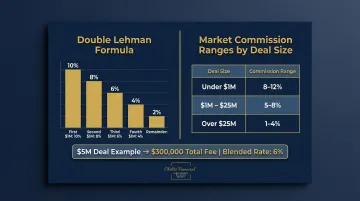
| Deal Size | Commission Range | Structure Type |
|---|---|---|
| Under $1M | 8-12% | Flat percentage |
| $1M-$25M | 5-8% (blended) | Double Lehman Scale |
| Over $25M | 1-4% (blended) | Modified Lehman |
For businesses sold between $100,000 and $1,000,000, the most common commission range is 10% to 15%. As the sale price increases, the commission percentage tends to decrease.
The Double Lehman formula is frequently used for deals between $1M and $25M:
- 10% on the first $1 million
- 8% on the second $1 million
- 6% on the third $1 million
- 4% on the fourth $1 million
- 2% on the remaining balance
For example, a $5 million transaction would result in a total fee of approximately $300,000 (a blended rate of 6%).
Upfront Retainers
Upfront retainers of $10,000 to $25,000 are increasingly standard for mid-market deals to cover valuation and marketing costs. Legitimate brokers credit these retainers toward the final closing success fee.
Red flag: Any broker demanding a large upfront fee that is not credited against the commission warrants serious scrutiny.
Is It Worth It?
A broker who secures a higher sale price, faster timeline, and cleaner close delivers far more value than their commission takes away. The numbers back this up:
- Sellers without a broker face a 60–70% lower chance of closing successfully
- Brokers with qualified buyer networks reduce time-on-market substantially
- A stronger offer structure can offset the commission many times over
How to Choose the Right Business Broker for Your Sale
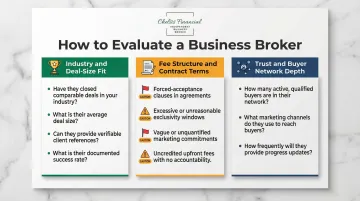
Not every broker is the right fit for your sale. The criteria below help you evaluate candidates across the three areas that most directly affect your outcome: industry fit, contract terms, and the quality of their buyer relationships.
Industry and Deal-Size Fit
Brokers specialize. Working with one who lacks experience in your industry or deal size is a costly mistake. Ask these questions to assess their track record:
- What comparable deals have you closed in my industry in the past 24 months?
- What is your average deal size, and how does my business fit that range?
- Can you provide references from sellers of similar businesses?
- What is your success rate (percentage of listings that close)?
Fee Structure and Contract Terms Transparency
Review the listing agreement carefully. Red flags include:
- Clauses obligating you to accept any offer within a set percentage of asking price
- Excessive exclusivity windows (longer than 12 months)
- Vague marketing commitments without specific deliverables
- Uncredited upfront fees that don't reduce the final commission
Trust, Communication Style, and Buyer Network Depth
Responsiveness and proactive buyer outreach — beyond standard listing sites — distinguish active brokers from passive ones. Ask potential brokers:
- How many active, pre-qualified buyers are in your network for my industry?
- What marketing channels do you use beyond standard listing sites?
- How often will you provide updates on buyer interest and feedback?
Chelsis Financial, for example, prioritizes confidentiality and direct outreach to qualified buyers in the Midwest — not just posting listings and waiting. That distinction matters more than most sellers initially realize.
Frequently Asked Questions
How much does a broker usually charge to sell a business?
Brokers typically charge 8-15% for smaller deals (under $1M) and 5-8% for larger transactions using sliding scales like the Double Lehman formula. Payment is on a success-fee basis — commission is due only at closing.
How much more do businesses sell for when they use a broker?
Industry data indicates businesses sold with broker representation fetch 6% to 25% more than FSBO sales. This premium comes from competitive buyer pools, accurate pricing, and skilled negotiation that creates auction-like environments.
Can I sell my business without a broker?
Yes, particularly for very small businesses (under $150K) or when you have an existing qualified buyer. However, going it alone carries real risks: pricing errors, confidentiality breaches, and closing rates that trail broker-assisted deals by a wide margin.
When should I contact a business broker?
Earlier is better — ideally 12-24 months before an intended sale. A good broker identifies value-building opportunities before you go to market: reducing owner dependency, diversifying customer concentration, and cleaning up financials.
What questions should I ask when interviewing a business broker?
Ask about:
- Comparable deals they've closed in your specific industry
- How they source and vet buyers beyond standard listing sites
- Fee and contract structure, including whether retainers are credited at closing
How long does it take to sell a business with a broker?
The median time to close is 170 days across all sectors, ranging from 163 days for retail to 223 days for manufacturing. Brokers typically shorten that timeline by keeping deal momentum and managing due diligence efficiently.