
Introduction
Most business owners spend decades building something worth selling — yet over 70% enter the sale process without a clear exit strategy. That gap between effort invested and outcome achieved is exactly where deals fall apart.
A business broker is the professional who bridges that gap — acting as your advocate from initial valuation through final closing, while keeping the sale confidential and the process on track.
This guide breaks down what business brokers actually do, why that role matters, and how to find the right one for your situation.
Key Takeaways
- Business brokers are licensed intermediaries who facilitate the sale of small to mid-sized businesses, typically valued under $2 million
- They handle valuation, confidential marketing, buyer screening, negotiation, and closing coordination
- On average, broker-represented sales close at 10–25% higher prices than owner-managed FSBO transactions
- Brokers charge 8-12% commission for smaller deals, paid only when the sale closes
- Choose a broker based on verified industry experience, certifications (such as CBI), and a proven buyer network
What Is a Business Broker?
A business broker is a licensed professional intermediary who facilitates the buying and selling of privately held businesses. They coordinate the transaction between owners ready to exit and qualified buyers seeking acquisitions—handling valuation, marketing, negotiations, and due diligence while keeping both parties' interests protected throughout.
Scope and Market Focus
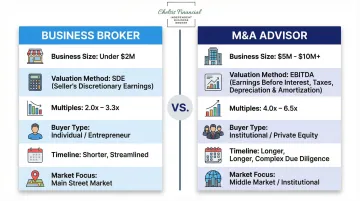
Business brokers primarily serve the "Main Street" market—small to mid-sized businesses typically valued below $2 million. This distinguishes them from M&A advisors or investment bankers who handle larger, more complex transactions involving institutional buyers and sophisticated financing structures.
According to BizBuySell's 2025 market data, Main Street businesses are valued using Seller's Discretionary Earnings (SDE) with average multiples ranging from 2.0x to 3.3x depending on industry. These transactions typically involve individual buyers or serial entrepreneurs rather than private equity firms. That buyer profile shapes everything from how a broker markets a listing to how they structure deal terms.
Licensing and Regulation
Business brokers may operate independently or as part of a brokerage firm. Licensing requirements vary significantly by state—some require a real estate license, others have specific business broker licensing, and some have no formal requirements at all.
For Midwest transactions specifically, requirements break down as follows:
- Illinois: Requires securities registration with the Secretary of State
- Michigan, Minnesota, Nebraska, South Dakota, Wisconsin: Require real estate licenses
- Indiana, Iowa, Kansas, Missouri, North Dakota, Ohio: Generally unregulated unless the transaction includes real property
Before engaging a broker, verify they meet your state's specific licensing requirements to avoid potential transaction complications.
What Does a Business Broker Do?
A broker's involvement begins well before any listing goes live. They start by understanding your goals, timeline, and financial objectives to create a strategy tailored to your specific situation.
Business Valuation
Brokers conduct or coordinate a business valuation to establish a realistic, defensible asking price. This typically involves:
- Analyzing cash flow using SDE or EBITDA metrics
- Applying industry-specific multiples based on recent comparable sales
- Assessing tangible assets (equipment, inventory, real estate)
- Evaluating intangible factors (customer contracts, brand value, market position)
An accurate valuation protects you from leaving money on the table or scaring off qualified buyers with an inflated number. According to industry valuation data, SDE multiples vary significantly by sector:
- Online and Technology: 3.33x
- Manufacturing: 3.03x
- Retail: 2.61x
- Food and Restaurants: 2.24x

Confidential Marketing and Buyer Outreach
Brokers list and market your business without revealing its identity to the public. This critical function protects your operations during the sale process through:
- Blind profiles that describe your business without naming it
- NDAs signed before any sensitive financials are shared
- Targeted outreach through buyer registries and platforms like BizBuySell
- Staged information release — details go only to vetted, qualified prospects
For community-based or closely held businesses, premature disclosure can unsettle employees, cause customers to seek alternatives, and give competitors an advantage. Professional brokers have systems in place to prevent these damaging leaks.
Buyer Screening and Qualification
Once confidentiality is secured, the focus shifts to finding the right buyer. Brokers filter out unserious or unqualified prospects by vetting:
- Liquid capital and financing options to confirm purchasing power
- Readiness and timeline to ensure buyers can actually move forward
- Industry background relative to the business being acquired
- Acquisition criteria to confirm the opportunity fits what the buyer is actually seeking
This saves you time and energy — you only engage with buyers who are realistically positioned to close. Chelsis Financial, for example, requires buyers to demonstrate a minimum of $500,000 in liquid funds before accessing confidential business information.
Negotiation and Deal Structuring
Experienced brokers act as skilled negotiators who:
- Defend your valuation when buyers push back on price
- Structure favorable deal terms (payment schedules, seller financing, earnouts)
- Navigate disagreements to keep transactions on track
- Balance competing priorities between parties
- Protect your interests while maintaining buyer engagement
A strong broker doesn't just negotiate price — they shape the payment structure, transition terms, and contingencies that determine what you actually walk away with.
Due Diligence Coordination and Closing
Brokers coordinate the due diligence process between buyers, sellers, attorneys, CPAs, and lenders. They manage the flow of documents and communications to keep deals moving forward, which is critical because the median time to close a small business sale is 170 days, with manufacturing firms taking up to 223 days.
Through closing, brokers oversee document execution, coordinate with escrow and legal, and manage transition planning — including staff introductions, customer notifications, and knowledge transfer to the incoming owner.
Why Use a Business Broker When Selling Your Business
Some owners attempt to sell independently, but most regret it. The process is more time-consuming, technically complex, and emotionally draining than anticipated. Mistakes at any stage can kill the deal or significantly reduce your final price.
Protecting Confidentiality
Confidentiality is the most compelling reason to use a broker. A leak about a pending sale can cause:
- Key employees to leave for more secure positions
- Customers to seek alternative suppliers or service providers
- Competitors to poach your best clients or talent
- Suppliers to tighten payment terms or reduce support
Professional brokers have proven systems and agreements to contain sensitive information throughout the process, protecting the value of your business during the months-long sale period.
Access to Qualified Buyers
Experienced brokers maintain proprietary networks of pre-screened buyers and investors actively seeking acquisition opportunities—far beyond what any online listing can reach.
The right buyer—not just any buyer—makes the difference between a clean closing and a deal that falls apart. Chelsis Financial maintains a registry of qualified buyers across the Midwest, matching sellers with serious prospects discreetly. Their Indiana network alone spans over 2,000 active business connections, giving sellers access to a deep pool of vetted candidates.
Maximizing Business Value
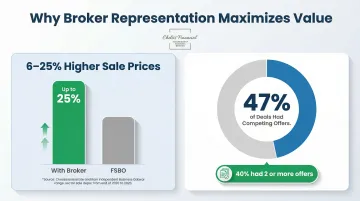
Research shows that businesses sold with broker representation fetch 6% to 25% higher sale prices than those sold directly by owners. This premium comes from:
- Multiple qualified buyers competing for the same deal
- Professional negotiation expertise that defends your valuation
- Better deal terms that protect your interests
- Transition arrangements that preserve what you built
According to IBBA data, 47% of successfully closed broker deals had at least one competing offer, and 40% had two or more—creating the competitive environment that drives higher prices.
Staying Focused on Operations
Selling a business is essentially a second full-time job. Using a broker allows you to keep running your business during the sale process, which is essential because a business that deteriorates during the sale period will lose value and may fail to close.
Buyers conduct extensive due diligence on financial performance, and declining revenue or operational issues during the sale process raise red flags that can kill deals or force price reductions.
Reducing Risk of Deal Collapse
The numbers are stark: 70% to 80% of small businesses listed For Sale By Owner fail to sell. In contrast, accredited business brokers achieve closing rates of approximately 50%.
Experienced brokers anticipate and manage common "landmines" that derail transactions:
- Unrealistic buyer expectations about business performance
- Financing failures due to inadequate buyer preparation
- Legal issues discovered during due diligence
- Family or advisor interference that creates doubt
- Loss of momentum that allows deals to stagnate
Professional brokers keep deals on track through each of these pressure points—so that a solvable problem doesn't become a dead deal.
Types of Business Brokers
Full-Service Brokers
Full-service brokers manage every phase of the transaction—from initial valuation through final closing. They're best suited for owners who want comprehensive, hands-off support and lack the time or expertise to manage complex sale processes themselves.
These brokers typically provide:
- Business valuation and pricing strategy
- Marketing material creation and listing management
- Buyer sourcing and qualification
- Negotiation and deal structuring
- Due diligence coordination
- Closing facilitation and transition planning
Specialized or Industry-Specific Brokers
Some brokers focus on particular sectors such as healthcare practices, restaurants, manufacturing, or technology services. They bring sector-specific knowledge and established buyer networks built specifically around those industries.
Specialized brokers understand industry-specific valuation factors, regulatory requirements, and buyer expectations that generalist brokers often overlook. That specialization can mean fewer deals falling apart during due diligence and stronger valuations for businesses with niche characteristics.
M&A Advisors
M&A advisors typically handle larger, more complex transactions—often above $5-10 million—involving mergers, recapitalizations, or management buyouts. They work with investment banking-level analysis and regularly work with institutional buyers like private equity firms.
Key differences from traditional business brokers:
- Focus on EBITDA rather than SDE for valuations
- Higher valuation multiples (4.0x-6.5x vs. 2.0x-3.3x)
- More complex deal structures with earnouts and equity rollovers
- Longer transaction timelines and more extensive due diligence
- Engagement with sophisticated institutional buyers
There's overlap at the lower end of the middle market ($2-5 million), where both business brokers and M&A advisors may operate. Understanding which type fits your transaction size and complexity is usually the first practical step in choosing the right representation.
Business Broker Fees: What to Expect
Standard Commission Structure
Most brokers work on a success-fee model, earning a commission paid only when your business sells. Typical rates include:
- Under $1 million: 8-12% (10% most common)
- $1-5 million: 5-8% using sliding scales
- Over $25 million: 1-4%
Many brokers enforce minimum fees ranging from $10,000 to $50,000 to ensure small transactions remain economically viable.
The Double Lehman Formula
For deals between $1 million and $5 million, brokers frequently use the "Double Lehman" scale:
- 10% on the first $1 million
- 8% on the second $1 million
- 6% on the third $1 million
- 4% on the fourth $1 million
- 2% on the remaining balance
Example: A $3 million sale yields a $240,000 commission ($100k + $80k + $60k).
Upfront Retainers
While Main Street brokers traditionally work on straight commission, upfront fees are increasingly common. Industry data shows that 33% of advisors charge retainers for deals under $500,000, covering valuation work and marketing material creation.
Are Broker Fees Worth It?
Commissions may look steep on paper, but sellers who work with experienced brokers often achieve 6-25% higher sale prices than those who sell independently — plus better terms and faster closings. That spread frequently exceeds the broker's fee.
Commission rates are also negotiable. Bring competing quotes to the conversation, and ask whether retainer fees offset the final commission at closing.
How to Choose the Right Business Broker
Listings Sold vs. Listed: The Number That Matters
Look at the broker's track record—specifically the ratio of listings sold versus listed. A broker who specializes in your industry will have better buyer connections and more credible valuations.
Ask prospective brokers:
- How many businesses in my industry have you sold?
- What percentage of your listings result in completed sales?
- Can you provide references from past clients?
- What is your average time from listing to closing?
Professional Credentials to Look For
Look for brokers who belong to professional associations like the International Business Brokers Association (IBBA) or hold certifications such as Certified Business Intermediary (CBI).
The CBI designation requires:
- 68 credit hours of IBBA coursework
- Evidence of leading at least three closed transactions
- Passing a comprehensive examination
- 48 continuing education credits every three years
These credentials signal a commitment to ethics, ongoing education, and professional standards.

Personal Fit and Goal Alignment
The right broker should understand your personal goals—not just the financial ones—and offer confidential, discreet service tailored to your situation. A good starting point is understanding what your business is actually worth before any commitment to sell.
Chelsis Financial's Complimentary Assessment of Value is designed for exactly this moment. It reviews financial statements, estimates tangible asset values, and delivers a defensible valuation based on market data—with no pressure to list.
The Risk of Dual Agency
Some states allow "dual agency," where a single broker represents both buyer and seller in the same transaction. This creates a conflict of interest that limits how hard the broker can push for your price.
When dual agency is proposed, the broker is legally barred from disclosing either party's pricing flexibility or motivations—which directly constrains their ability to negotiate on your behalf.
Frequently Asked Questions
What exactly does a business broker do?
A business broker acts as an intermediary who manages the entire process of selling a business—from valuation and confidential marketing to negotiation, due diligence, and closing. They protect the seller's interests throughout the transaction while maintaining confidentiality and connecting sellers with qualified buyers.
How much does a business broker charge?
Most brokers work on a success-fee model, earning a commission ranging from 8–12% of the sale price for businesses under $1 million, paid only when the deal closes. Some also charge upfront retainers for valuation or preparation work.
Do I really need a business broker to sell my business?
Using a broker isn't legally required, but 70–80% of FSBO business sales fail to close—and those that do sell for 6–25% less than broker-represented transactions. For most owners, professional guidance on valuation, confidentiality, and negotiation leads to meaningfully better outcomes.
What is the difference between a business broker and an M&A advisor?
Business brokers typically handle smaller Main Street businesses valued below $2 million, while M&A advisors work on larger, more complex transactions involving mergers, acquisitions, or significant financial restructuring—usually above $5-10 million with institutional buyers.
How do business brokers find buyers?
Brokers draw on proprietary buyer databases, professional networks, industry contacts, and targeted listings on platforms like BizBuySell. Throughout the process, they protect the seller's identity through blind profiles and NDAs.
How long does it take to sell a business with a broker?
Most Main Street business sales take six months to a year to close, with a median of 170 days. Manufacturing businesses average closer to 223 days. Working with a broker typically shortens the timeline compared to selling independently.