

Introduction
For most business owners, the question isn't whether to sell — it's when. Timing a business sale directly shapes the final sale price, the quality of buyers attracted, and the owner's ability to move on with financial security.
Selling too early can mean leaving significant value on the table. Waiting too long risks declining performance, market shifts, or personal burnout undermining the deal.
GF Data reports that while 2021's record 7.8x EBITDA multiples have cooled, valuations have stabilized at a healthy 7.2x EBITDA for the lower middle market. For owners weighing their options now, that stability means a well-timed exit can still command strong returns — without waiting for a peak that may not return.
This guide covers the key signals that it's time to sell, the warning signs that shouldn't drive your decision, and what owners lose when they get the timing wrong.
Key Takeaways
- Selling at the right time maximizes value and attracts stronger buyers
- Timing depends on financial performance, personal readiness, and market conditions — all three need to line up
- Key signals include strong financials, succession gaps, and active M&A markets
- Avoid selling during declining performance or when heavily owner-dependent
- Start preparation 12–24 months before your target sale date
Why Timing Matters When Selling Your Business
Timing is the single biggest lever a business owner can pull to maximize sale proceeds. A business sold at peak performance in a favorable M&A environment will command a materially different multiple than the same business sold during a downturn or without preparation.
Two forces make timing so consequential:
- Buyer competition: When conditions are right, multiple qualified buyers create competitive tension that drives up price and improves deal terms. A poorly timed sale may attract only one or two buyers, weakening your negotiating position and leaving money on the table.
- Preparation runway: Business owners who plan their exit 1–2 years in advance can address weaknesses — customer concentration, messy financials, owner-dependence — that directly affect valuation. Roughly 31% of M&A engagements fail to close due to valuation gaps between buyer and seller. Most of those gaps are just 11%–30%, meaning modest preparation could have bridged the divide.

Reactive sellers consistently leave value on the table. While 74% of employer-business owners plan to sell or transfer ownership for retirement, 30% have no formal succession plan. That planning deficit forces owners into weak negotiating positions when life events or market shifts demand a quick exit.
The Right Time to Sell Based on Your Situation
There is no universal "best time" to sell. The right moment depends on personal readiness, business health, and external market conditions all aligning. Each scenario below reflects a different dimension of that alignment.
Based on Personal Readiness
The most common personal triggers that indicate the right time include:
- Approaching retirement — over half of all small business sellers plan to retire
- Burnout or waning passion — the second most common catalyst, affecting 40-50% of sellers
- Significant life events — health issues, family obligations, or relocation
- Achieved goals — having met the financial or professional objectives that originally motivated building the business
Emotional readiness matters as much as financial readiness. Owners who haven't defined what comes next — retirement, new venture, family time — often delay or sabotage the sale process. Having a post-sale plan accelerates better decision-making and prevents last-minute hesitation that can collapse deals.
Based on Business Performance
The best time to sell from a business perspective is when the company is at or near peak performance:
- Growing revenues and strong profitability
- Diversified customer base with no single client exceeding 20% of revenue
- Management team that doesn't depend entirely on the owner
- Clean, auditable financial records and documented processes
Buyers pay premiums for upward momentum — they're purchasing future potential, not a snapshot of past results. Businesses showing growth trajectories attract higher multiples, while those already plateauing face valuation compression.
Before going to market, it's worth knowing exactly where your business stands. Chelsis Financial's Complimentary Assessment of Value identifies value gaps that can be closed during the preparation window — so you go to market at full strength, not partway there.
Based on Market and Economic Conditions
You're in a seller's market when:
- High buyer demand and available acquisition capital
- Over $1 trillion in private equity dry powder actively seeking deployment
- Competitive interest rates enabling leveraged buyouts
- Active M&A deal flow with rising multiples
Industry-specific trends matter. A business tied to a sector experiencing consolidation, technological transformation, or strong tailwinds may attract a premium from strategic acquirers. Conversely, a business in a disrupted or declining industry should be sold sooner rather than later. The manufacturing sector, for example, saw an 11% decline in transactions in 2025 as buyers moved to the sidelines — showing how industry slowdowns push valuations lower.
Signs It's Time to Sell Your Business
Multiple signals appearing simultaneously is the strongest indicator that timing is right. Consider these as a practical checklist:
Your Business Has Hit Peak Financial Performance
Revenues are growing, margins are healthy, and the trajectory is favorable. This is the optimal moment to capture maximum value. Buyers pay for the future, so selling while the future looks bright commands the highest price. Waiting for "just one more good year" often backfires when unforeseen market shifts or operational challenges erode that momentum.
You Have No Clear Succession Plan
If there is no internal successor — family member or key employee — ready and willing to take over, the business tends to stagnate: key employees leave for more certain futures, capital investment gets deferred, and customer relationships erode. Nearly half of U.S. small-business owners are 55 or older, yet only 46% have a formal succession plan in progress. Selling to an external buyer with the vision and resources to carry the business forward is the strongest succession move available.
You Have Received Unsolicited Acquisition Interest
Inbound offers from competitors, private equity firms, or strategic buyers are a strong market signal. Even if the first offer isn't accepted, it validates that your business is in demand and warrants exploring a formal sale process.
These unsolicited approaches typically mean one of two things: industry consolidation is underway, or your business has reached a scale or capability that strategic buyers are actively targeting.
The Market Is Active and Favorable
A seller's market shows these practical signs:
- Rising deal multiples across your industry
- Active buyer pools with concentrated demand in the $1M–$3M EBITDA range
- Low borrowing costs enabling leveraged buyouts
- Sector consolidation creating competitive bidding
Valuations have stabilized at healthy levels — not the anomaly pricing of 2021, but a solid seller's environment. If your business checks the boxes above, waiting rarely improves the outcome.
You Are Emotionally and Financially Ready for the Next Chapter
Personal alignment removes the hesitation that often leads to last-minute deal collapses. This means:
- Knowing what post-sale life looks like
- Having addressed estate and tax planning basics
- Being genuinely ready to transition leadership and daily involvement
Owners who enter the process with this clarity close faster, negotiate from a stronger position, and walk away without regret.
When You Should Avoid Selling Your Business
Just as there are clear signals to sell, there are circumstances where attempting a sale will likely result in a poor outcome — a lower price, a failed deal, or long-term regret.
Avoid Selling When the Business Is in Decline or Chaos
Buyers scrutinize trajectories, not just snapshots. A business with declining revenues, unresolved legal issues, customer churn, or dependency on a single client will struggle to attract credible buyers and will be heavily discounted.
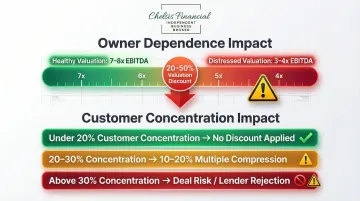
Businesses highly reliant on their founders face 20% to 50% valuation discounts, dropping from 7-8x multiples down to 3-4x EBITDA. If a top customer accounts for 20-30% of revenue, expect valuation compression of 10-20%. Above 30%, many PE firms and SBA lenders will pass entirely.
Stabilize the business before going to market. That means:
- Resolving operational issues and plugging revenue leaks
- Diversifying the customer base away from single-client dependency
- Documenting processes so the business runs without you
Avoid Selling When You Are Under Reactive Pressure
Distressed circumstances force sellers into weak negotiating positions:
- Urgent personal financial need
- Partnership disputes handled hastily
- Health crises without planning
- Market panic or industry disruption
Reactive sales almost always favor the buyer. They recognize desperation and structure deals accordingly — lower prices, punitive terms, and minimal competition.
Avoid Selling During a Broad Market Downturn
When credit is tight, buyer appetite shrinks, and deal multiples compress. With SBA 7(a) maximum loan rates ranging from 9.75% to 11.75%, buyers face expensive capital and lower their offers accordingly. Sellers who wait for conditions to improve typically recover significantly more value than those who panic-sell into a recession.
What Happens If You Sell at the Wrong Time
Financial Cost of Selling Too Early
A business sold before it reaches peak performance may achieve a fraction of the value it could have commanded 18–24 months later. The difference in EBITDA multiples — selling at a 4x multiple versus a 6x — translates to hundreds of thousands or millions of dollars in lost proceeds.
For a business generating $2M in EBITDA, the difference between a 4x and 6x multiple is $4M in total sale proceeds. That's real money left on the table by failing to prepare adequately.
What Happens When a Sale Is Rushed or Forced
Rushing a sale compresses the timeline, limits your buyer pool, and hands leverage to whoever does show up. The average time to sell a small business has risen to 8.6 months, with lower middle market deals stretching to 10–11 months — and that's under normal conditions. When sellers are pressed, the consequences compound:
- Fewer competing offers, leading to weaker terms and lower valuations
- Due diligence gaps that cause deals to fall through entirely
- EBITDA recalculations by buyers during diligence that reduce final proceeds by $50,000–$200,000 or more
- Mounting legal fees and confidentiality exposure when deals collapse or drag on
Non-Financial Consequences
The financial damage is measurable — the non-financial damage often isn't. A sale made under duress can push owners toward the first willing buyer rather than the right one. Buyers who dismantle the culture, lay off long-term employees, or walk away from community commitments leave a mark that no earnout clause can fix.
Owners who take control of their timing typically have the leverage to negotiate for cultural fit alongside price — something that matters long after the wire transfer clears.
Best Practices for Timing Your Business Sale
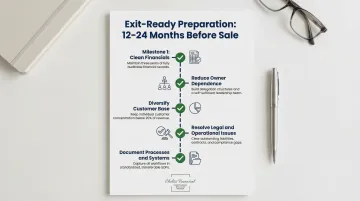
Start Preparing 12–24 Months Before You Intend to Go to Market
Use this window to:
- Clean up financials and ensure three years of auditable records
- Reduce owner-dependency by delegating key responsibilities
- Diversify the customer base below the 20% concentration threshold
- Resolve any legal or operational issues
- Document processes and systems
"Exit-ready" means a buyer reviewing your business for the first time sees:
- Professional financial reporting with consistent, reconciled statements
- A management team capable of running operations without the owner
- Documented customer relationships and retention strategies
- Clean legal structure with no pending disputes or liabilities
That preparation also puts you in a stronger position to read the market — which is the next variable you need to control.
Monitor Valuation Indicators and Market Signals Regularly
Business owners shouldn't wait for a crisis to understand what their company is worth. Tracking industry deal multiples, comparable transactions, and internal financial performance trends helps owners recognize when the window of optimal timing opens.
Working with a business advisor gives owners the market intelligence to act on timing rather than react to circumstances. Chelsis Financial offers a Complimentary Assessment of Value and monitors sector-specific deal activity, buyer appetite, and financing conditions — context most owners don't have visibility into on their own.
Align Personal, Financial, and Business Readiness Before Going to Market
The most successful sales happen when all three are aligned:
- The owner has a clear post-sale plan and is emotionally ready to step away
- The business is performing at or near peak with clean, auditable records
- Market conditions and buyer demand support a premium valuation
Rushing any one of these dimensions undermines the others. A business at peak performance sold by an owner who isn't emotionally ready will likely collapse during negotiations. A personally ready owner with a declining business will face severe valuation discounts.
A confidential advisor helps you identify exactly where each dimension stands — and what needs to close before you go to market.
Frequently Asked Questions
How do you know when it's time to sell your business?
The clearest signal is the convergence of personal readiness, strong business performance, and favorable market conditions. Professional valuation helps confirm the timing and identifies gaps to address before going to market.
Should I sell my business when it's at its peak or wait for more growth?
Selling at or near peak captures maximum buyer interest and valuation multiples, because peak performance signals continued upside — exactly what buyers pay a premium for. Waiting risks unforeseen downturns eroding that value, and buyers discount businesses already past their growth phase.
How long does selling a business typically take?
Most sales take 6–12 months from engaging an advisor to closing. Lower middle market deals often stretch to 10–11 months due to due diligence complexity, so starting preparation early matters.
What are the biggest timing mistakes business owners make when selling?
The most common errors are waiting too long until performance declines, selling reactively under pressure, or going to market without preparation. All three reduce price and buyer quality, often by 20-50%.
Does my business need to be profitable to sell?
Profitability and cash flow are key valuation drivers, but even businesses with strong revenue trajectories or strategic assets can attract buyers. Recurring revenue models and defensible market positions can offset lower current profitability when positioned correctly.
How do I find out what my business is worth before deciding to sell?
A professional business valuation sets realistic expectations, identifies value gaps to address, and determines whether the timing is right to go to market. Chelsis Financial offers a Complimentary Assessment of Value that reviews financial performance, market positioning, and readiness factors to help owners make informed timing decisions.