

For US family business owners considering a third-party sale — not passing the business to the next generation — the process can feel overwhelming without a clear roadmap. The good news: it's entirely manageable when you approach it in the right sequence.
This guide walks through the six key steps, what to prepare, and the mistakes that turn promising deals into failed ones.
Key Takeaways
- Get family alignment before anything else — unresolved disagreements kill deals mid-process
- A professional valuation sets realistic expectations and surfaces issues that reduce value
- Preparation takes 12–24 months; sellers who skip it accept lower offers or fail to close
- A business broker protects confidentiality and levels the playing field with experienced buyers
- Due diligence is where roughly half of all deals fall apart; prepare your records and disclosures well before buyers arrive
Why Selling a Family Business Requires a Different Approach
Most businesses have one owner with one set of goals. Family businesses often have several — a retiring founder, an involved spouse, adult children with differing opinions, and long-tenured employees who feel like part of the family.
These competing interests create complexity that purely financial decisions don't face.
There's also an emotional dimension that's easy to underestimate. Wilmington Trust notes that selling a family business can trigger genuine grief — a loss of identity, purpose, and the sense of obligation to prior generations who built what you're now handing over. Acknowledging this upfront leads to better decisions, not worse ones.
The structural reality compounds the challenge. According to the PwC US Family Business Survey 2025, only 23% of US family businesses have a formal, documented succession plan. That leaves most families navigating a high-stakes ownership transition without any documented process to guide them.
The six steps below give that process a shape — and account for the financial, relational, and emotional dimensions that make family business sales uniquely demanding.
The Six Key Steps to Selling Your Family Business
Step 1: Align the Family and Clarify Your Goals
Before contacting a single advisor or signing anything, every key stakeholder needs to agree (not merely accept) the decision to sell.
A spouse who has reservations, a sibling who feels blindsided, or a co-owner with a different price expectation can derail a deal months into the process. That's expensive, embarrassing, and avoidable.
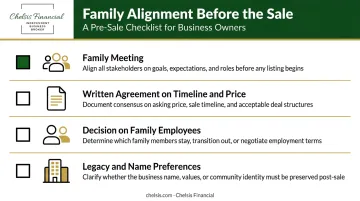
What alignment looks like in practice:
- A formal family meeting where every stakeholder's concerns are heard
- A written summary of the agreed timeline, minimum acceptable price, and deal structure preferences
- Clear decisions on what happens to family employees under new ownership
- Agreement on whether preserving the company name or legacy matters in buyer selection
Beyond family consensus, clarify your personal goals before the process starts:
- How much do you need from this sale to fund retirement?
- Are you willing to carry seller financing or stay on for a transition period?
- Does it matter who buys the business, or is price the primary driver?
These answers shape every decision that follows, from how you structure the deal to which buyers you'll consider.
Step 2: Get a Professional Business Valuation
Emotional attachment consistently causes owners to overvalue their businesses. The BEI Business Owner Survey found that 52% of owners believed they had built sufficient business value — but only 35% had obtained an independent valuation. Those two numbers rarely match when tested against the market.
A formal valuation does three things:
- Establishes a defensible asking price backed by data, not hope
- Surfaces issues that reduce value before buyers find them
- Sets realistic expectations so negotiations don't collapse at the first offer
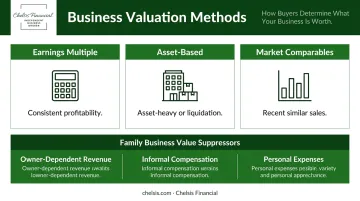
Common valuation methods for private businesses:
| Method | Best Used When |
|---|---|
| Earnings multiple (SDE or EBITDA) | Business has consistent profitability |
| Asset-based | Asset-heavy businesses; liquidation scenarios |
| Market comparables | Similar businesses have recently sold |
For family businesses specifically, several factors routinely suppress valuations: owner-dependent revenue, informal compensation arrangements, and personal expenses run through the business. All three are fixable, provided they're caught before buyers run their own analysis.
Chelsis Financial offers a complimentary Assessment of Value as a starting point. The assessment reviews three years of financial statements, cash flow, balance sheets, and seller's discretionary earnings (SDE) to give owners a realistic picture of where they stand before committing to a sale. All discussions are held in strict confidence.
Step 3: Prepare the Business for Sale
Pre-sale preparation is where deals are won or lost — yet most sellers either rush it or skip it entirely.
"Pre-diligence" preparation means getting the business ready before buyers ever see it:
- Reconcile three years of P&Ls, balance sheets, and tax returns into a consistent financial narrative
- Document key processes: SOPs, org charts, and role definitions that show the business runs beyond its owner
- Categorize personal expenses as owner add-backs so buyers see true operating profitability
- Resolve outstanding disputes, expired contracts, and compliance gaps before going to market
- Demonstrate the business can operate independently — buyers heavily discount seller-dependent revenue
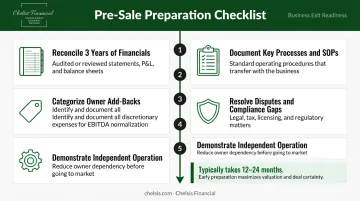
This preparation phase commonly takes 12–24 months for businesses that aren't already sale-ready. Sellers who invest in this work typically achieve stronger multiples and shorter time-to-close.
Chelsis Financial helps sellers build a diligence-ready file before the first offer arrives — including financials, lease agreements, customer concentration data, and transition support plans — so that nothing discovered during due diligence comes as a surprise.
Step 4: Work with a Business Broker
Most family business owners have sold exactly zero companies. The buyers across the table — whether private equity firms or experienced strategic acquirers — have done dozens.
That asymmetry is the core argument for professional representation.
A business broker's role goes beyond finding a buyer:
- Markets the business confidentially through buyer networks, blind teasers, and staged disclosure
- Screens and qualifies buyers before releasing any sensitive information
- Requires signed NDAs before sharing anything beyond a blind summary
- Negotiates deal structure on the seller's behalf — with the experience to know which terms matter
- Keeps the process on schedule, since stalled deals rarely recover
Confidentiality is especially critical for family businesses. Premature disclosure can trigger employee departures, cause customers to seek alternative suppliers, and give competitors an opening to exploit uncertainty. Chelsis Financial's process uses blind teasers, NDA requirements, and controlled information release to ensure the business identity stays protected until the right buyer is fully qualified.
The firm networks with over 2,000 businesses in Indiana and maintains a buyer registry that matches acquisition criteria to available listings — meaning qualified buyers are often already in the pipeline before a business officially goes to market.
Step 5: Qualify Buyers and Negotiate the Deal
The headline price on an offer is only part of the picture. Who's buying, and why, shapes whether a deal actually closes on terms that work for you.
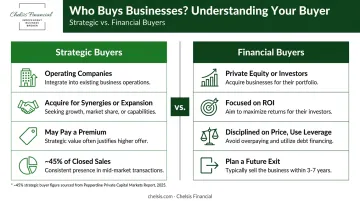
Two primary buyer types:
- Strategic buyers: operating companies that acquire for synergies, market expansion, or competitive positioning. They may pay a premium because the business is worth more to them than to a financial investor.
- Financial buyers: private equity firms and investors focused on return on investment. They're disciplined on price, often use leverage, and typically plan for a future exit.
According to the Pepperdine 2025 Private Capital Markets Report, approximately 45% of closed sales involved strategic buyers. That context matters when comparing two offers at similar prices but with very different structures.
What to evaluate in a Letter of Intent (LOI):
- Asset sale vs. stock sale structure
- All-cash vs. seller financing vs. earnout arrangement
- Employee retention commitments
- Transition period length and seller involvement
- Use of the family name post-close
The BizBuySell Insight Report found that 61% of buyers hoped seller financing would be included, viewing it as a bridge for valuation gaps. Seller financing (typically structured at 5–7 years, 8–10% interest) can make a deal happen that otherwise wouldn't — but it also means the seller carries risk if the new owner struggles.
Step 6: Navigate Due Diligence and Close the Sale
Roughly half of business sales fall apart during due diligence, according to Coldstream Capital Partners. The most common reasons: financial inaccuracies, unsupported add-backs, undisclosed legal issues, and customer concentration surprises.
The solution is preparation — specifically, a virtual data room organized before any LOI is signed.
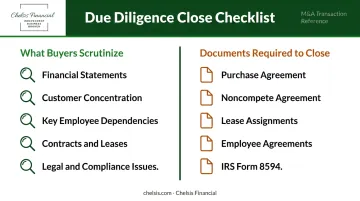
What buyers scrutinize:
- Three years of financial statements and tax returns
- Customer concentration analysis
- Key employee dependencies and retention risk
- Contracts, leases, and IP ownership
- Pending legal matters or compliance issues
Key legal documents required to close:
- Purchase agreement (asset or stock)
- Noncompete agreement
- Assignment of leases
- Employee agreements
- IRS Form 8594 (required for both buyer and seller in asset sales)
An experienced business attorney should be involved from the LOI stage , not brought in at the closing table. The structure of the deal (asset vs. stock sale) has significant tax implications that can change your net proceeds materially, and those decisions need to be made before terms are locked.
Key Factors That Can Make or Break the Sale
Timing
Market conditions affect both the ability to sell and the price achieved. The Q1 2026 BizBuySell data shows the average cash-flow multiple at 2.7x — up 3% quarter over quarter — but multiples fluctuate with economic cycles and industry trends.
Most sellers who wait for ideal conditions end up waiting too long. A business's performance trajectory at the time of sale matters as much as market conditions — buyers pay for momentum, not potential.
That momentum question extends beyond timing into how your revenue is structured.
Customer Concentration Risk
Deals frequently stall or receive price adjustments when buyers discover that one or two customers represent a disproportionate share of revenue. Anything above 20–30% concentration in a single client triggers hard questions. Sellers who address this before going to market — by diversifying the customer base or at minimum documenting the relationships' stability — are in a stronger position.
Revenue structure shapes valuation. Deal structure shapes what you actually keep.
Tax Structure
The difference between an asset sale and a stock sale can significantly affect your after-tax proceeds. Federal long-term capital gains rates run 0%, 15%, or 20% depending on taxable income. Recapture rules, state taxes, and deal structure add further complexity on top of that. Consult a CPA with M&A experience before signing an LOI, not after.
Common Mistakes Family Business Owners Make When Selling
Most family business sales don't fail because of bad businesses — they fail because of avoidable mistakes in the process. These three come up most often.
Going to market unprepared. Messy financials, undocumented processes, and high owner dependence produce lower offers, extended timelines, or outright failures. Sellers who invest 12–24 months preparing typically close faster and at better multiples.
Letting emotions drive negotiating. Anchoring the asking price to personal financial needs rather than market value — or reacting personally to due diligence requests — damages negotiations. A broker acting as a buffer between seller and buyer keeps the conversation professional when it gets uncomfortable.
Underestimating confidentiality risks. When a sale leaks before closing, the damage compounds quickly:
- Key employees start looking for other jobs
- Customers begin qualifying backup suppliers
- Competitors use the uncertainty to their advantage
Standard protections — blind teasers, NDAs before any detail is shared, staged disclosure — exist for a reason. Skipping them to move faster nearly always costs more than it saves.
Frequently Asked Questions
How do you sell a family-owned business?
Align the family first, then get a professional valuation, prepare financials and operations, engage a business broker, qualify buyers, and close. The full process — including preparation — typically takes one to three years, with the active sale process running six to twelve months.
How do you value a family business?
Most family businesses are valued using an earnings multiple (SDE or EBITDA-based), an asset-based approach, or market comparables. A certified appraiser or business broker can provide a formal valuation that accounts for owner dependence, add-backs, and other family-business-specific factors.
How long does it take to sell a family business?
The active process from listing to closing typically runs six to twelve months, with total time including preparation landing between one and three years. Businesses with clean financials, low owner dependence, and clear succession plans tend to close faster and at stronger prices.
What taxes do you pay when you sell a family business?
Sellers typically owe federal capital gains tax at long-term rates (0%, 15%, or 20% depending on income), plus potential state income tax. The asset vs. stock sale structure significantly affects tax liability — involve a CPA before agreeing to deal terms.
Do I need a business broker to sell my family business?
Not legally required, but strongly advisable. Brokers typically increase sale price, protect confidentiality, and reduce time to close — especially for sellers navigating this for the first time, while most buyers are experienced dealmakers.
What happens to family employees when a family business is sold?
Employee retention is a negotiable deal term. Sellers can — and should — request retention commitments as part of the purchase agreement. Outcomes vary by buyer, but raising it openly during negotiations gives it the best chance of being honored.