Introduction
Most business owners spend years—sometimes decades—building their companies, yet fewer than half have a formal plan for how they'll eventually leave. This gap is costly. According to the Exit Planning Institute's 2023 State of Owner Readiness report, 80% of business owners lack a written transition plan, and 50% of all exits are forced by unplanned events rather than strategic choice.
A business exit strategy is not just an "end plan." It shapes how you run, value, and transition your business — whether you're preparing for a planned retirement or navigating an unexpected health crisis or partnership dispute.
The right strategy influences hiring decisions, financial reporting, and buyer attractiveness long before you list your company for sale.
What follows breaks down the main exit strategy types, what separates a good plan from a reactive one, and how to match the right approach to where your business — and your life — actually stands.
Key Takeaways
- A business exit strategy is a formal plan for reducing or transferring ownership through sale, succession, or wind-down
- Exit planning shapes business decisions, valuation, and buyer appeal at every stage of ownership
- Main types include third-party sale, management buyout, family succession, ESOP, and liquidation
- The right strategy depends on financial needs, timeline, legacy goals, and desired post-exit involvement
- Planning 3–5 years ahead expands your options and drives a stronger final valuation
What Is a Business Exit Strategy?
A business exit strategy is a structured plan outlining how a business owner will reduce or transfer their ownership stake. This can mean selling to an external buyer, transferring to a successor, or winding down operations. The strategy applies equally to successful businesses seeking to maximize returns and struggling ones trying to minimize losses.
A good exit strategy isn't purely reactive: triggered by illness, burnout, or financial pressure. It's ideally built into the business plan from the start, influencing hiring, financial reporting, and growth decisions well before exit becomes imminent.
The Exit Planning Institute frames this as a fundamental shift in mindset, defining exit planning as "a pathway to create better and more prepared businesses and lives today while securing a more significant and fulfilling future" — moving from income generation to value creation.
The Role of Business Valuation
That value creation mindset only works if you know what your business is actually worth. Owners frequently overestimate or underestimate their company's value without a formal assessment — and that gap can derail an otherwise well-planned exit. Business brokers like Chelsis Financial provide valuation services to establish a defensible market value, so exit decisions rest on financial reality rather than assumptions.
Why Every Business Owner Needs an Exit Plan
Without a defined exit strategy, owners risk making reactive decisions under pressure—accepting below-market offers, missing tax-planning windows, or leaving employees and partners unprepared for the transition.
Concrete benefits of planning ahead include:
- Clearer financial goals and retirement readiness
- More attractive presentation to buyers
- Smoother leadership transitions
- Ability to time the market rather than being forced out of it
- Reduced owner dependency, which increases business value
Yet most owners haven't taken that first step. 69% of owners consider exit strategy a priority, but only 42% have a written formal plan—a gap that leaves owners exposed to forced exits that rarely achieve optimal outcomes.
Knowing your business's value before choosing an exit path changes every decision that follows. Chelsis Financial offers a complimentary business valuation assessment for owners who want a concrete starting point, not a generic estimate.
Types of Business Exit Strategies
No single exit strategy suits every business. The right approach depends on who the owner wants to pass the business to, how much liquidity they need, how fast they want to exit, and how much control they wish to retain post-transition.
Sale to a Third Party
This is the most common exit route for small and mid-sized business owners. The owner sells the business outright to an external buyer—either a strategic buyer (competitor or company in the same industry), a financial buyer (private equity group), or an individual entrepreneur. The process typically involves confidential marketing, qualifying buyers, and negotiating terms.
Who benefits most: Owners who want a clean exit, maximum financial return, and no ongoing involvement post-sale. Third-party sales consistently produce the highest purchase prices, but they require significant preparation and professional support to execute well.
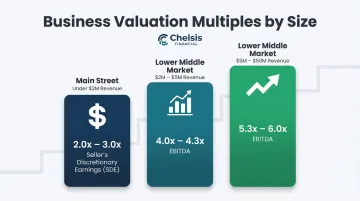
Valuation multiples vary by size and sector:
- Main Street businesses (<$2M value): 2.0x-3.0x Seller's Discretionary Earnings
- Lower middle market ($2M-$5M): 4.0x-4.3x EBITDA
- Lower middle market ($5M-$50M): 5.3x-6.0x EBITDA
According to BizBuySell data, the median time to close for Main Street businesses accelerated to 149 days in Q3 2025, while lower middle market deals typically take 7-10 months from engagement to close.
Trade-offs: It's a longer process requiring confidentiality management, professional advisors (broker, attorney, CPA), and emotional readiness to hand over what you've built. Deals can also fall through during due diligence.
Management Buyout (MBO)
An MBO is a transaction in which the existing management team purchases the business from the owner, typically using a combination of their own capital, seller financing, and sometimes third-party lending. Because management already knows the operations, transition risk and knowledge loss are significantly reduced.
Best-fit scenarios: Owners who want business continuity, trust their management team's capability, and are comfortable with a slower or partially financed payout structure.
Trade-offs: Purchase price is typically lower than a third-party sale. Buyers may have limited personal liquidity, requiring heavy seller financing. Management may not always translate operational skill into entrepreneurial leadership.
Family Succession / Intergenerational Transfer
This strategy involves passing ownership to a family member—often a child or other relative—through a sale, gifting arrangement, or phased transfer over time. It's the preferred approach for many family business owners who prioritize legacy continuity over maximizing sale price.
The reality gap: While 54% of business owners intend to pass their business to family, only 30% of family-owned businesses successfully transition to a second generation, 12% to a third, and just 3% to a fourth. A major barrier: 43% of family business owners have no succession plan in place.
Trade-offs: Lower sale price, potential family conflict during negotiations, and risk of key employees leaving if they perceive the successor as unqualified or if the transition feels uncertain.
Employee Stock Ownership Plan (ESOP)
An ESOP is a structure in which ownership is transferred to employees collectively through a trust. The company typically borrows funds to purchase shares from the owner, which are then allocated to employees over time—making employees partial or full owners.
Best-fit scenarios: Owners who want to reward loyal employees, maintain company culture, and benefit from favorable tax treatment. For C-corporation sellers, IRC Section 1042 allows capital gains tax deferral if the ESOP holds at least 30% of the company's stock post-sale and the seller reinvests proceeds into Qualified Replacement Property.
As of 2023, there are 6,609 active ESOPs in the U.S. covering 15.1 million participants and holding over $2 trillion in assets.
Trade-offs: More complex and expensive to set up than other options. Requires securities compliance, and the company must eventually buy back shares from departing employees, creating an ongoing financial obligation.
Liquidation / Wind-Down
Liquidation is the process of closing the business and selling off its assets—equipment, inventory, real estate, intellectual property—to pay creditors and distribute remaining proceeds to the owner. This is distinct from selling the business as a going concern; there is no transfer of goodwill or customer relationships.
Best-fit scenarios: Businesses where asset value exceeds the value of continuing operations, or where no viable buyer or successor can be found. Also used when the owner needs to exit quickly and other options aren't feasible.
Trade-offs: Proceeds are uncertain and capped by asset liquidation value (no payment for goodwill). Employees lose their jobs, and there can be reputational or emotional costs. Approximately 1 in 12 businesses close every year, and liquidation is often the default for distressed or unsalable entities—rarely a planned first choice.
How to Choose the Right Exit Strategy for Your Business
The right exit strategy depends on three things working in sync: your personal goals after the sale, what your business is actually worth today, and who realistically exists to buy or succeed it. Get those three factors aligned and the path forward usually becomes clear.
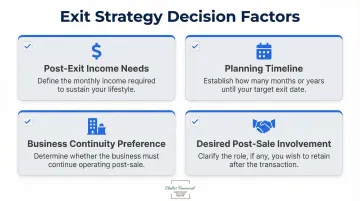
Key Factors to Weigh
- How much post-exit income do you need to fund retirement or your next chapter?
- How far out are you planning? Professional advisors recommend starting 3 to 7 years in advance to fix operational gaps, build out management, and optimize tax structures.
- Do you want the business to continue operating, and under what kind of ownership?
- Are you looking for a clean break, or are you open to staying on in a transition role?
Market Conditions Matter
An IPO is a poor choice during a recession. A third-party sale commands the highest prices in a strong market with active buyers. Timing the exit to business and market cycles can shift outcomes by millions. However, Main Street transaction data shows resilience—in 2025, 71% of business brokers reported that recent rate cuts had no noticeable impact on buyer behavior, noting that "buyers buy" based on personal timelines and business fundamentals rather than macro-cycles.
Staged Approaches
Owners are not limited to a single strategy. A staged approach—such as selling a majority stake while retaining a minority position, or doing a partial recapitalization followed by a full sale later—can reduce risk while still unlocking equity.
Working with a business broker who specializes in confidential transactions can help owners navigate these decisions—from pinning down an accurate valuation to connecting with pre-qualified buyers and managing the process discreetly through closing. Chelsis Financial offers a complimentary business assessment as a starting point for owners who aren't sure where they stand.
Common Mistakes to Avoid When Planning Your Exit
Waiting Too Long to Start
Owners who only begin exit planning when forced to—by health crisis, partner dispute, or market downturn—rarely achieve optimal outcomes. They have fewer options, less negotiating leverage, and often accept below-market terms. Early planning keeps more options open.
Neglecting Business Valuation Before Choosing a Strategy
Many owners select an exit route based on familiarity or emotion rather than what their actual business value and buyer market support. The number one reason deals fail to close is "unrealistic seller value expectation," accounting for 23% of terminated engagements. A formal valuation grounds the decision in financial reality and prevents leaving money on the table.
Underestimating Transition Complexity
Exits involve legal, financial, tax, and operational dimensions simultaneously. Trying to manage these without experienced advisors leads to costly errors, including:
Exits involve legal, financial, tax, and operational dimensions simultaneously. Trying to manage these without experienced advisors—broker, CPA, attorney—leads to costly errors, including:
- Triggering unnecessary tax events through poor deal structuring
- Breaching confidentiality before a transaction is secure
- Failing to satisfy buyer due diligence requirements
The payoff for getting this right is measurable. According to Value Builder data, businesses that achieve a sellability score of 90 or greater receive acquisition offers averaging 7.1x pre-tax profit, compared to 3.5x for the average business—a 71% premium for owners who prepared.

Conclusion
A business exit strategy shapes more than the final transaction — it influences every decision you make as an owner in the years leading up to it. Starting early gives you options; waiting limits them.
The right strategy varies by owner. Some will maximize value through a third-party sale, others will prioritize legacy through family succession or an ESOP. The ideal path depends on an honest assessment of goals, timeline, and business value.
The best time to start planning is now, regardless of where you are in your ownership journey. A few key questions worth answering before you move forward:
- What is your business actually worth in today's market?
- How long do you have — or want — before you exit?
- Which exit type aligns with your financial and personal goals?
Chelsis Financial offers a complimentary business valuation to help owners answer that first question with confidence. It costs nothing and gives you a concrete starting point for every decision that follows.
Frequently Asked Questions
What is a business exit strategy?
A business exit strategy is a formal plan for how a business owner will transfer or reduce their ownership stake—through a sale, succession arrangement, or wind-down. It applies to both profitable exits and situations where an owner needs to minimize losses.
What are the main exit strategies for a business?
The most common types include:
- Sale to a third-party buyer
- Management buyout (MBO)
- Family or succession transfer
- Employee Stock Ownership Plan (ESOP)
- Liquidation
The right choice depends on the owner's financial goals, timeline, and desired level of post-exit involvement.
What is an example of a business exit strategy?
A small business owner works with a broker to confidentially market and sell their company to a strategic buyer in the same industry—receiving a lump-sum payment and stepping away from operations after a short transition period.
When should I start planning my business exit strategy?
Exit planning should begin 3-5 years before the intended exit date. Early planning improves valuation, broadens options, and allows time to address weaknesses that could reduce sale price or limit buyer interest.
How do I know which exit strategy is right for my business?
The right strategy depends on your financial needs, desired timeline, how much control you want to retain, and current business value. A qualified business broker can map these factors to specific exit options and identify which structure makes the most financial sense for your situation.
What is the most profitable exit strategy for a business?
A sale to a third-party buyer—particularly a strategic buyer—typically generates the highest sale price. However, "most profitable" also depends on tax structuring, deal terms, and how well the business is prepared and positioned before going to market.