Introduction
Nearly half of all business owners—49% according to the Exit Planning Institute—intend to exit their companies within the next five years. Yet only 42% have a formal, written transition plan in place. This planning gap creates enormous risk: roughly half of all business exits are involuntary, forced by events like death, disability, or financial distress. When owners are unprepared, they often realize only 86% of their business's benchmark value—or fail to close the deal entirely.
For most business owners, the company represents their single largest asset and their primary retirement vehicle. Without a structured transition plan, decades of value creation can evaporate through poor timing, wrong buyer selection, or unfavorable deal terms. The gap between what your business is worth and what you actually walk away with often comes down to how early—and how deliberately—you planned.
This guide covers everything you need to build a solid ownership transition plan: the four pillars of readiness, the 5 D's that make planning non-negotiable, your three main exit paths, actionable planning steps, and how to assemble the right advisory team.
TLDR:
- 49% of owners plan to exit within 5 years, but only 42% have a written plan
- Your business is likely your largest asset—unplanned exits cost 14% or more in lost value
- Four pillars (business, personal, financial, family readiness) must align for success
- The 5 D's (Death, Disability, Divorce, Distress, Departure) can force unplanned exits
- Start planning 3-5 years early to maximize options and value
What Is Ownership Transition Planning?
Ownership transition planning is the proactive, ongoing process of preparing for the intentional transfer of business ownership—whether through a sale, family succession, employee buyout, or gifting structure—in a way that aligns with the owner's personal, financial, and legacy objectives.
How It Differs from Succession and Estate Planning
Many owners confuse ownership transition planning with two related but distinct concepts:
Succession planning focuses on leadership continuity—identifying and preparing the next CEO or management team. It addresses who leads the business going forward, not who owns it. A company can have a well-developed succession plan with no ownership transfer strategy in place.
Estate planning addresses wealth distribution at death through wills, trusts, and tax strategies. It's typically triggered at death and doesn't address the business's operational transition during the owner's lifetime.
Ownership transition planning is broader and more proactive than both. It integrates leadership continuity, ownership transfer, tax optimization, and personal financial goals into a single strategic framework. And it must begin years before either succession or estate planning typically kicks in.
Why Timing Matters
While a business sale typically takes nine to twelve months to close once formally underway, full preparation—including valuation, legal structuring, reducing owner dependency, and identifying a qualified buyer or successor—can take three to five years. The Exit Planning Institute recommends this 3–5 year window as the standard for maximizing value and ensuring a smooth transition.
Starting early gives owners meaningful advantages:
- More buyer options — a longer runway attracts strategic buyers, not just opportunistic ones
- Higher valuations — time to address operational gaps that suppress sale price
- Greater flexibility — room to respond to shifts in health, market conditions, or personal goals
- Cleaner deals — legal and financial structures are in place before buyer scrutiny begins
The Four Pillars of a Successful Ownership Transition Plan
Every ownership transition decision should be evaluated through four foundational pillars. A plan that ignores any one pillar is incomplete and vulnerable to failure.
Business Readiness
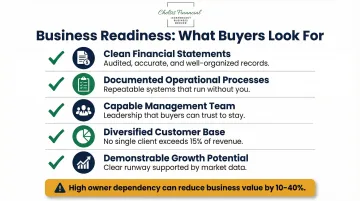
Business readiness means your company can operate and be valued independently of you. This is the single most important value driver in any transition.
Key elements include:
- Clean, audited financial statements that match tax returns and demonstrate consistent profitability
- Documented operational processes so the business doesn't rely on your institutional knowledge
- Capable management team that functions without your daily involvement
- Demonstrable growth potential that makes the business attractive to successors or outside buyers
- Diversified customer base so no single client represents excessive concentration risk
Documented systems and recurring revenue attract buyers willing to pay more. High owner dependency, by contrast, can cost 10-20% of your business's value—and up to 30-40% in private equity transactions.
Getting your business ready is the foundation. But the transition will stall if you're not equally prepared on a personal level.
Personal Readiness
Personal readiness is your internal preparation for life after the business.
This includes:
- Define what comes next—retirement, a new venture, philanthropy, or something else entirely
- Emotional preparation to relinquish control and the identity tied to the business
- Establish the minimum financial outcome needed to fund your post-transition lifestyle
- Set a realistic timeline aligned with personal goals and market conditions
Many owners underestimate the psychological challenge of letting go. For decades, the business has been your identity, your daily routine, and your primary source of purpose. Honest self-reflection—often with a coach or peer group—is part of the work.
Financial Readiness
Financial readiness is the intersection of business value and personal wealth planning.
Critical components include:
- Professional business valuation to understand current worth and value drivers
- Tax implications of different transfer structures (sale vs. gift vs. ESOP)
- Retirement account funding to ensure financial security beyond business proceeds
- Estate plan alignment with transition strategy to minimize tax burden and protect heirs
- Deal structure understanding—recognizing that valuation is only one dimension of a successful exit
Approximately 70% of business owners need to harvest their business's value to fund their post-exit lifestyle. That reality puts accurate valuation and tax-efficient structuring at the center of every sound transition plan.
That financial clarity also shapes the fourth pillar—one that many owners address too late.
Family and People Readiness
Family and people readiness addresses the human dimension of your transition.
Key considerations include:
- Identify whether family members are genuinely willing and capable of taking over
- Surface and resolve competing interests among family members before they escalate
- Retain key employees whose departure could disrupt operations mid-transition
- Honestly assess whether your chosen successor has the skills and drive to grow the business
- Build a communication strategy that maintains trust without triggering premature disclosure
The numbers here are sobering: only about 30% of family businesses survive into the second generation. Unresolved dynamics, underprepared successors, and the absence of a formal plan are the most common reasons why.
The 5 D's: Risks That Make Transition Planning Non-Negotiable
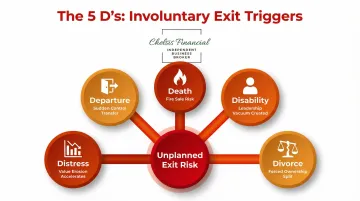
Most owners plan for retirement on their own timeline. But five involuntary triggers—the 5 D's—can force an unplanned transition before you're ready, often at great financial and personal cost.
The Five Involuntary Triggers
Death — Fire Sale Risk: Without a succession plan, your heirs inherit an illiquid asset, face a potential estate tax crisis, and have no clear path forward. The business may be forced into a fire sale or closure.
Disability — Leadership Vacuum: Prolonged incapacity removes you from operations with no replacement in place. Your business loses direction, customers lose confidence, and value erodes quickly.
Divorce — Forced Valuation: A marital split can trigger a court-ordered business valuation or compel you to sell equity to satisfy property division—often at the worst possible moment.
Distress — Leverage Loss: Financial difficulty or a market downturn can pressure a sale at an unfavorable price. Distressed sellers have little negotiating leverage and typically receive below-market valuations.
Departure — Ownership Dispute: When a co-owner exits without a buy-sell agreement in place, the result is often prolonged legal disputes and business disruption that erodes value for everyone involved.
How a Formal Plan Mitigates Risk
Each of the 5 D's is manageable—but only if you've put the right legal and financial instruments in place before a trigger occurs. A formalized transition plan directly addresses each one:
- Buy-sell agreements funded with life and disability insurance ensure liquidity when needed most
- Key-person insurance provides capital to recruit replacement leadership
- Updated estate documents minimize tax burden and clarify ownership transfer at death
- Contingency plans establish clear protocols for involuntary exits
- Regular valuations ensure buy-sell agreement pricing stays current
According to the Exit Planning Institute, only a minority of business owners have a written buy-sell agreement, and fewer still have agreements funded with life or disability insurance. If yours is unfunded or nonexistent, each of the 5 D's represents a direct threat to the value you've spent years building.
Your Three Main Transition Paths
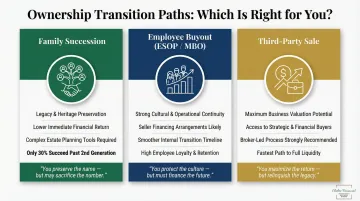
The right transition path depends on your goals, your company's characteristics, and who is best positioned to take the business forward.
Transitioning Ownership to Family
Why owners choose this path: Legacy preservation, personal continuity, and keeping the business "in the family."
Key requirements:
- Willing and capable next-generation successor
- Careful navigation of family dynamics, especially with multiple children
- Complex estate planning tools such as Grantor Retained Annuity Trusts (GRATs), Intentionally Defective Grantor Trusts (IDGTs), and installment sale structures
- Clear communication to prevent sibling rivalry or resentment
Trade-offs: Family transitions typically deliver lower financial returns than third-party sales. You're prioritizing legacy and family harmony over maximum valuation. Only about 30% of family businesses successfully transition to the second generation—making preparation and professional guidance essential.
Transitioning Ownership to Employees
Two main structures:
Employee Stock Ownership Plans (ESOPs): Ownership transfers broadly across the workforce through a qualified retirement plan structure. ESOPs offer notable tax advantages—for C-corporation sellers, IRC Section 1042 allows capital gains tax deferral if the ESOP owns at least 30% post-sale and proceeds are reinvested in qualified replacement property.
Management Buyouts (MBOs): Ownership transfers to a select leadership group. MBOs are generally simpler, faster, and better suited to smaller businesses—requiring less regulatory complexity than ESOPs, though with fewer tax benefits.
Why owners choose this path: Cultural continuity, employee wellbeing, and maintaining the company's mission and values. Employees already understand the business and are invested in its success.
Trade-offs: Internal buyers often lack the capital for an all-cash purchase, requiring seller financing or earn-out structures. Valuations may be lower than third-party sales, but the transition is typically smoother and less disruptive.
Selling to a Third Party
Why owners choose this path: Maximum financial return and a clean exit.
Third-party sales are most likely to maximize valuation, particularly for owners whose primary goal is to secure the best possible price. Two types of buyers dominate this market:
- Strategic buyers — Competitors or industry players who may integrate or absorb your business. They pay premiums for synergies like customer lists, geographic expansion, or complementary capabilities.
- Financial buyers — Private equity firms and investment groups focused on ROI. They typically seek businesses with EBITDA above $1M, strong management teams, and growth potential.
**Working with a business broker** significantly improves valuation outcomes. Broker-led transactions close at roughly 50%—nearly double the 25-30% success rate for unrepresented sellers. Advisors create competitive processes that generate multiple offers, strengthen your negotiating position, and protect your interests from listing to closing. Chelsis Financial specializes in exactly this: connecting owners with qualified buyers through a confidential sales process built for Midwest small to mid-market businesses.
Steps to Build Your Ownership Transition Plan
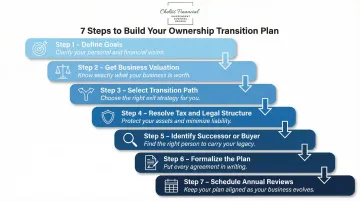
Follow this core planning sequence to maximize your transition success:
1. Define your personal, financial, and legacy goals — Clarify what a successful exit actually means: the number you need to retire comfortably, the legacy you want to leave, and how involved you want to stay post-sale.
**2. Get a professional business valuation** — Understand what your business is worth and what's driving that value. Mispricing — in either direction — is one of the most common reasons deals fall apart.
3. Select the appropriate transition path — Whether you're transitioning to family, employees, or an outside buyer, align your choice with your goals, successor availability, and financial requirements.
4. Resolve tax, legal, and structural considerations — Engage CPAs and attorneys early to structure the transaction for tax efficiency and legal protection — the details here can shift your net proceeds significantly.
5. Identify, evaluate, and prepare a successor or buyer — Confirm they have the skills, capital, and motivation to carry the business forward — internal or external candidates both require rigorous vetting.
6. Formalize the plan in writing — Put your strategy, timeline, contingencies, and milestones in a written document that all key advisors can reference.
7. Schedule regular reviews — Revisit the plan at least annually. A plan that sits untouched for three years is rarely still accurate.
Start Early—Ideally 3-5 Years Before Exit
A longer runway creates more buyer options, more room to increase business value, and genuine flexibility when personal or market conditions shift. Data shows that advisor-led deals with proper preparation achieve closing rates nearly double the industry average.
Starting early also gives your plan time to breathe. Tax laws shift, business conditions change, and family circumstances rarely stay static. Treat your transition plan as a living document — one that gets updated as your business and life evolve, not filed away after the first draft.
Assembling the Right Advisory Team
No business owner should navigate a transition alone. Four essential professional roles form the core of any successful ownership transition:
| Advisor Role | Primary Responsibility |
|---|---|
| Business broker or M&A advisor | Values and markets the business; connects you with qualified buyers and manages the sale process |
| CPA or tax advisor | Structures the deal for tax efficiency; models outcomes across asset vs. stock sale, ESOP, and other structures |
| Transaction attorney | Drafts and reviews purchase agreements, buy-sell agreements, and all legal documents; handles risk allocation |
| Financial planner | Aligns personal retirement and wealth goals with the transaction; determines what you need to maintain your post-exit lifestyle |
Early Engagement Delivers Better Outcomes
Business owners who engage advisors early and maintain those relationships over time consistently achieve better valuations and smoother closings. Owners who start the process 12–24 months before their target exit date have more time to address value gaps, clean up financials, and attract multiple competing offers — all of which strengthen your final deal terms.
Chelsis Financial offers a no-obligation Assessment of Value as a starting point for owners who want to understand what their business is worth before committing to any path.
Frequently Asked Questions
What is ownership transition planning?
Ownership transition planning is the proactive process of preparing for the intentional transfer of business ownership—through sale, succession, employee buyout, or gifting—in alignment with the owner's personal, financial, and legacy goals.
What are the four components of an ownership transition plan?
The four pillars are business readiness (operations and value independent of the owner), personal readiness (emotional and lifestyle clarity), financial readiness (valuation and tax alignment), and family/people readiness (successor identification and stakeholder alignment).
What are the 4 P's of ownership transition?
The 4 P's framework includes Purpose (defining why and what the transition should achieve), People (identifying who will lead after the transition), Process (the operational and legal steps required), and Property (the assets and value being transferred).
What are the 5 D's of ownership transition planning?
The 5 D's—Death, Disability, Divorce, Distress, and Departure—are involuntary events that can force an unplanned business transition. A formal plan with buy-sell agreements, insurance, and updated estate documents protects against each of these risks.
When should I start planning for a business ownership transition?
Start at least three to five years before your target transition date. More lead time means more options, better valuations, and greater flexibility to adapt to changing circumstances or market conditions.
How long does it take to sell or transition a business?
The sale process itself typically takes nine to twelve months from listing to close. Full preparation—valuation, legal structuring, reducing owner dependency, and identifying the right buyer—can take one to three years depending on business complexity and the transition path.