
Introduction
Selling your business represents the largest financial transaction most owners will ever complete—and for 90% of lower middle-market sellers, it's their first time navigating this complex process. Research shows that 80% of business owners lack a written exit plan before engaging professional help — leaving them exposed to costly mistakes in valuation, negotiation, and deal structuring.
Without the right guidance, sellers risk leaving significant money on the table. Businesses sold with professional representation fetch 6% to 25% more than those sold by owners alone, and sellers who go it alone face a 60% to 70% lower chance of closing successfully.
What follows is a practical breakdown of what M&A experts actually do — and how the right representation can be the difference between a clean exit and a deal that falls apart at the finish line.
Key Takeaways
- M&A experts manage every stage—from valuation and documentation to buyer outreach and closing
- Competitive buyer processes they run typically drive sale prices 5–15% higher than one-on-one negotiations
- Without professional help, sellers risk undervaluing their business by 6-25% and missing qualified buyers
- A formal business valuation sets your price anchor—without one, you're negotiating blind
- Most sales close in 6–9 months; expert guidance keeps the timeline on track and protects deal value
What Is an M&A Expert and What Do They Do?
An M&A (mergers and acquisitions) expert is a professional advisor who facilitates the sale of businesses, but the specific title and services vary based on deal size and complexity.
Three distinct professional types serve different deal sizes:
- Business brokers handle smaller transactions (under $2 million), working primarily with individual buyers
- M&A advisors serve the lower middle market ($2M–$50M enterprise value), managing complex deals with private equity firms and strategic acquirers
- Investment bankers take on the largest deals (above $50 million), involving institutional buyers and intricate financing arrangements

Your business's enterprise value determines which professional fits your situation. Deals above $2 million typically require EBITDA-based valuation and targeted outreach to qualified institutional buyers.
Valuation and Financial Analysis
M&A experts conduct thorough financial analysis of your business, reviewing financial statements, cash flow patterns, and calculating key metrics like EBITDA (Earnings Before Interest, Taxes, Depreciation, and Amortization). Recast EBITDA is used in 76% of valuations, where advisors identify legitimate add-backs to present the most accurate picture of profitability.
A single $50,000 legitimate add-back can increase enterprise value by $200,000 at a 4x multiple—demonstrating why professional financial analysis is critical. This process establishes a realistic, defensible sale price grounded in market data and comparable transactions.
Marketing and Buyer Outreach
M&A experts actively market your business to potential buyers through professionally prepared materials including:
- Teasers: One-page blind summaries distributed to prospective buyers before identity is disclosed — designed to generate interest while protecting confidentiality
- Confidential Investment Memorandums (CIMs): 30-60 page documents covering financials, operations, and growth opportunities in enough depth to move serious buyers to the offer stage
- Offering decks: Visual presentations used in management meetings to reinforce key value drivers and differentiate your business from competing deals
Advisors leverage their existing networks of qualified strategic and financial buyers, creating competitive processes that generate multiple offers. This competition is crucial—auction processes produce premiums 5-15 percentage points higher than bilateral negotiations.
Deal Structuring and Negotiation
Beyond price, M&A experts structure deals to optimize tax treatment and risk allocation. Key decisions include:
- Asset sale vs. stock sale: Each has distinct tax implications for buyers and sellers
- Payment terms: Cash at close, seller financing, or earn-outs tied to future performance
- Representations and warranties: Legal assurances about business condition and future obligations
Skilled negotiation addresses far more than the headline number. Advisors negotiate indemnification caps, escrow arrangements, non-compete terms, and transition support requirements—all of which significantly impact your actual take-home value and post-sale obligations.
Confidentiality Management
Protecting seller confidentiality is one of the most operationally sensitive parts of the entire process. Advisors use NDAs, controlled information sharing, and discreet outreach to prevent employees, customers, or competitors from learning about the sale prematurely. A confidentiality breach can damage morale, strain customer relationships, and erode supplier trust before a deal ever closes.
At Chelsis Financial, confidentiality isn't a procedural checkbox — it's central to how every transaction is managed, keeping business operations stable from first conversation through closing.
The Step-by-Step M&A Process When Selling Your Business
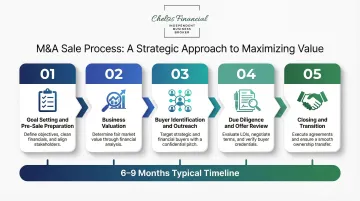
The average M&A process takes 6-9 months from engagement to closing, with complex transactions extending to a year or more. Each stage requires expert guidance to avoid delays or value erosion.
Step 1: Goal Setting and Pre-Sale Preparation
The process begins with your advisor helping clarify your goals—retirement, new venture, estate planning, or other priorities. Advisors then conduct a thorough review of financial records, legal agreements, customer contracts, and operational assets before going to market.
This preparation phase identifies and addresses value gaps that could derail deals later. Common issues include customer concentration (where one customer represents over 15% of revenue), incomplete financial documentation, or unresolved legal liabilities.
Step 2: Business Valuation
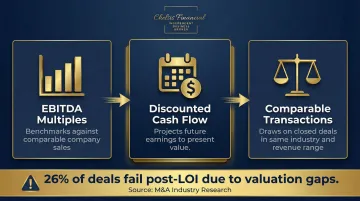
A formal business valuation is conducted using methods including:
- EBITDA multiples — benchmarks your business against recent sales of comparable companies
- Discounted cash flow — projects future earnings and converts them to a present-day value
- Comparable transactions — draws on closed deals within your industry and revenue range
Aligning expectations with realistic valuation prevents wasted time and failed deals. 26% of deals fail post-LOI due to valuation gaps, with 84% of those pricing gaps being 11-30% wide.
For owners still in the exploration stage, Chelsis Financial's Complimentary Assessment of Value provides a no-commitment starting point before any formal process begins.
Step 3: Buyer Identification and Outreach
Advisors identify a targeted list of potential buyers including strategic acquirers (competitors or companies in adjacent markets) and private equity groups seeking platform acquisitions. They reach out confidentially using buyer registries and databases to maximize the number of qualified buyers engaged.
This broad outreach creates the competitive tension necessary to drive up both price and deal quality.
Step 4: Due Diligence and Offer Review
Once serious buyers emerge, they thoroughly examine your business's finances, operations, contracts, and legal standing. The median time from LOI to close is 3-4 months, with due diligence consuming the majority of this period.
Your advisor coordinates document exchange, manages the virtual data room, and reviews Letters of Intent (LOIs) to identify favorable terms and potential red flags.
They also ensure you understand representations, warranties, indemnification concepts, and how different deal structures affect your real take-home value.
Step 5: Closing and Transition
The final stages include contract drafting, regulatory approvals, final signatures, and executing the transition plan. Advisors help you plan for post-sale wealth management and ensure a smooth exit that preserves business value and customer relationships.
Many deals include transition support periods ranging from 30 days of availability to 6 months of part-time guidance, depending on business complexity and buyer requirements.
Key Benefits of Hiring an M&A Expert to Sell Your Business
The fee paid to an M&A expert is typically offset—and often exceeded—by the higher sale price and avoided mistakes that result from professional representation. Professionally represented sellers achieve 6-25% higher valuations than unadvised sellers, far outweighing typical advisory fees. The fee paid to an M&A expert is typically offset—and often exceeded—by the higher sale price and avoided mistakes that result from professional representation. Professionally represented sellers achieve 6–25% higher valuations than unadvised sellers, far outweighing typical advisory fees. Four advantages drive that outcome.
Maximized Sale Price Through Buyer Competition
One of the most powerful contributions of an M&A expert is creating a competitive process with multiple buyers simultaneously. When buyers know they face competition, they submit stronger offers with better terms.
Targeted auction processes generate 25-38% typical premiums, while negotiated bilateral sales produce only 18-28% premiums. This 5-15 percentage point difference translates to hundreds of thousands—or millions—in additional value for sellers.
Access to a Qualified Buyer Network
Established M&A advisors maintain registries of pre-vetted buyers including private equity firms, strategic acquirers, and qualified individual investors. This gives sellers immediate access to a pool of interested, capable buyers they would not reach on their own.
Chelsis Financial networks with over 2,000 businesses across the Midwest, providing sellers with extensive buyer connections across manufacturing, distribution, service, and technology sectors.
Reduced Burden on the Business Owner
Managing a business sale while running the business can consume 10–15 hours a week on top of normal operations. Without professional help, that burden falls entirely on the owner—and business performance is usually the first casualty.
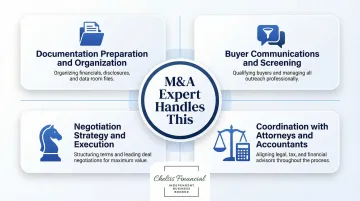
M&A experts handle the operational details so you don't have to:
- Documentation preparation and organization
- Buyer communications and screening
- Negotiation strategy and execution
- Coordination with attorneys and accountants
Staying focused on the business during this period matters. Declining revenue mid-sale can derail deals entirely or give buyers leverage to push offers lower.
Tax and Legal Risk Mitigation
Advisors work alongside tax professionals and attorneys to structure deals that minimize tax liability and ensure compliance with all legal and regulatory requirements. Asset sales versus stock sales have dramatically different tax implications, and improper structuring can cost sellers hundreds of thousands in unnecessary taxes.
Professional guidance also protects against post-close surprises that erode your actual proceeds:
- Indemnification claims from the buyer
- Unresolved liabilities discovered after closing
- Unfavorable tax treatment from a poorly structured deal
The Risks of Selling Your Business Without Professional Help
Sellers who attempt FSBO (For Sale By Owner) face a 60-70% lower chance of closing successfully and typically sell for 6-25% less than professionally represented peers. While advisory fees may seem like an expense to avoid, the financial and legal risks of going alone far exceed those costs.
Undervaluation and Missed Opportunities
Without a formal valuation and competitive buyer process, owners often accept the first offer they receive—which may undervalue the business entirely. Sophisticated buyers recognize when sellers lack professional representation and adjust their offers accordingly.
The "proprietary deal trap" is particularly dangerous: a buyer convinces an owner to negotiate exclusively without competition, then uses information asymmetry and emotional investment to extract favorable terms—leaving owners with far less than their business is worth.
Owners without established buyer networks also miss out on strategic acquirers—those outside their immediate circle who would pay premium multiples for the right fit.
Valuation gaps and missed buyers are just two dimensions of FSBO risk. Structural and legal exposure can be even more costly.
Due Diligence and Legal Exposure
Inadequate due diligence preparation, incomplete documentation, or failure to address legal liabilities prior to going to market can derail deals or expose sellers to post-closing claims and financial penalties.
Poor deal structure creates future liability in ways sellers rarely anticipate. Common pitfalls include:
- Overly broad representations and warranties
- Insufficient indemnification caps
- Unfavorable escrow arrangements and release conditions
These issues often don't surface until months or years after closing, when buyers make claims against sellers for discovered problems.
Negotiation Disadvantages
Sophisticated buyers—especially private equity firms and strategic acquirers—have experienced deal teams including M&A professionals, attorneys, and accountants. Sellers without professional representation face significant disadvantages in negotiations over:
- Purchase price and payment structure
- Representations and warranties
- Indemnification caps and survival periods
- Escrow amounts and release conditions
- Non-compete terms and duration
- Transition support requirements
Buyers use superior negotiation tactics to obtain favorable terms, and sellers often don't recognize unfavorable provisions until it's too late to renegotiate.
How to Choose the Right M&A Expert for Your Business Sale
Not all M&A advisors or business brokers are equal. Look for professionals with relevant industry experience, a proven track record of completed deals, a strong and active buyer network, and transparent fee structures.
A simple framework to evaluate candidates covers three areas:
- Competence — technical expertise and verifiable deal experience in your industry
- Integrity — genuine commitment to your best interests, not just closing a transaction
- Clarity — ability to explain complex concepts without burying you in jargon

Key Questions to Ask Before Hiring
Vet prospective advisors thoroughly by asking:
- How many businesses similar to mine have you sold? Look for specific examples in your industry and size range, not just general experience.
- Who is in your buyer network for my type of business? They should identify specific strategic acquirers and financial buyers likely to be interested.
- How do you handle confidentiality throughout the process? They should explain NDA procedures, controlled information sharing, and discreet outreach methods.
- What is your fee structure, and what services does it include? Understand retainers, success fees, minimum fees, and what expenses you'll be responsible for.
- What is your close rate, and how long do your deals typically take? Accredited advisors achieve close rates around 50%, far above the industry average of 25-30%.
Why Confidentiality and Discretion Matter in Your Choice
Your advisor's commitment to confidentiality is especially critical. A breach can damage employee morale, customer relationships, and supplier trust before the deal even closes. Confidential details that circulate prematurely can alert competitors and erode the competitive position you've spent years building.
That's why choosing an advisor who treats discretion as a non-negotiable — not an afterthought — matters so much. Chelsis Financial's process is built around this principle, from the first conversation through closing. If you're exploring a potential sale, the Complimentary Assessment of Value is a no-commitment starting point: you get a clear picture of your business's worth while everything stays completely confidential.
Frequently Asked Questions
How much is a business worth with $500,000 in sales?
A business with $500,000 in sales is not valued on revenue alone—profitability, EBITDA, industry multiples, customer concentration, and growth trends determine worth. Revenue multiples vary dramatically by industry, ranging from 0.42x for food/restaurant businesses to 1.19x for financial services. A certified business valuation is the only reliable way to pin down an accurate number.
How much do M&A advisors charge?
M&A advisor fees typically include a success fee (a percentage of the final sale price) and sometimes a retainer. Fees scale inversely with deal size: 8-12% for deals under $1 million, 5-8% for $1-$25 million deals, and 1-4% for deals over $25 million. The fee is usually far outweighed by the 6-25% higher valuation that professional representation delivers.
What is the difference between a business broker and an M&A advisor?
Business brokers typically handle smaller transactions (under $2 million) using Seller's Discretionary Earnings (SDE) for valuation and working primarily with individual buyers. M&A advisors work on larger, more complex deals ($2-$50 million) using EBITDA-based valuation and engaging strategic buyers and private equity firms. The services are similar but scale with deal complexity.
How long does it take to sell a business with an M&A expert?
The typical timeline is 6-9 months from engagement to closing, with the post-LOI due diligence phase consuming 3-4 months. Complex deals or difficult market conditions can extend this to a year or longer. Proper preparation and experienced guidance prevent unnecessary delays.
When should I start working with an M&A expert?
Ideally 12-24 months before a planned sale. That window gives your advisor time to close value gaps, optimize financials, strengthen operations, and time the market—preventing the most common deal killer: financial preparation issues that create valuation gaps during due diligence.
Can I sell my business without an M&A advisor?
It's technically possible but carries significant risks. Unrepresented sellers face 60-70% lower close rates and sell for 6-25% less than professionally represented peers. Without representation, valuation mistakes, missed buyers, and negotiation gaps against sophisticated buyer teams are difficult to overcome.